Maine Coons are so big mainly because of inherited breed genetics, generations of selective breeding, and a naturally substantial body structure. They also mature more slowly than many domestic cats, giving their frame and muscle more time to develop. Their long coat, neck ruff, and bushy tail add to the impression of size, but a large appearance is not the same as excess weight.
This guide explains the breed traits behind Maine Coon cat size, how their growth differs from that of many other cats, why males are usually larger than females, and how to distinguish a genuinely large cat from an overweight or dramatically photographed one.
The Main Reasons Maine Coons Are So Big
The clearest answer is that Maine Coons inherit a tendency toward a large frame. Their breed traits include a long body, broad chest, substantial bone structure, and strong musculature. These features make them physically larger than the average household cat before their coat is even considered.
Selective breeding reinforced those traits over time. Once people valued the Maine Coon’s distinctive size, structure, coat, and overall appearance, breeding choices helped preserve larger, more imposing examples. This does not mean every individual will be enormous; inherited traits vary within any breed.
A cold regional environment may also have favored sturdy bodies and protective coats during the breed’s early development. That climate-adaptation explanation is plausible, particularly for the thick coat and robust build, but it should be treated as supporting context rather than a complete explanation.
Maine Coon size is therefore a combination of frame, muscle, bone, tail, and coat. Weight alone cannot explain why this breed looks so imposing.
- Inherited genes support a larger body frame.
- Selective breeding helped preserve substantial breed traits.
- A thick coat, ruff, and bushy tail increase visual volume.
- Slow maturation allows the body to keep developing after kittenhood.
Genetics vs. Myth: What Actually Explains Their Size
Genetics are the strongest explanation for the breed’s size. A Maine Coon receives inherited instructions that influence bone development, body proportions, muscle potential, coat, and adult size. The combination creates a recognizable large-bodied cat rather than a typical domestic cat with an unusually long coat.
Cold-weather adaptation may have contributed to the breed’s sturdy appearance, but it should not be presented as proof that every large feature developed for one specific reason. Breed history is complex, and popular explanations often turn reasonable possibilities into certainty.
Stories about Maine Coons descending directly from wildcats are not needed to explain their size. Such legends are part of the breed’s folklore, but they oversimplify its origins and do not replace the straightforward explanation of inherited variation and selective breeding.
The most reliable way to understand the breed is to separate documented breed traits from appealing origin stories. Maine Coons are large because large-bodied characteristics became established and recognized within the breed, not because a single dramatic myth explains every feature.
Why Maine Coons Look Bigger Than Other Cats
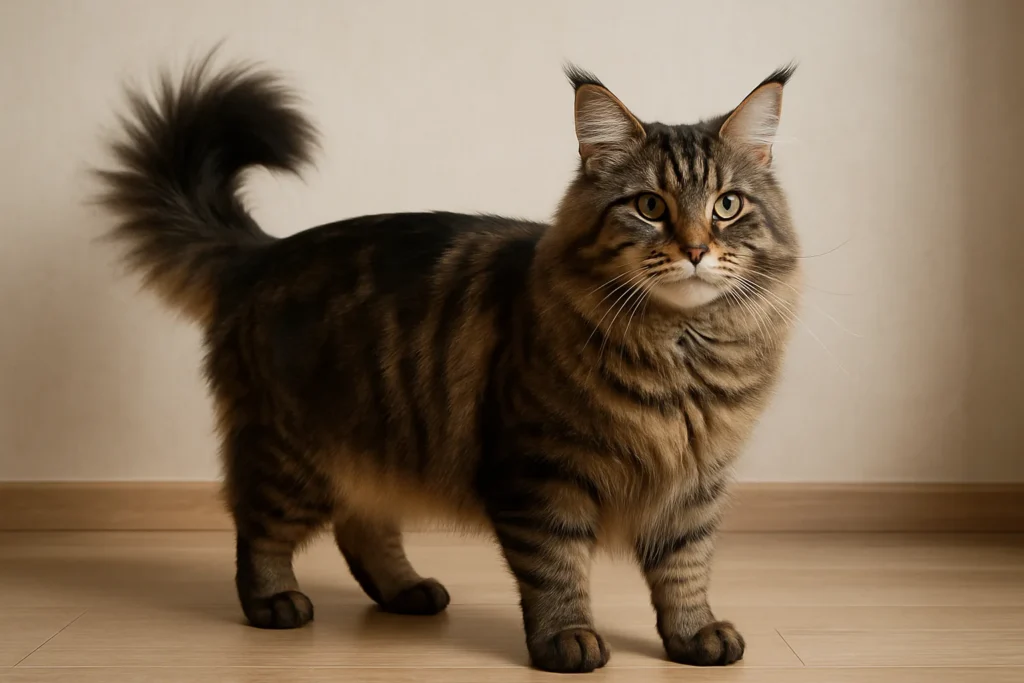
Maine Coons combine several size-enhancing features. Their bodies are typically long and broad, with a deep chest and a substantial frame. Heavy bone structure and developed muscles add genuine mass, while their proportions make the cat appear larger from a distance.
The tail and coat amplify that effect. A long, bushy tail can add considerable visual length, and a thick coat creates a wider outline around the body. Ear tufts, feathering, and a neck ruff make the head and shoulders look especially prominent.
This is why comparing a Maine Coon with a short-haired cat by sight alone can be misleading. Some of the difference is physical structure, and some is the extra volume created by fur. A scale measures weight, but it does not capture length, height, coat density, or visual presence.
How Large Do Maine Coons Get?
Adult Maine Coons are generally much larger and longer-bodied than average domestic cats. They are often described as one of the largest domestic cat breeds because their combination of length, frame, muscle, and coat creates an especially substantial appearance.
Males usually grow larger and heavier than females, although individual variation is considerable. A female from a large line may outweigh a smaller male, so sex provides a useful expectation rather than a guarantee.
Length and body frame matter as much as the number on a scale. A long, muscular cat may be healthy at a weight that would be excessive for a smaller-framed cat. Exceptionally large individuals exist, but they are not the standard every Maine Coon owner should expect.
Why Maine Coons Grow More Slowly Than Many Breeds
Maine Coons mature more slowly than many domestic cats. Instead of reaching their adult proportions quickly, they may continue lengthening, gaining muscle, and filling out for several years. This extended development is an important part of why a young Maine Coon may look modest at first and become much more substantial later.
A slow growth rate does not mean a kitten should be pushed to grow faster. Nutrition should support steady development, while the cat’s age, sex, family size, and body condition should guide expectations. Sudden changes in growth, poor condition, or persistent concerns deserve a veterinarian’s assessment.
When judging a Maine Coon’s eventual size, compare the cat with appropriate age and sex expectations rather than with a fully mature adult. A lanky adolescent may still be developing, while a smaller adult may simply have inherited a more moderate frame.
Do All Maine Coons Get Large?
No. Not every Maine Coon becomes huge. The breed has a tendency toward large size, but genes are inherited in different combinations, so adult cats can vary in length, height, bone structure, and weight.
Sex, family genetics, nutrition, and overall health all influence final size. A cat with mixed ancestry may also show a wider range of body types than a carefully bred cat from consistently large lines. Even within one litter, siblings can mature differently.
Healthy size is not the same as extreme size. A moderate-sized Maine Coon with a lean, muscular body may be healthier than a heavier cat whose extra weight comes from body fat. The goal is a sound body condition, not a record-breaking appearance.
Maine Coons Compared With Other Cats and Large Breeds
Compared with the average domestic cat, a Maine Coon usually has a longer body, heavier frame, fuller coat, and more prominent tail. Those combined traits explain why the breed is so often recognized as a gentle giant and placed among the largest domestic cat breeds.
Comparisons with other large breeds require care because size can mean different things. A Maine Coon may be especially notable for overall length and bulk, while a breed such as the Savannah may rival or exceed it in height or apparent size depending on the individual and the measurement used.
The words longest, tallest, and heaviest do not describe the same achievement. A cat can have long body proportions without being the tallest, or stand tall without having the greatest body mass. Breed comparisons are most useful when they identify the specific trait being compared rather than declaring one universal winner.
Big Does Not Always Mean Overweight
A large frame and excess body fat are different things. A healthy Maine Coon may have a broad chest, strong shoulders, and heavy bone structure while still retaining a defined waist and a firm, muscular feel.
The coat can hide body condition, especially around the belly and sides. Owners should assess the cat by gently feeling for the ribs and observing the body outline rather than relying only on a visual impression. A veterinarian can help evaluate body condition when the coat makes judgment difficult.
Viral photos can encourage owners to treat extreme size as the ideal. In practice, steady mobility, comfortable grooming, healthy muscle, and an appropriate body condition matter more than whether a cat looks enormous beside a person.
Why Some Online Photos Make Maine Coons Look Even Bigger
Camera perspective can dramatically change how large a Maine Coon appears. A cat positioned close to the lens may look oversized compared with a person or household object in the background. Wide-angle phone cameras can exaggerate the effect further.
Grooming also matters. Brushing can lift the coat, while a full ruff and fluffed tail create a larger outline than a wet, resting, or recently shed coat. A cat standing in a long stretch may look much longer than it does in a normal relaxed posture.
The largest examples are more likely to be shared because they attract attention. That creates a distorted impression of the breed’s typical size. Photos are useful for appreciating breed traits, but body condition, age, sex, and natural posture provide better context.
The Real Reason Maine Coons Are So Big
Maine Coons are large because inherited genetics and selective breeding established a substantial body frame, while slower maturation gives that frame more time to develop. Their muscles, bone structure, long proportions, thick coat, ruff, and tail make them look even bigger.
Not every Maine Coon becomes huge, and extreme size is not a measure of better health. The most useful comparison considers age, sex, ancestry, body condition, and overall structure—not a carefully staged photo or an impressive number on a scale.
Why are Maine Coons so big compared to other cats?
Their size mainly reflects inherited breed genetics and selective breeding for substantial body traits. A broad chest, heavy bone structure, muscular build, long body, and slow maturation all contribute, while the thick coat and bushy tail make them look even larger.
At what age is a Maine Coon fully grown?
Maine Coons mature more slowly than many domestic cats and may continue developing for several years. The exact point of physical maturity varies with genetics, sex, nutrition, and health, so a cat’s age should be considered alongside its body condition and growth pattern.
Do all Maine Coons get huge?
No. Maine Coons tend to be large, but individuals vary widely. Genetics, sex, ancestry, nutrition, and health influence adult size, and a moderate-sized Maine Coon can be completely healthy.