If you are wondering how to know if your cat is a Maine Coon, start by treating appearance as a clue rather than proof. A large frame, square muzzle, tufted ears, shaggy coat, and bushy tail can suggest Maine Coon ancestry, but many domestic longhairs share some of these features.
The most useful approach is to assess several traits together, account for your cat’s age, compare likely lookalikes, and check available records. This guide explains how to find out your cat’s breed without confusing a visual resemblance with confirmed purebred status.
What Actually Counts as a Maine Coon?
A purebred Maine Coon is a cat whose ancestry is documented through a recognized pedigree. Breed registration or reliable breeder records provide a much stronger basis for calling a cat purebred than appearance alone.
A Maine Coon mix may inherit several recognizable traits without matching the full breed standard. A cat can also look remarkably similar to a Maine Coon while simply being a domestic longhair with no known Maine Coon ancestry.
Visual breed identification is therefore suggestive, not definitive. The more hallmark traits your cat shares, the more plausible Maine Coon influence may seem, but a photograph or casual comparison cannot establish ancestry by itself.
Use This Maine Coon Trait Checklist First
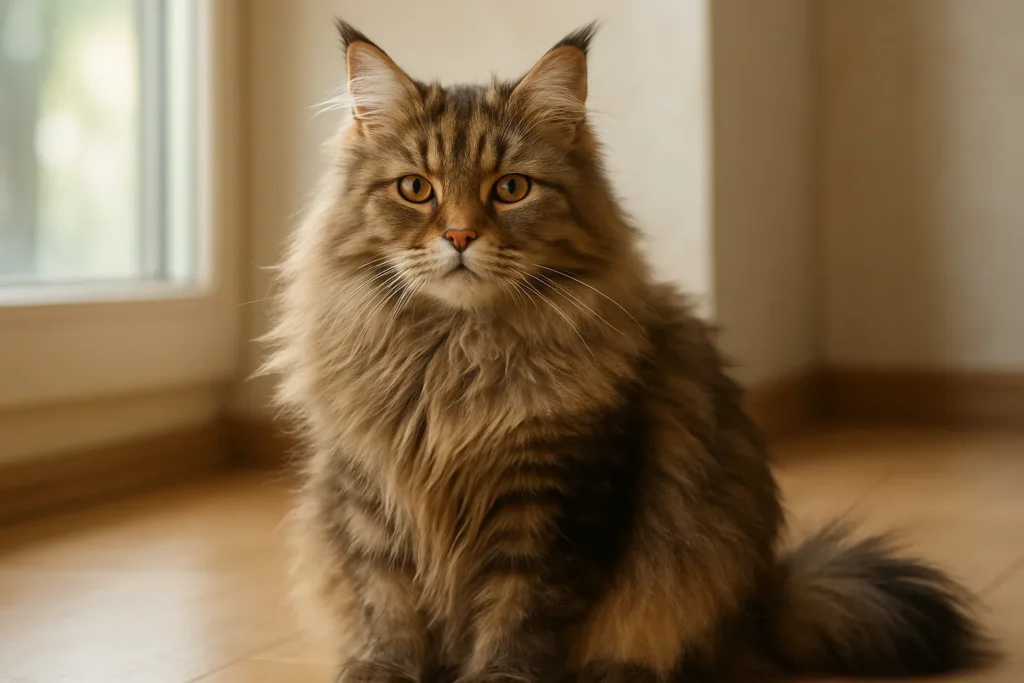
Assess your cat as a whole rather than focusing on one dramatic feature. A fluffy tail or large paws may attract attention, but breed-like structure is more informative when several traits appear together.
- A large overall frame with a long, sturdy body
- A rectangular outline rather than a short, cobby build
- A square or boxy muzzle and strong chin
- Large ears, often with inner furnishings and possible lynx-like tips
- A long, shaggy coat with a fuller neck ruff and rear-leg britches
- A long, bushy, plume-like tail
- Large paws, sometimes with noticeable tufts between the toes
Head and Face Signs That Suggest Maine Coon Heritage
The head can be more useful than coat color or pattern when you are assessing Maine Coon traits. Look for a broad, somewhat rectangular head, a square muzzle, and a firm chin that appears aligned with the nose and lower jaw.
Maine Coon-like ears are usually large and set high enough to give the head an alert, open appearance. Inner furnishings and pointed tufts may strengthen the impression, although ear tufts also occur in other cats.
The eyes are typically large and expressive, but eye color and expression are not reliable proof of breed. A rounder head, finer muzzle, or very compact facial structure may point more toward another type of cat, though individual variation is considerable.
Body, Coat, and Tail Features to Check Next
Next, examine the silhouette from the side and from above. A Maine Coon-like body is generally long and substantial, with noticeable bone and a gradual, rectangular outline rather than a small, rounded shape.
The coat should be considered for texture and layering, not just length. A shaggy, uneven coat with a fuller neck ruff, longer furnishings, and rear-leg britches is more informative than ordinary soft fluff. Seasonal shedding can also make the coat look very different at different times of year.
The tail is often one of the most striking features: long, full, and tapered like a plume. Large paws and toe tufts can support the impression, but these details still need to be interpreted alongside the head and body.
How to Tell if a Kitten Might Be Maine Coon
Kittens are especially difficult to identify because their proportions change quickly. A temporary growth stage, a fluffy baby coat, or oversized ears can make an ordinary kitten look like a large, long-haired breed.
Early clues may include unusually large paws, a long body, prominent ears, and a developing tail. However, the adult ruff, full coat texture, and final body proportions may not be apparent yet.
Maine Coon development is often described as extended or slow compared with many cats, so size alone is a poor test during kittenhood. Do not treat a tabby pattern, ear tufts, or general fluffiness as proof. The kitten’s history and later structure matter more.
Signs Your Cat Could Be a Maine Coon Mix
A possible Maine Coon mix may show a combination of recognizable traits without presenting the complete breed-like silhouette. For example, your cat might have a long body and bushy tail but a narrower muzzle, smaller ears, or a less substantial frame.
Moderate ear furnishings, a partial neck ruff, large paws, or a shaggy coat can all be compatible with mixed ancestry. Size may vary widely, so a smaller cat cannot be ruled in or out from stature alone.
Temperament can overlap with descriptions commonly associated with Maine Coons, but personality is not a breed test. It is more accurate to describe a cat as likely purebred, possibly mixed, or a convincing lookalike than to claim certainty from appearance.
Maine Coon vs. Domestic Longhair: The Most Common Confusion
Many pet cats are domestic longhairs: cats with long coats whose ancestry is not tied to a documented breed. Natural variation can give them a ruff, ear tufts, a plume tail, or a large-looking coat without indicating Maine Coon heritage.
Coat length, color, and pattern are therefore weak evidence on their own. Structural traits such as the muzzle, chin, body outline, ear placement, paw size, and tail proportions deserve more weight.
A domestic longhair may look especially Maine Coon-like in winter or when its coat is fully grown. The absence of papers does not make it a domestic longhair with certainty, but it does mean appearance should be described cautiously.
Maine Coon vs. Norwegian Forest Cat and Other Lookalikes
Maine Coon and Norwegian Forest cats can both be large, long-haired, tufted, and heavily coated. A comparison is useful, but individual cats and mixes may not fit a clean visual description.
A Maine Coon-like cat often gives a longer, more rectangular impression with a prominent square muzzle. A Norwegian Forest cat is commonly described as having a different head profile, with a straighter facial outline and a more triangular overall impression.
Coat texture and silhouette can also differ, but grooming, season, age, and mixed ancestry blur these distinctions. Domestic longhairs and other large-looking cats may share features with both breeds, so comparison can narrow possibilities without proving identity.
Behavior and Growth Clues That Can Support Breed ID
Growth can provide context when a young cat continues developing a long, substantial body over time. It should support, not replace, an assessment of physical structure and known history.
A sociable, interactive cat may fit the temperament many people associate with Maine Coons, and vocal habits or a confident play style can seem suggestive. These behaviors also occur in countless cats with no Maine Coon ancestry.
Use personality as background information only. Behavior is shaped by genetics, early experience, health, and environment, so it should never outweigh pedigree records or a consistent set of physical traits.
How to Find Out Your Cat’s Breed for Real
If you want the strongest breed confirmation, begin with documentation. Pedigree papers from a recognized registry or reliable breeder are the clearest evidence that a cat is a purebred Maine Coon.
Adoption or rescue records may contain useful information about a cat’s reported background, but descriptions such as “Maine Coon mix” are not always verified. Treat them as context rather than conclusive proof.
A cat DNA test may offer clues about ancestry, but results depend on the test’s reference data and should not be treated as equivalent to a pedigree. A veterinarian can assess the cat’s physical features and general health, but usually cannot certify a purebred from appearance alone.
In practical terms, pedigree provides the strongest purebred evidence, records may provide supporting history, DNA may offer an ancestry estimate, and visual assessment helps form a reasonable description.
A Simple Step-by-Step Decision Guide
Use this sequence when deciding how to identify a cat’s breed without overclaiming what you know:
- Check pedigree, breeder, shelter, or adoption records before relying on appearance.
- Assess multiple core traits, including the muzzle, ears, body shape, coat, tail, and paws.
- Compare the overall structure with Maine Coon lookalikes rather than matching one feature.
- Consider your cat’s age, since kitten proportions and seasonal coats can be misleading.
- Use a DNA test if you want additional ancestry evidence and understand its limitations.
- Describe the result realistically as documented purebred, likely mix, or likely domestic longhair lookalike.
The Most Reliable Way to Judge Maine Coon Traits
The best answer to how to know if your cat is a Maine Coon is to look for a consistent pattern of structure rather than a single impressive feature. A square muzzle, large tufted ears, rectangular body, layered shaggy coat, plume-like tail, and substantial paws can make Maine Coon ancestry plausible, but they cannot prove it.
For greater certainty, combine your observations with pedigree or background records and consider DNA testing as supporting evidence. When documentation is unavailable, “Maine Coon-like” or “possible Maine Coon mix” is often the most accurate conclusion.
Can a small cat still be part Maine Coon?
Yes. Mixed cats can inherit some Maine Coon traits without the breed’s full size or structure. Age, sex, overall genetics, and individual variation also affect size, so a small cat cannot be ruled out based on stature alone.
How do I find out my cat’s breed if I do not have papers?
Review adoption or shelter records, assess the cat’s full physical structure, compare common lookalikes, and consider a cat DNA test for additional ancestry clues. A veterinarian can help describe features, but appearance alone cannot certify a purebred.
What is the difference between a Maine Coon and a Norwegian Forest cat?
Both can be large and long-haired, but Maine Coon-like cats often have a longer rectangular outline and a more square muzzle. Norwegian Forest cats are commonly associated with a different, more triangular head profile. Mixed and non-pedigreed cats may not match either breed exactly.