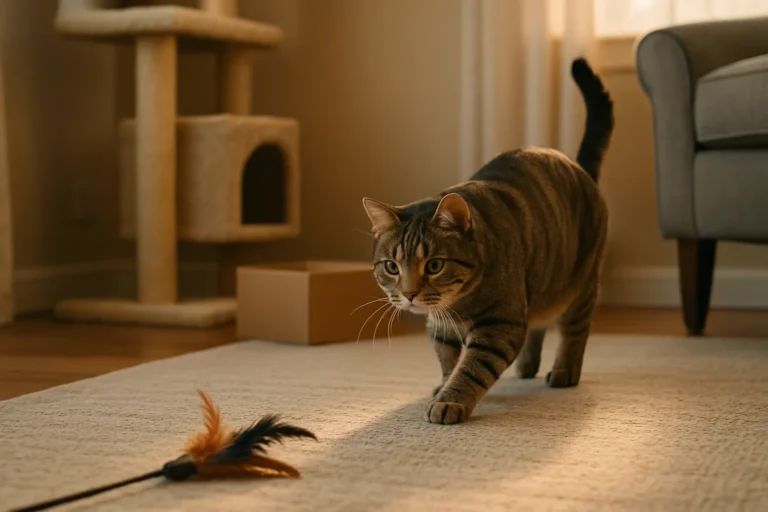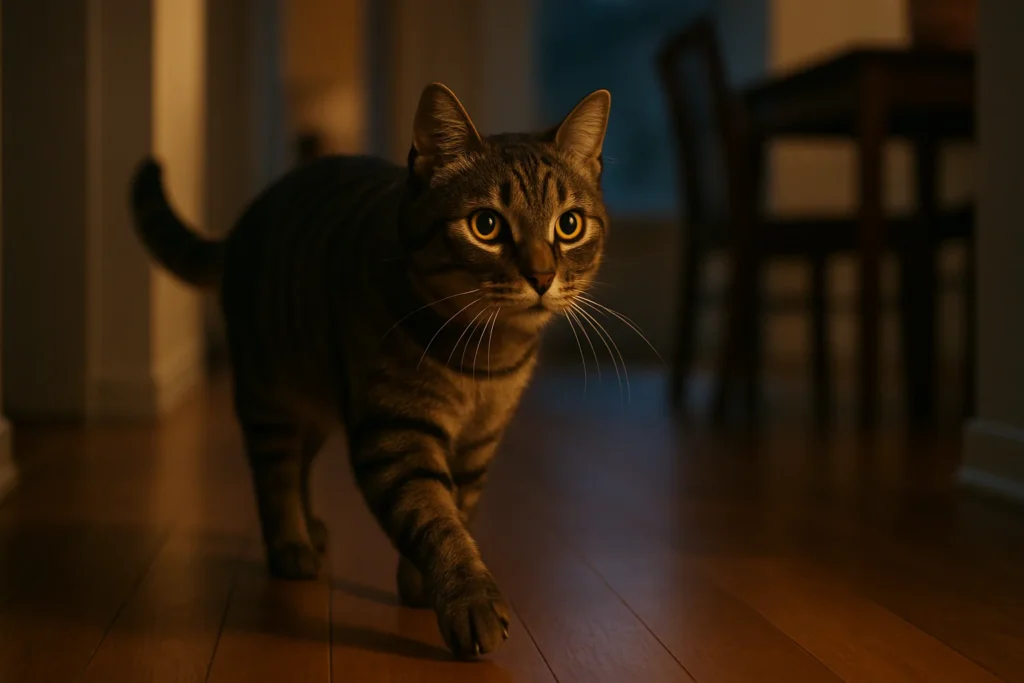
Cats see much better than people do in low light, which is why they can move around comfortably at dusk, dawn, and in a dim room. Their eyes are built to gather available light and detect movement, but they do not provide true vision in a completely lightless space.
So, how well can cats see in the dark, and are cats okay in the dark? Healthy cats usually manage dim conditions well, although they may need help with unfamiliar rooms, stairs, clutter, or age-related vision changes. The key is to distinguish low light from total darkness.
The Short Answer: Cats See Very Well in Low Light, Not in Total Darkness
Cats need far less light than humans to navigate. They can often detect shapes, movement, and pathways in conditions that seem too dark for a person to see comfortably.
Complete darkness is different. If there is no light at all, a cat cannot form a visual image. The idea that cats have true dark vision is a common myth; their eyesight is specialized for low-light conditions, not the absence of light.
Why Cats Can See Better at Night Than People
Feline eyesight combines several features that improve low-light vision. A cat’s retina contains many rod cells, which are especially useful for detecting movement and working when light is scarce. Cats also have cone cells for color and detail, but their vision places less emphasis on those abilities than human vision does.
Cats have large pupils that expand to admit more available light. Behind the retina is a reflective layer called the tapetum lucidum. It sends light back through the retina, giving the eye another opportunity to detect it. This layer is also responsible for the eye shine seen when a light catches a cat’s eyes.
These adaptations suit a crepuscular lifestyle. Cats are naturally well equipped to notice movement during the dim periods around dawn and dusk, when their hunting ancestors could remain active without relying on bright daylight.
How Well Do Cats See in the Dark Compared With Humans?
Cats can function in much dimmer conditions than humans. In a low-light room, a cat may spot a moving toy or navigate around familiar furniture while a person sees only vague outlines.
Their advantage is strongest for motion detection and general navigation. Human vision is usually better for fine detail, color richness, and sharp distance vision in brighter conditions. Cat vision is therefore specialized rather than universally superior: cats trade some daytime detail for stronger performance when light levels fall.
Can Cats See in Complete Darkness?
No. Complete darkness means there is no light available to enter the eye, and vision requires at least some light source. Even the most capable feline night vision cannot overcome that limit.
A cat may still move confidently through an extremely dark area because it is using more than its eyes. Whiskers can help detect nearby surfaces, while hearing, smell, memory, and familiarity with the layout provide additional information. Confident movement does not necessarily mean the cat can see every object clearly.
Do Cats See Better in the Dark or in the Light?
Cats are optimized for dim conditions such as dusk and dawn, not for complete darkness or bright midday detail. Their eyes are especially effective at detecting movement and navigating when some light is available.
In bright light, their pupils narrow to control the amount entering the eye. People may have an advantage when tasks require sharp detail, close visual discrimination, or a broad range of colors. A cat’s vision works best when viewed as a set of adaptations for a particular lifestyle, rather than as better in every lighting condition.
What Cats Can and Cannot See at Night
In a dim space, cats can often detect moving animals, people, and toys, as well as the larger shapes of furniture and doorways. This helps them travel through familiar areas and respond quickly to movement.
They may not see fine details as clearly as an owner expects. A stationary object that blends into its surroundings can be difficult to notice, especially when the room is very dark. Sudden changes to furniture placement, clutter on the floor, or dark obstacles can also make navigation harder.
Cats do see some colors, but color is not their main advantage at night. Their low-light vision relies more heavily on light detection, movement, and contrast than on the rich color perception people use in daylight.
Are Cats Okay in the Dark?
Healthy adult cats are usually comfortable in dim conditions, especially in a familiar home. Most do not need a light left on overnight simply to move between their usual sleeping, eating, and resting areas.
A small night-light can still be useful in an unfamiliar home, near stairs, or around a litter box and food area. It may also help when furniture has been rearranged or when a cat appears hesitant to cross a particular space.
Senior cat vision changes or an existing eye problem can make darkness more challenging. Watch the individual cat rather than assuming that strong feline night vision applies equally at every age. Stress may also come from an unfamiliar room, sudden noises, or a changed layout rather than from darkness itself.
- Keep pathways clear, especially around stairs and litter boxes.
- Avoid making sudden layout changes in areas a cat uses at night.
- Use gentle, low-level lighting if your cat seems uncertain in an unfamiliar space.
- Give senior cats easy-to-follow routes between essential areas.
Do Cats See Better Than Dogs at Night?
Both cats and dogs are adapted to function in lower light than humans, and both can use movement detection and other senses when visibility is limited. Cats are particularly well suited to low-light stalking and noticing small movements.
It is difficult to make a simple absolute ranking because vision differs between individuals, breeds, environments, and the task being performed. For everyday care, the useful conclusion is that cats generally handle dim familiar spaces well, but neither cats nor dogs can see in complete darkness.
Can Cats See in Color?
Yes, cats see some color, but not with the same range or richness humans do. Blue and yellow tones are generally easier for cats to distinguish than reds and greens.
This is one of the tradeoffs in feline eyesight. Cat vision is strongly adapted for detecting available light and movement, while color and fine detail play a smaller role. A toy’s movement, contrast, texture, and sound may attract a cat more reliably than its exact color.
When Poor Night Navigation May Signal a Vision Problem
A cat that suddenly struggles in familiar surroundings may need more than a brighter room. Bumping into furniture, hesitating on routes it previously used, or having trouble locating the litter box or food in normal lighting can indicate a change worth discussing with a veterinarian.
Other concerning changes can include unusually dilated pupils, cloudy-looking eyes, or a noticeably increased startle response. If these signs appear suddenly, worsen, or occur with other changes in behavior, arrange a veterinary visit rather than assuming the problem is ordinary nighttime uncertainty.
The Bottom Line on Feline Night Vision
Cats see very well in low light because their eyes are designed to gather available light and detect movement. They can navigate dim familiar spaces more effectively than people, but they cannot see in complete darkness and may struggle with fine details, clutter, or unfamiliar layouts.
For most healthy adult cats, a dark overnight room is not automatically a problem. Keep pathways safe, consider gentle lighting where needed, and pay attention to new hesitation or navigation changes, particularly in senior cats.
Can cats see in full darkness?
No. Cats need at least some light to see. In full darkness, they rely more on whiskers, hearing, smell, memory, and familiarity with their surroundings.
Should I leave a light on for my cat at night?
Usually, a light is not necessary for a healthy adult cat in a familiar home. Consider a gentle night-light if the space is unfamiliar, includes stairs, has recently changed, or seems difficult for a senior cat to navigate.
What age can kittens start seeing well in low light?
Kittens’ vision develops as their eyes open and mature, so low-light ability is not fully established immediately. Young kittens should be kept in a safe, familiar environment rather than expected to navigate dark spaces independently.