Learning how to play with a cat is about more than keeping your pet busy. The most satisfying sessions resemble a small hunting expedition: the cat notices movement, watches, stalks, chases, pounces, and eventually catches its target.
When play follows that natural sequence, daily interactive play can provide exercise, mental stimulation, and a useful outlet for cat behavior. The techniques below show how to create engaging sessions indoors or in a secure outdoor space, whether your cat is a kitten, adult, or senior.
Why Play Matters for Cat Behavior
Play gives cats an appropriate way to practise stalking, chasing, pouncing, and catching. It also combines physical movement with decisions about timing, distance, and direction, making it a form of enrichment rather than simple entertainment.
Cats that spend most of their time indoors may have fewer opportunities to use these natural skills. Consistent play can help reduce boredom-related behaviors such as pestering, restless nighttime activity, or attention-seeking, although it will not solve every behavior problem by itself.
Every cat has an individual play style. One may prefer a toy that skims across the floor, while another may enjoy a slowly climbing feather toy. Notice whether your cat likes speed, height, hiding, batting, wrestling, or a mixture of these patterns.
- Play supports movement as well as mental engagement.
- Interactive sessions let a cat use natural hunting behaviors in a controlled setting.
- Different cats may prefer different speeds, surfaces, textures, and toy movements.
How Cats Like to Play With Humans
A person should imitate the behavior of prey, not simply wave a toy in the cat’s face. Move the toy away from your cat more often than toward it, because retreating movement gives the cat a reason to follow.
Use short bursts, pauses, and sudden changes in direction. Let the toy disappear behind a chair, peek around a corner, or remain still long enough for your cat to focus. Constant motion can make the toy look artificial and give the cat no opportunity to plan a pounce.
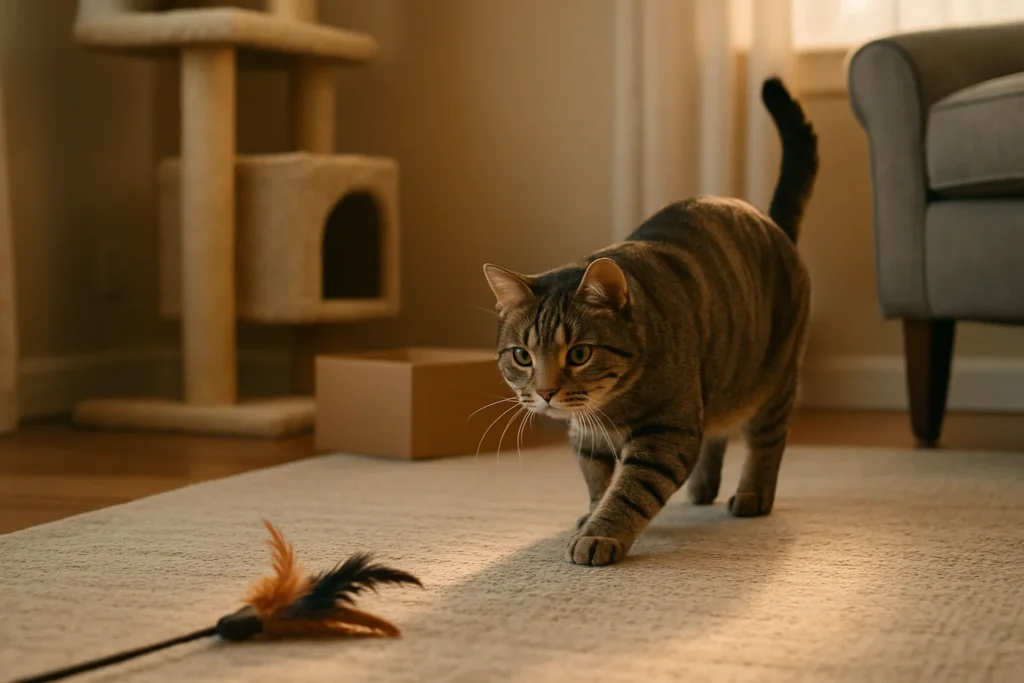
Keep a mouse-like toy low to the ground and make it dart along edges, under furniture, or across a rug. Raise a feather or similar toy only when you are imitating a bird. In both cases, allow the cat to watch and stalk instead of forcing continuous chasing.
- Move away, hide, pause, and then reappear.
- Use low, quick movements for ground prey.
- Use brief upward movement for bird-like play.
- Give your cat time to observe before changing direction.
How to Play With a Cat Step by Step
A good session can be simple. Choose one interactive toy and a quiet area where your cat can turn, stop, and land without sliding. A rug or other surface with traction is preferable to a slick floor.
Begin with the toy resting or moving slowly at the edge of your cat’s attention. If your cat looks, turns an ear, crouches, or follows the toy with its eyes, continue gradually rather than rushing into a chase.
Build a short stalk-chase-pounce cycle. Move the toy away, pause behind an object, make it dart across the floor, and then stop so your cat can pounce. Change direction occasionally, but avoid frantic movement that makes the session feel chaotic.
Let your cat catch the toy at intervals. After a successful catch, keep the toy still for a moment, then restart if your cat remains interested. Finish with one final catch and a small reward or a meal when that fits your cat’s normal routine. A calm ending helps prevent frustration.
- Select one interactive toy and a safe, uncluttered play area.
- Start slowly and wait for your cat to notice the toy.
- Create a repeating stalk, chase, and pounce sequence.
- Use hiding places, pauses, and direction changes to add realism.
- Offer regular opportunities to catch the toy.
- End with a final successful catch and a calm transition.
Best Toys for Interactive Cat Play
The most useful interactive toy is one that lets you control distance and movement while keeping teeth and claws away from your hands. A wand toy is often a practical choice because it can skim along the floor, disappear behind furniture, or move through the air while giving your cat room to chase.
Small toss toys suit cats that like batting, carrying, or sprinting after a moving object. Kick toys are useful for cats that grab a target with their front legs and bunny-kick with their back legs. Choose a size and construction that your cat can handle safely, and inspect toys regularly for loose parts or damage.
Puzzle toys and other independent toys can extend enrichment between human-led sessions, but they do not provide the same responsive movement. Rotate a few toys instead of leaving every option out all the time. Bringing back a familiar toy after a break can make it seem interesting again.
- Wand toys: useful for distance, controlled movement, and prey-style play.
- Small toss toys: suitable for batting, carrying, and short chases.
- Kick toys: appropriate for grabbing and wrestling.
- Puzzle or independent toys: helpful supplements between interactive sessions.
- Toy rotation: a way to preserve novelty without constantly adding more toys.
How to Play With a Cat Without Toys
You can create things to do with your cat at home without relying on a commercial toy. Roll a loosely crumpled paper ball across a clear floor, slide a cardboard box across a rug, or encourage your cat to investigate a box with an open top. Supervise these activities and remove anything that begins to shred.
Hide-and-seek games can use furniture as cover. Move out of sight, make a quiet sound, and let your cat search rather than chasing the cat yourself. You can also hide a few pieces of your cat’s usual food around an accessible room so it can sniff and explore at its own pace.
Boxes, tunnels, cushions, and stable low furniture can form an obstacle-style route. Leave enough space for easy movement and avoid creating high jumps or unstable stacks. Strings, ribbons, elastic items, and small pieces should not be left with a cat that might chew or swallow them.
- Roll paper balls or move safe cardboard across the floor while supervising.
- Use furniture for gentle hide-and-seek and search games.
- Encourage scent-based food hunts with appropriate portions from the usual diet.
- Arrange stable boxes and tunnels to create a simple movement route.
- Remove strings, small parts, and damaged materials after play.
How to Play With a Cat Indoors
Indoor play becomes more varied when you use the whole room instead of one patch of floor. Guide a toy around a corner, along a hallway, over a rug, or behind a sofa. These changes give your cat different surfaces and sightlines for stalking.
Vertical space can add another option. A cat tree, sturdy stool, or secure sofa area may let your cat watch from above before descending toward the toy. Keep landings clear and adjust the height to your cat’s confidence and mobility.
A useful indoor routine combines interactive play with solo enrichment. After a morning session, leave a safe independent activity available for later. A second session in the evening can provide a more focused outlet when many cats naturally become active.
- Use hallways, corners, rugs, and furniture edges as parts of the play route.
- Add secure vertical options when your cat enjoys climbing.
- Mix human-led sessions with safe independent enrichment.
- Vary the room and movement pattern so indoor play does not become predictable.
How to Play With a Cat Outside Safely
Outdoor play should take place only in a secure, supervised setting, such as a catio, enclosed patio, properly fenced area, or controlled harness-trained outing. Free roaming adds escape, traffic, animal, and environmental risks that play does not require.
In a secure area, use a wand toy for brief play and allow time for scent exploration. Keep the pace modest if the surroundings are new. A cat that is scanning constantly, crouching low, hiding, or trying to retreat may be stressed rather than ready to play.
Check the area before each session for escape routes, unstable structures, extreme weather, and plants or materials that may be toxic. Outdoor distractions can make toy play less useful, so return indoors if the environment becomes overwhelming.
- Choose an enclosed or controlled outdoor setting.
- Supervise every session and check for escape opportunities.
- Combine short play with relaxed scent exploration.
- Watch for signs that noise, weather, or unfamiliar surroundings are causing stress.
How Long and How Often to Play With a Cat
Short, frequent sessions usually work better than one exhausting session. Many cats do well with sessions of about 10 to 15 minutes once or twice daily, but the best routine depends on age, health, temperament, and how readily your cat engages.
Kittens often prefer several brief bursts because they tire and become distracted quickly. Adult cats may settle into a predictable morning and evening routine. Senior cats may enjoy slower movement, fewer jumps, and more rest between attempts.
End while your cat is still interested rather than continuing until it becomes frustrated or exhausted. Heavy breathing, repeated missed pounces, irritability, flattened posture, or walking away can signal that the session should stop and the cat should have time to settle.
- Start with brief sessions and adjust according to engagement.
- Offer more frequent bursts for kittens.
- Use gentler, lower-impact play for seniors.
- Stop when your cat loses focus, becomes frustrated, or appears tired.
Mistakes That Make Cats Lose Interest
The way you move a toy matters as much as the toy itself. Repeating the same pattern, waving directly at the cat, or moving too quickly can make the activity predictable or unappealing. Try imitating a different type of prey and changing the route through the room.
Hands and feet are not toys. Letting a kitten or adult cat bite, grab, or chase them can teach the cat that human skin is an acceptable target. Use a toy with distance instead, particularly for wrestling and kicking.
A cat that never catches its target may become frustrated or stop believing the chase is worthwhile. Include pauses and successful catches, then finish with a clear win. Also avoid interrupting play when the cat is sleepy, stressed, immediately after a large meal, or distracted by noise.
- Replace repetitive motion with pauses, hiding, and varied routes.
- Keep hands and feet out of play, even during kitten games.
- Allow successful catches instead of keeping the toy permanently out of reach.
- Shorten sessions when the cat becomes overstimulated.
- Rotate movement styles and toys.
- Choose a time when the cat is alert and comfortable.
What to Do if Your Cat Won’t Play
When a cat will not play, start by changing one factor at a time. Test a different texture, toy size, movement style, or play surface. A cat that ignores an airborne toy may respond to a small object sliding slowly along the floor.
Reduce competing noise and give the session more pauses. Dawn and dusk may suit cats that are naturally more active at those times, but an individual cat’s routine matters more than a fixed clock. Keep the first attempts short and stop before the cat becomes wary.
Body language can help identify the problem. Turning away may indicate low interest or poor timing; crouching tightly, hiding, or retreating may suggest fear or stress; swatting hard, tail lashing, or biting may indicate overstimulation. Adjust the environment and intensity accordingly.
A sudden loss of interest is different from a long-standing preference for quiet play. Pain, illness, weight-related difficulty, or stress can affect activity. If the change is abrupt, persistent, or accompanied by other concerning behavior, arrange a veterinary assessment rather than trying to solve it with more intense play.
- Change toy texture, size, movement, or surface gradually.
- Lower noise and reduce visual distractions.
- Try a shorter session during a naturally active period.
- Use body language to distinguish fear, boredom, and overstimulation.
- Seek veterinary advice when reduced play is sudden or persistent.
Adjusting Play for Kittens, Adult Cats, and Seniors
Kittens need frequent, gentle opportunities to chase and pounce. Redirect biting and grabbing toward a toy every time possible, and avoid games that teach them to attack fingers, toes, or clothing. Their sessions may be energetic but should remain brief and supervised.
Adult cats often benefit from consistency. A predictable morning and evening routine can make play easier to anticipate, while changes in toy movement keep the activity fresh. Match the intensity to the cat rather than assuming every adult wants a fast chase.
Senior cats may still enjoy hunting-style play but often need low jumps, slower movement, soft landings, and longer pauses. Keep toys within comfortable reach and avoid forcing stairs or leaps. In a multi-cat home, one-on-one sessions can help each cat play at its own pace without competition.
- Kittens: redirect attacks to toys and use frequent, gentle bursts.
- Adult cats: use a consistent routine with varied prey-style movement.
- Senior cats: choose slower play, low-impact routes, and comfortable landings.
- Multi-cat homes: provide individual sessions when cats have different preferences.
A Simple Daily Play Routine You Can Start Today
A repeatable routine removes the guesswork. Begin with a quick morning session that uses slow floor-level movement and a few opportunities to catch. Later, offer safe independent enrichment while you are occupied.
Make the evening session the main prey-style activity. Use a wand toy or another interactive option to create several stalk, chase, and pounce cycles. Change the route or toy type across the week, but keep the overall sequence familiar.
End the evening with a final catch, followed by a small reward or the cat’s usual meal when appropriate. Put interactive toys away afterward, allow a calm wind-down, and note which movements your cat preferred so the next session can be more effective.
- Morning: offer a brief interactive session with slow, low movement.
- During the day: provide safe independent enrichment or a supervised exploration game.
- Evening: use a longer interactive session with varied stalk-and-chase patterns.
- End: allow a final catch, then transition to food or quiet time.
- Across the week: rotate toys and movement styles based on your cat’s response.
Make Play Feel Like a Successful Hunt
The most effective cat play is responsive rather than complicated. Move toys like prey, give your cat time to watch and stalk, allow regular catches, and adjust the pace to the cat in front of you.
With short, consistent sessions and sensible safety boundaries, play can become one of the easiest ways to support enrichment and strengthen your daily relationship. Start with one quiet session today, then refine the routine as you learn what makes your cat want to chase.
How can I play with my cat without toys?
Try supervised paper-ball or cardboard games, gentle hide-and-seek around furniture, food-scent hunts, or a route made from stable boxes and tunnels. Remove strings, small pieces, and damaged materials that could be swallowed.
How long should I play with my cat each day?
Many cats do well with short sessions of about 10 to 15 minutes once or twice daily, but kittens may prefer more frequent bursts and seniors may need shorter, gentler play. Stop when your cat loses focus, becomes frustrated, or appears tired.
Why won’t my cat play with me?
Your cat may dislike the toy or movement, feel stressed, be distracted, or be playing at a different time of day. Try quieter, shorter sessions with slower movement and different toy textures. If the loss of interest is sudden or persistent, ask a veterinarian to check for pain, illness, weight-related difficulty, or stress.