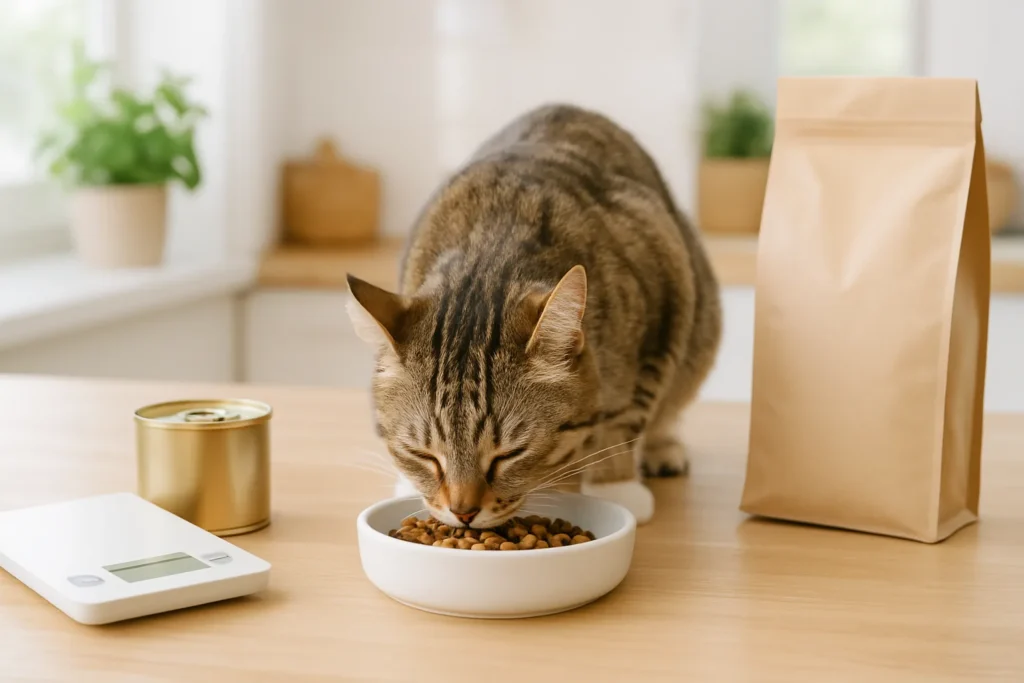
Knowing how much to feed your cat starts with calories, not just the apparent size of a scoop, can, or pouch. Food differs greatly in calorie density, so the same volume can provide very different amounts of energy.
Use your cat’s ideal body weight, life stage, activity level, and body condition to establish a starting point. Then use the calorie statement on the label, measure the daily ration, and watch weight and body shape over time. This approach is more reliable than following a universal cat feeding chart.
Start With Your Cat’s Daily Calorie Needs
A cat’s daily calorie needs are an estimate of the energy required to maintain a healthy body condition. The right amount varies with ideal weight, age, neuter status, activity, environment, and health. An indoor cat that spends most of the day resting may need less energy than an active outdoor cat of the same size.
Use current ideal weight when you are correcting excess weight. Calculating portions from the cat’s present weight can maintain the extra weight rather than gradually reducing it. Your veterinarian can help identify a suitable target weight, especially when obesity, muscle loss, or illness is involved.
Treat the food label’s calorie information as the bridge between energy needs and portions. Once you have a daily calorie target from your veterinarian or a trusted veterinary calculation, divide that target by the food’s calories per cup, can, pouch, or gram.
Daily calorie needs depend on body weight, life stage, and activity. This article explains how veterinarians estimate energy requirements without publishing a precise chart here. Ask your veterinarian for individualized feeding guidance.
- Neutered cats may need less energy than intact cats.
- Low activity and indoor living can reduce calorie needs.
- Growing kittens, pregnant cats, nursing cats, and cats on therapeutic diets require separate guidance.
- A calorie target is a starting point, not a permanent prescription.
How Much Should a 10-Pound Cat Eat?
There is no single correct answer to how much should a 10 lb cat eat. A healthy, active adult and a sedentary indoor adult at the same weight can have different energy needs. The cat’s ideal body condition matters as much as the number on the scale.
For a 10-pound adult cat, begin with an individualized maintenance calorie estimate rather than copying a can or cup recommendation. A veterinarian, veterinary technician, or nutrition calculator can provide that estimate using weight and lifestyle. Choose the lower end of the guidance when the cat is prone to weight gain, and reassess rather than making a large immediate cut.
To convert the estimate into food, find the label’s kcal per cup for dry food or kcal per can or pouch for wet food. Divide the daily calorie allowance by that value. The result is the total for the day, not the amount for each meal.
For example, a dry food with more calories per cup will require a smaller measured volume than a less energy-dense food. Likewise, two small cans may provide less energy than one larger can, depending on the label. Always verify the calories in your own product before portioning.
- Use ideal body weight when weight loss is the goal.
- Compare the cat’s current body condition with the calorie estimate.
- Measure the complete daily ration before dividing it between meals.
- Recheck the cat’s weight and shape regularly before changing the amount again.
Cat Feeding Chart by Weight
A weight-based chart can be useful for orientation, but publishing a precise calorie range without knowing the food, life stage, activity, and health status can create false accuracy. Use common adult weights as prompts to obtain an individualized daily calorie estimate, not as fixed feeding instructions.
For healthy adult maintenance, the general pattern is straightforward: larger cats usually need more energy than smaller cats, but body condition can reverse that comparison. A heavier cat carrying excess fat may need portions calculated from a lower target weight, while a lean, highly active cat may need more than a sedentary cat of similar size.
After choosing a starting portion, monitor the weekly trend rather than reacting to one day of appetite. Stable weight and a healthy body shape suggest the amount is close to appropriate. A steady change in either direction indicates that the ration should be reassessed.
- Small adult cats: start with a veterinary estimate based on ideal weight.
- Medium adult cats: adjust the estimate for indoor activity and body condition.
- Larger adult cats: check whether the extra weight reflects muscle or excess fat.
- Any adult cat with weight change: reassess calories and seek veterinary advice if the change is unexplained.
How to Convert Calories Into Real Portions
Look for a calorie statement such as kcal per cup, kcal per kilogram, kcal per can, or kcal per pouch. The guaranteed analysis lists nutrients such as protein and fat, but those percentages do not directly tell you how much food to serve. The calorie statement is the key figure for portioning.
For dry food, divide the cat’s daily calorie allowance by the food’s kcal per cup to find the daily volume. If the label provides kcal per kilogram rather than kcal per cup, a kitchen scale is the more dependable option. Weighing the daily amount in grams avoids errors caused by different kibble shapes and loose or tightly packed measuring cups.
For wet food, divide the daily calorie allowance by the kcal per can or pouch. If a container is opened and only part is used, measure the portion rather than estimating by eye. Refrigerate unused wet food according to the label’s storage directions.
For mixed feeding, set one daily calorie budget first. Allocate some calories to wet food, subtract them from the total, and use the remaining calories to calculate the dry portion. Do not feed the full suggested amount of both foods unless the combined calories have been checked.
- Record the calorie value and serving unit for each food.
- Calculate the entire day’s ration before splitting it into meals.
- Use a kitchen scale for dry food when accurate portions are important.
- Count treats, toppers, supplements, and shared table food in the daily intake.
How to Use a Cat Feeding Calculator
A cat feeding calculator should be treated as an estimate. Enter the cat’s ideal weight and relevant lifestyle details, then compare the result with the food label and the cat’s body condition. Calculator output cannot account for every medical issue or individual difference.
If the result conflicts sharply with the label, do not combine both recommendations. Check that you entered the correct weight, selected the correct life stage, and used the label’s calorie unit. Ask your veterinarian to resolve the discrepancy when the cat is overweight, underweight, ill, or losing weight unexpectedly.
How Much Dry Food Should I Feed My Cat?
Dry food can look like a surprisingly small portion because it contains little water and is often calorie-dense. A large bowlful may provide far more energy than a cat needs, particularly when the cat is indoors and not very active.
Use the label’s kcal per cup or kcal per kilogram to calculate the daily ration. Foods with a higher calorie density require less volume, while foods with a lower density require more. Because cups are easy to overfill, weighing the portion in grams is usually more accurate.
Free-feeding can make portion control difficult. Some cats regulate their intake, but others repeatedly return to the bowl and gradually gain weight. Measured meals, a timed feeder, or food puzzles can make the daily amount easier to manage without leaving unlimited food available.
- Measure the whole day’s dry ration instead of topping up an empty bowl.
- Keep the measuring method consistent from day to day.
- Reduce the meal size if treats are a regular part of the routine.
- Track body weight and waist shape when changing foods or activity.
How Much Wet Food Should I Feed My Cat?
Wet food portions for cats depend on the calories in each can or pouch, not simply on the number of containers. Read the label for the complete calorie content of the specific size and recipe you feed.
Two cans may be enough for one cat and not enough for another. A smaller can with a lower calorie content may provide less energy than a larger can, and an active cat may need more than a quiet indoor cat. Calculate the day’s total from the label, then divide it between meals.
Wet food contributes substantial moisture to the diet, which can be useful for cats that do not drink much. It still supplies calories, however, so adding wet food to a full dry-food ration can unintentionally overfeed the cat.
- Check calories per can or pouch rather than relying on container count.
- Use the same container size when estimating the daily amount.
- Cover and refrigerate unused food promptly.
- Discard uneaten food when it has been left out too long according to safe handling guidance.
How to Feed a Mixed Diet Without Overfeeding
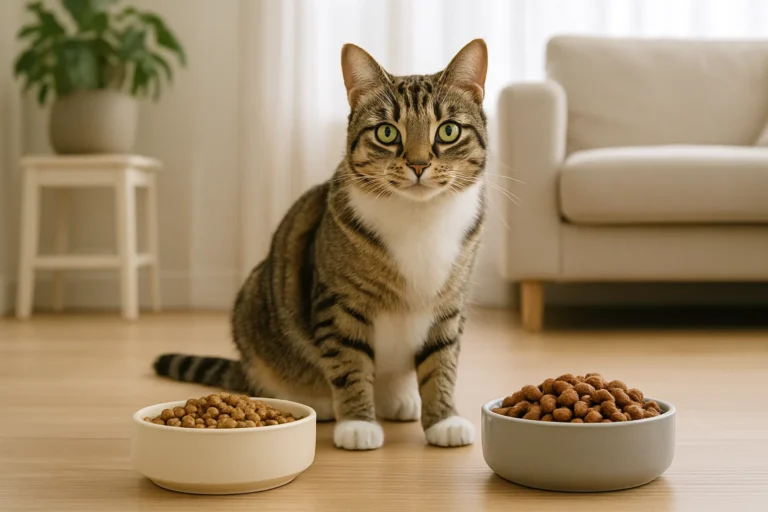
Mixed feeding works best when wet and dry food share one daily calorie budget. Decide how much of the day’s energy will come from each type, calculate the wet portion, and use the remaining allowance for dry food.
For instance, you might provide a wet-food meal and use measured dry food for another meal. The exact portions depend on each product’s calorie density. If the wet food supplies one part of the daily calories, reduce the dry food accordingly rather than adding the wet food on top of the usual ration.
Treats should also come out of the same daily budget. A small amount given repeatedly can matter, especially for a small or inactive cat. Keep a simple food log while establishing a new routine.
- Choose the daily calorie budget first.
- Calculate wet-food calories separately.
- Subtract wet-food calories before measuring dry food.
- Count treats and extras rather than treating them as free calories.
How Often Should Cats Eat Each Day?
Most adult cats do well when their measured daily food is divided into multiple meals rather than served all at once. Splitting the ration can support portion control and may better match a cat’s tendency to eat small amounts throughout the day.
Dry food can be divided into scheduled meals or dispensed in measured portions through a timed feeder. Wet food is usually offered as separate meals because it should not sit out indefinitely. Follow safe food-handling practices for opened and served food.
More frequent, smaller meals may suit cats that beg between meals, eat too quickly, or need food with medication. Cats with diabetes, gastrointestinal disease, kidney disease, or other conditions may need a feeding schedule set by a veterinarian.
Once-daily feeding is not automatically harmful for every healthy adult cat, but it can make hunger, rapid eating, and accurate portion control more difficult. A divided schedule is generally more practical for most households.
- Divide the measured daily amount before serving it.
- Keep meal times consistent when possible.
- Use enrichment feeders for dry food if rapid eating is a problem.
- Do not increase the daily total simply because meals are divided.
Adjust Portions by Age, Body Condition, and Lifestyle
Age changes feeding needs. Kittens are growing and should not use an adult maintenance chart. They need food and meal guidance appropriate for growth. Senior cats also need individual reassessment because aging can affect muscle, appetite, activity, dental comfort, and the management of chronic disease.
An indoor cat feeding guide should account for activity rather than assuming every indoor cat needs the same amount. A cat that climbs, plays, or exercises regularly may need more energy than one that sleeps most of the day. Neuter status and changes in routine can also alter requirements.
Body condition score is more useful than appearance alone. Look for a visible waist from above, ribs that can be felt under a light covering of fat, and an abdomen that does not sag heavily. Ask a veterinary professional to assess body condition if you are unsure.
Make small, deliberate changes when the cat’s weight trend shows that the starting portion is unsuitable. Avoid aggressive restriction, particularly if the cat is overweight, because sudden food reduction can be dangerous. Veterinary supervision is appropriate for structured weight loss.
- Kittens: use growth-specific feeding guidance.
- Adults: adjust maintenance portions for activity and body condition.
- Seniors: monitor muscle condition, appetite, and health changes.
- Overweight cats: base the plan on a veterinarian-approved target weight.
Signs You’re Feeding Too Much or Too Little
Possible signs of overfeeding include gradual weight gain, a less visible waist, reduced mobility, and a persistent pattern of high-calorie eating. Begging alone does not prove that a cat needs more food; boredom, habit, or highly palatable food can also drive begging.
Possible signs of underfeeding include ongoing weight loss, low energy, poor muscle condition, and a consistently empty bowl combined with a declining body condition. These signs can also indicate illness, dental pain, parasites, or another problem rather than a simple portion error.
After changing a portion, allow enough time to observe a clear weight trend unless the cat is losing weight rapidly or seems unwell. Record food, treats, weight, and appetite so you can identify patterns. Make only modest adjustments and reassess rather than changing the amount repeatedly.
Contact a veterinarian for sudden appetite changes, unexplained weight loss or gain, vomiting, diarrhea, marked lethargy, increased thirst, or other concerning symptoms. A cat that stops eating needs prompt attention.
- Weigh the cat consistently using the same method.
- Check body shape as well as scale weight.
- Review treats and food additions before increasing the main ration.
- Seek veterinary help for sudden or unexplained changes.
Use the Label, Then Let Your Cat’s Body Guide Adjustments
The best answer for how much to feed your cat combines ideal body weight, an individualized calorie estimate, the food label, and a consistent meal routine. Convert calories into a measured daily portion, divide it into suitable meals, and count treats as part of the total.
Start conservatively, monitor weight and body condition, and adjust with veterinary guidance when needed. A cat’s age, activity, health, and food can all change the correct portion, so regular reassessment is more reliable than any fixed chart.
Is 2 cans of wet food a day enough for a cat?
It can be enough for one cat but insufficient for another. Can size and calories per can vary, as do the cat’s ideal weight, activity, and health. Add the calories in both cans and compare the total with an individualized daily target. Include treats and any dry food in that calculation.
Is 2 meals a day enough for a cat?
Dividing a measured daily ration into two meals is suitable for many healthy adult cats. Some cats do better with smaller, more frequent meals, especially if they eat quickly, beg between meals, or need food with medication. Keep the same daily total unless a veterinarian recommends a change.
Is it okay to feed my cat once a day?
Some healthy adult cats may tolerate one scheduled meal, but feeding once daily is often less practical for hunger control and portion management. Dividing the daily amount into multiple meals can reduce rapid eating and better suit normal feline eating patterns. Cats with medical conditions need a veterinarian-approved schedule.