The right amount of food for a cat depends on more than body weight. Age, activity, whether the cat is spayed or neutered, body condition, and the calorie density of the food all affect the daily portion. A useful feeding plan starts with calories, then converts that target into cups, cans, pouches, or grams.
Use the chart below as a starting point for an adult cat at an appropriate weight. Then check the food label, divide the daily portion into meals, and adjust gradually if your cat gains or loses weight. Cats with medical conditions, sudden appetite changes, or unusual weight changes need individualized veterinary advice.
How to Figure Out How Much Cat Food Per Day
To decide how much food to feed a cat per day, work through five steps rather than copying a portion from another cat. The result is an estimate that you refine by monitoring your cat’s body condition and weight.
First, record your cat’s current weight and consider the ideal weight. If your cat is overweight, using the current weight can produce an overly generous portion. Ask a veterinarian to help identify a realistic target weight when the difference is substantial.
Next, estimate a daily calorie target using the feeding chart. Choose the lower end for a sedentary indoor cat that gains weight easily and the higher end for a lean, active cat. Then find the food’s calorie density on its label, usually listed as kilocalories per cup, can, pouch, kilogram, or gram.
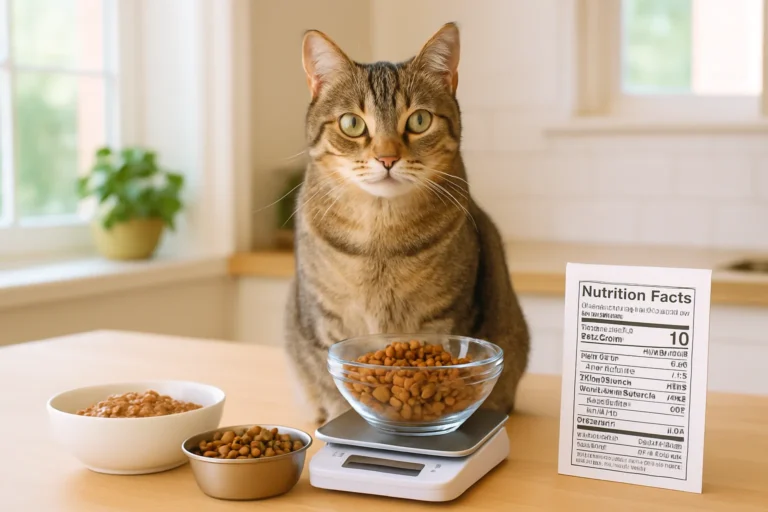
Convert the calorie target into a daily portion, divide that portion among meals, and reassess after a few weeks. Use a level measuring cup for dry food or, preferably, weigh portions on a kitchen scale.
| Step | What to do |
|---|---|
| 1 | Use current weight and, when appropriate, ideal weight. |
| 2 | Estimate daily calories from the cat feeding chart. |
| 3 | Read the food’s kcal per cup, can, pouch, kilogram, or gram. |
| 4 | Convert the calorie target into a daily portion. |
| 5 | Split the portion into meals and monitor weight and body condition. |
Cat Feeding Chart by Weight and Daily Calories
This feeding chart gives approximate daily calories for indoor, spayed or neutered adult cats at a healthy body weight. The active range is a higher starting point for cats that exercise regularly, spend time outdoors, or have a naturally high activity level. These figures are not a substitute for a veterinary feeding plan.
Use the low end when your cat is sedentary, prone to weight gain, or already has a soft body condition. Use the high end when your cat is lean, active, and maintaining weight normally. For an overweight cat, calculate portions from ideal weight rather than simply feeding for the current number on the scale.
| Cat weight | Approximate weight | Indoor adult range | More active range |
|---|---|---|---|
| 4 lb | 1.8 kg | 80–100 kcal/day | 100–140 kcal/day |
| 6 lb | 2.7 kg | 120–150 kcal/day | 150–210 kcal/day |
| 8 lb | 3.6 kg | 160–200 kcal/day | 200–280 kcal/day |
| 10 lb | 4.5 kg | 200–250 kcal/day | 250–350 kcal/day |
| 12 lb | 5.4 kg | 240–300 kcal/day | 300–420 kcal/day |
| 14 lb | 6.4 kg | 280–350 kcal/day | 350–490 kcal/day |
| 16 lb | 7.3 kg | 320–400 kcal/day | 400–560 kcal/day |
How Many Calories Per Day Does a Cat Need?
For many healthy adult cats, a broad starting estimate is about 20 to 30 calories per pound of ideal body weight per day. That places a typical 10-pound adult cat at roughly 200 to 300 kcal daily, although an indoor neutered cat may need less than an active cat of the same weight.
The answer to how many kcal per day for a cat changes with metabolism, age, activity, and body condition. A cat that spends most of the day sleeping may need the low end of the range, while a lean cat that plays frequently may need more. Spaying or neutering and a tendency to gain weight can also make the lower end more appropriate.
Calorie information is more useful than a cup measurement because foods vary widely in energy density. A feeding guide on a bag or can is a general starting recommendation, and it may provide too many calories for a sedentary cat. If your cat has diabetes, kidney disease, hyperthyroidism, digestive disease, or another medical concern, have a veterinarian set the target.
How to Convert Calories Into Cups, Cans, and Grams
Once you have a daily calorie target, divide it by the calorie density of the food. The same method works for dry food, canned food, pouches, and weighed portions.
For dry food, use: daily cups = daily calorie target ÷ kcal per cup. For wet food, use: daily cans or pouches = daily calorie target ÷ kcal per can or pouch. If the label gives kcal per kilogram, use: daily grams = daily calorie target ÷ kcal per gram. To find kcal per gram from kcal per kilogram, divide the kilogram figure by 1,000.
For example, a cat with a 240-kcal daily target eating dry food that provides 400 kcal per cup needs 0.6 cup per day. A wet food containing 120 kcal per can would provide the same cat with two cans daily. Divide either amount into the number of meals you plan to serve.
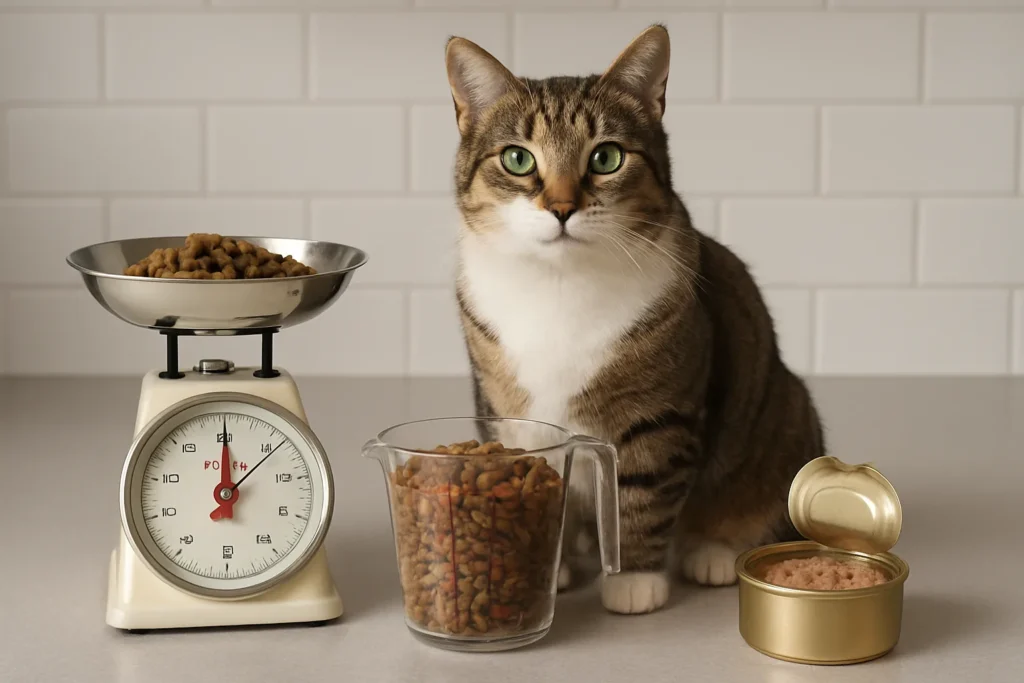
Weighing food is more consistent than filling a scoop by eye. A level cup can still vary because kibble pieces differ in size and shape, while a scale lets you repeat the same portion each day.
| Food information | Formula | Example |
|---|---|---|
| Kcal per cup | Daily kcal ÷ kcal per cup | 240 ÷ 400 = 0.6 cup |
| Kcal per can | Daily kcal ÷ kcal per can | 240 ÷ 120 = 2 cans |
| Kcal per gram | Daily kcal ÷ kcal per gram | 240 ÷ 4 = 60 g |
How Many Cups of Cat Food Per Day?
There is no single answer to how many cups of cat food per day a cat should receive because kibble calorie densities differ. Many dry foods fall roughly between 350 and 500 kcal per cup, so a 200- to 250-kcal daily target could equal about 0.4 to 0.7 cup per day.
For example, a food with 350 kcal per cup would provide 240 kcal in about 0.69 cup. A food with 500 kcal per cup would provide the same calories in about 0.48 cup. The second portion looks smaller but supplies the same energy.
A cat may need far less than a full cup, particularly if the food is calorie-dense or the cat is small and inactive. Check the label every time you change formulas. Comparing cups across brands without comparing kcal per cup can lead to accidental overfeeding or underfeeding.
| Food energy density | Portion for 200 kcal | Portion for 250 kcal |
|---|---|---|
| 350 kcal per cup | 0.57 cup | 0.71 cup |
| 400 kcal per cup | 0.50 cup | 0.63 cup |
| 500 kcal per cup | 0.40 cup | 0.50 cup |
How Much Wet Food or Mixed Feeding Per Day?
To calculate wet food, divide your cat’s daily calorie target by the kcal per can or pouch. A 10-pound adult with a 240-kcal target would need two 120-kcal cans, one 240-kcal can, or an equivalent number of pouches. Can sizes are not interchangeable, so use the calorie statement for the specific food.
For mixed feeding, assign calories to each food instead of giving a full dry portion and a full wet portion. For example, provide half of a 240-kcal target from wet food and half from dry food. If the wet food supplies 120 kcal per can and the dry food supplies 400 kcal per cup, the daily portion is one can plus 0.3 cup of dry food.
Treats, toppers, lickable snacks, and table food add to the daily total. Keep them modest and subtract their calories from the main meals when they are a regular part of the routine.
| Daily target | Wet food | Dry food | Mixed example |
|---|---|---|---|
| 240 kcal | Two 120-kcal cans | 0.6 cup at 400 kcal/cup | One 120-kcal can plus 0.3 cup of 400-kcal dry food |
How Much to Feed a Cat by Age and Life Stage
Age changes feeding priorities. A kitten needs energy for growth and usually needs more calories per pound than an adult cat. Feed a complete kitten formula according to the package directions and veterinary guidance rather than applying the adult chart to a growing body.
Kittens generally do best with several small meals because their stomachs are small and their energy needs are high. As they mature, gradually move toward an adult maintenance food and portion schedule recommended for their changing size and condition.
Adult cats usually need a measured maintenance portion based on ideal weight, activity, and body condition. Senior cats do not automatically need less food; their portion should reflect weight, muscle condition, activity, and any health concerns. A veterinarian can help adjust the diet if a senior cat is losing muscle or gaining fat.
Pregnant or nursing cats can need substantially more food and a growth-oriented diet. Use a kitten or reproduction-appropriate formula and veterinary guidance during pregnancy and lactation rather than relying on an adult maintenance chart.
| Life stage | Feeding approach |
|---|---|
| Kitten | Use complete kitten food, higher energy density, and several small meals. |
| Adult | Use a measured maintenance portion based on ideal weight and body condition. |
| Senior | Adjust for muscle, weight, activity, and health rather than age alone. |
| Pregnant or nursing | Use appropriate growth or reproduction nutrition with veterinary guidance. |
How Often Should Cats Eat Each Day?
Kittens commonly need three or more small meals each day, while many adult cats do well with two or three measured meals. Seniors can follow an adult schedule if they maintain weight and appetite, but some benefit from smaller, more frequent portions.
Scheduled meals make it easier to track how much food your cat actually eats and to notice changes in appetite. They can also help with portion control when free access to calorie-dense dry food leads to overeating. Automatic feeders can divide a measured daily amount into several servings, but the total for the day still matters.
Cats with a sensitive stomach, increased appetite, or a need for frequent medication-related meals may do better with smaller portions spread throughout the day. If a cat suddenly refuses food or begins eating much more than usual, investigate the change with a veterinarian rather than only changing the feeding schedule.
| Cat | Typical starting schedule |
|---|---|
| Kitten | Three or more small meals daily |
| Adult | Two or three measured meals daily |
| Senior | Two or more meals, adjusted for appetite and condition |
Signs You Should Adjust the Amount
A feeding chart is a starting point, not a permanent prescription. Weigh your cat periodically and look for gradual changes in body shape. A healthy body condition generally includes a visible waist from above and ribs that can be felt under a light covering of fat; pronounced bones or a widening waist suggest that the plan needs review.
If your cat gains or loses weight over several weeks, adjust the daily calories gradually and reassess. Do not make large changes without guidance, especially for an overweight cat. Recheck the label if you changed foods, because a different kcal-per-cup or kcal-per-can value changes the portion even when the calorie target stays the same.
Food left behind, persistent hunger, lower energy, changes in play, and a recent change in activity can all provide useful context. Sudden appetite changes, rapid weight loss or gain, vomiting, diarrhea, marked lethargy, or increased thirst warrant prompt veterinary advice.
| What you notice | Useful response |
|---|---|
| Gradual weight gain | Review treats and portions, then consider a modest calorie reduction. |
| Gradual weight loss | Check intake and food calories, then seek advice if the change continues. |
| Food consistently left behind | Recheck freshness, appetite, meal size, and possible health changes. |
| Sudden appetite or weight change | Contact a veterinarian rather than relying only on a feeding adjustment. |
Common Cat Feeding Mistakes
The most common error is treating a weight chart as an exact prescription. It is more reliable to use the chart to establish calories, convert those calories using the label, and then adjust for the individual cat’s body condition.
Avoid these mistakes when setting a daily portion:
- Feeding for a cat’s current overweight body weight instead of discussing an ideal target weight.
- Ignoring calories from treats, toppers, table food, and flavored supplements.
- Switching foods without checking the new kcal per cup, can, pouch, or gram.
- Using an unlevel scoop or eyeballing portions instead of measuring consistently.
- Free-feeding calorie-dense dry food without tracking how much the cat consumes.
Build the Portion Around Calories, Then Adjust
The best answer to how much cat food per day begins with ideal weight and a reasonable calorie target. From there, the food label tells you whether that target equals a fraction of a cup, a number of cans, a pouch, or a measured number of grams.
Serve the daily amount in a consistent meal schedule, include treats in the total, and monitor weight and body condition. Recalculate portions whenever you change foods or your cat’s life stage, activity, or health status changes.
How many calories per day does a 10-pound cat need?
A 10-pound adult cat may start around 200 to 250 kcal per day if it is an indoor, spayed or neutered cat, while a leaner or more active cat may need closer to 250 to 350 kcal. Use ideal weight and monitor body condition rather than treating the range as an exact prescription.
How much should a kitten eat per day?
Kittens need more calories per pound than adult cats and should eat a complete kitten formula in several small meals. Follow the food label’s growth-feeding directions and veterinary guidance because the appropriate amount changes quickly with age, size, and growth rate.
Is wet food better than dry food for portion control?
Neither format automatically provides better portion control. Wet food is often divided by cans or pouches, while dry food can be measured by cup or gram. In both cases, compare the food’s kcal per can, pouch, cup, or gram and measure the daily total.
How many times a day should a cat eat?
Many adult cats do well with two or three measured meals daily. Kittens generally need three or more smaller meals, and some senior or medically managed cats may benefit from more frequent portions. The total daily amount is more important than a single universal schedule.