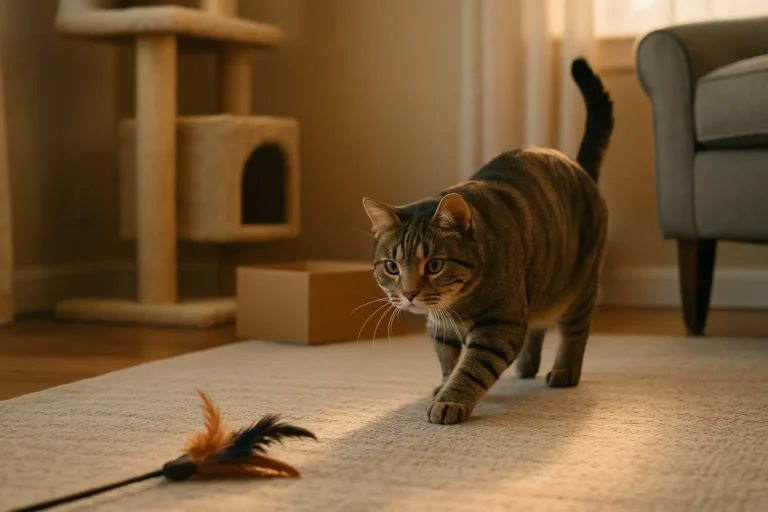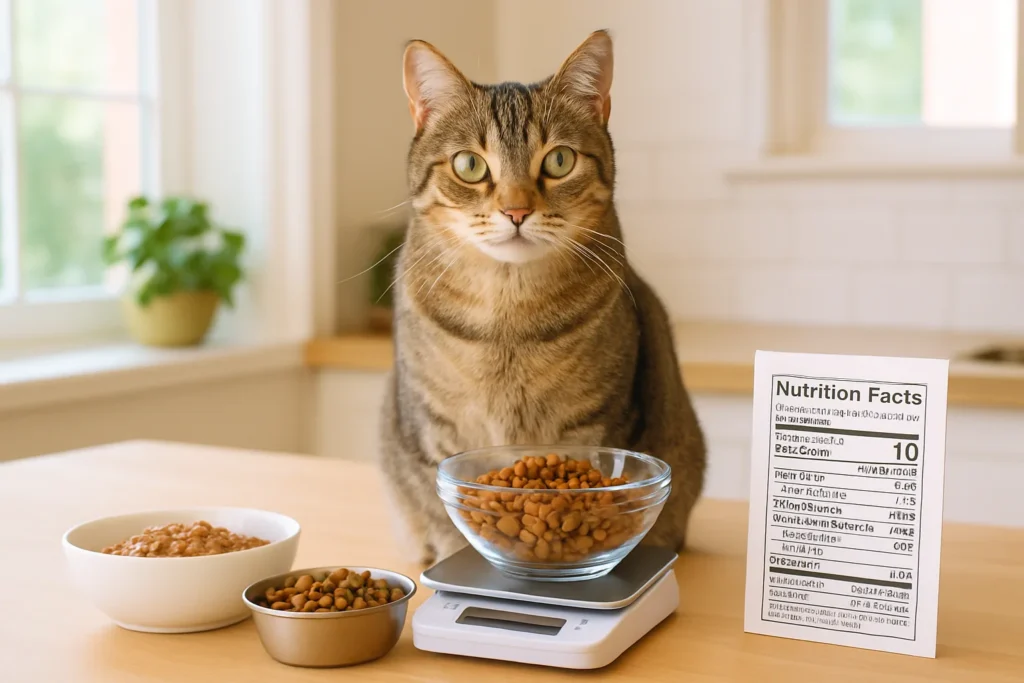
How many calories does a cat need in a day? There is no single number that fits every cat, but most adult cats need a moderate daily amount influenced by body size, activity, age, reproductive status, and body condition. An indoor neutered cat may need less energy than an active outdoor cat of the same weight.
The most useful approach is to begin with a weight-based estimate, compare it with your cat’s ideal body condition, and then adjust according to weight trends. This guide explains how many calories a cat needs per day in practical terms, how to read food labels, and when individualized veterinary advice is important.
Start With a Simple Daily Calorie Range for Most Cats
Daily cat calorie needs vary enough that a universal chart can mislead. A smaller, sedentary indoor cat generally needs less energy than a larger, muscular, highly active cat. Use any general range as a starting point rather than a promise that the same amount will maintain every cat.
A practical rule of thumb is to think in calories relative to body weight, using either pounds or kilograms. The estimate should then be refined for activity, neuter status, age, and body condition. A cat carrying excess fat should not automatically receive calories based on its current weight if the goal is gradual weight reduction.
Indoor and neutered cats often use less energy because they may move less and have lower daily energy demands. Active or intact cats may need more. Feeding directions on a package can provide a useful starting point, but they are not a final answer because they cannot account for every cat’s metabolism and lifestyle.
How to Estimate Your Cat’s Calories Step by Step
Veterinary nutrition uses two related ideas. Resting energy requirement, or RER, is the energy a cat needs for basic body functions while resting. Maintenance energy requirement, or MER, builds on that foundation and reflects the energy needed for a particular cat’s normal life, including movement, age, reproductive status, and health.
To estimate a daily target, first identify your cat’s weight in pounds or kilograms. Next, consider the ideal weight rather than the current weight when excess body fat is present. A veterinary professional can help identify an appropriate target if the cat is overweight, underweight, growing, or affected by illness.
The final step is choosing an adjustment for the cat’s life stage and lifestyle. A calm indoor adult, an active adult, a kitten, and a senior cat should not automatically receive the same maintenance estimate per unit of body weight. The result is a starting target that must be checked against body condition and weight changes.
Online cat calorie calculator tools can make the arithmetic easier, but they do not replace judgment. A calculator cannot reliably assess muscle mass, body condition, disease, medication effects, or whether a weight-loss target is appropriate.
- Record current weight and, when relevant, an ideal target weight.
- Classify the cat as a kitten, adult, or senior and note activity level.
- Account for indoor living, neuter status, body condition, and health history.
- Use the estimate as a starting point and monitor the cat’s response.
Cat Calories per Day by Weight
Weight-based estimates are useful for answering questions such as how many calories a cat needs per day, but weight alone does not determine the correct target. Two cats at the same weight can have different muscle mass, activity levels, and body-condition scores.
An 8-pound adult cat will generally need less energy than a 10-pound adult cat, while a 12-pound cat may need more if that weight represents a lean, active body. If the 12-pound cat is overweight, however, feeding for its ideal target weight may be more appropriate than feeding for its current scale weight.
For smaller and larger adult cats, the same principle applies: begin with a weight-based estimate, then adjust for lifestyle and body condition. The phrase cat calories per kg describes the same process using metric weight, but it should not be treated as a fixed requirement for every cat.
A 12-pound cat’s calories per day therefore cannot be determined from the number 12 alone. Its age, activity, reproductive status, body composition, and health all affect the maintenance target.
What Changes a Cat’s Calorie Needs?
Calorie needs change because cats differ in how much energy they use and how efficiently they use it. A feeding plan should reflect the whole cat, not just the number on the scale.
Indoor cats often have fewer opportunities for spontaneous movement than cats that roam or spend substantial time outdoors. Neutered adult cat calories may also be lower than those for an intact cat with a similar body size. These are tendencies, not rules, so the cat’s actual body condition remains the deciding feedback.
Kittens need energy for growth and should be fed according to a growth-appropriate plan rather than an adult maintenance target. Adult cats generally need a stable maintenance plan. Senior cat calorie needs vary: some older cats become less active, while others lose weight or muscle and need an assessment rather than an automatic reduction.
Activity level and muscle mass matter as well. A lean, athletic cat may require more energy than a less active cat of the same weight. Body condition score and the desired weight goal are especially important when a cat is overweight or underweight.
Health conditions and medications can change appetite, digestion, or energy use. A noticeable change in eating, drinking, weight, or body condition deserves veterinary attention instead of an unsupervised calorie adjustment.
- Indoor or outdoor lifestyle
- Neutered or intact status
- Kitten, adult, or senior life stage
- Daily activity and muscle mass
- Current body condition and target weight
- Health conditions and medications
How Many Calories Should an Indoor Cat Eat Daily?
An indoor adult cat commonly needs a moderate maintenance intake, but the correct amount depends on body size, activity, and body condition. A quiet indoor cat may need less than an active cat of the same weight, especially after neutering.
Indoor cats are often overfed because treats, free-choice dry food, and generous portions are easy to overlook. Food should be measured, and all extras should be considered part of the daily calorie total.
If an indoor cat is overweight, estimate needs from an appropriate ideal target weight rather than simply using its current weight. Make changes gradually and monitor weight, waistline, and overall condition. Sudden loss of appetite or rapid body changes should be discussed with a veterinarian.
How Many Calories Does a Cat Need to Lose Weight?
A cat’s weight-loss plan should begin with an appropriate ideal target weight, not an aggressive restriction based only on the current scale reading. The goal is a conservative reduction that preserves health and can be maintained consistently.
Crash dieting is risky for cats. Do not make a severely overweight cat go without food or impose a drastic portion cut without veterinary guidance. A veterinarian can assess body condition, check for contributing health issues, and set a suitable feeding plan.
Weigh the cat consistently and look for gradual progress rather than demanding an immediate dramatic change. If weight is not moving, portions, treats, food choice, activity, and medical factors may need review. If the cat loses weight unexpectedly or stops eating, seek veterinary advice promptly.
- Use an ideal target weight when estimating the plan.
- Reduce intake conservatively rather than restricting food sharply.
- Count treats and table food in the daily total.
- Monitor weight and body condition regularly.
- Use a veterinary-guided plan for substantial obesity or medical concerns.
Convert Calories Into Actual Food Portions
Once you have a daily calorie target, read the food label for its energy statement. Look for calories per can, pouch, cup, kilogram, or another stated unit. The target is then divided by the calories in the chosen unit to determine the day’s portion.
Wet food and dry food can have very different calorie densities. A can or pouch may contain a complete daily amount for one cat or only part of it, while a small volume of dry food can contain substantial energy. Compare the calorie statement rather than judging portions by volume alone.
For mixed feeding, add the calories from the wet and dry portions together and reserve part of the daily total for treats. A kitchen scale is especially useful for dry food because measuring cups can be inconsistent. Divide the daily portion among meals that suit your cat and household routine.
- Find the label’s kcal information for the exact food.
- Choose the daily calorie target for the individual cat.
- Allocate calories between wet food, dry food, and treats.
- Measure portions consistently, preferably by weight for dry food.
- Recheck the plan if body weight or condition changes.
Sample Daily Calorie Examples for Common Cats
Examples are most useful for showing how the framework works, not for assigning one precise number to every cat. The same 10-pound body weight can describe a quiet indoor neutered adult, an active lean cat, or an overweight cat whose target weight is lower.
For an average 10-pound indoor neutered adult, begin with a conservative maintenance estimate and compare it with body condition. If the cat steadily gains weight, the portion may be too large; if the cat loses weight without that being the goal, the plan needs review.
An active 10-pound cat may use more energy than the indoor example because movement and muscle mass increase demand. A 12-pound lean adult may likewise need more than a smaller cat, while a 12-pound overweight cat may need a plan based on its ideal target weight.
Is 200 calories a day enough for a cat? It may be suitable for some cats and too much or too little for others. The answer depends on the cat’s size, life stage, activity, body condition, and health, so the number should be evaluated alongside weight trends rather than in isolation.
For a cat beginning a weight-loss plan, the appropriate intake should be set from the desired target and adjusted gradually. Veterinary guidance is particularly important if the cat is substantially overweight, has medical problems, or shows reduced appetite.
How to Tell if You Need to Increase or Decrease Calories
Monitor the plan using consistent weigh-ins, a visual assessment of the waistline, and the feel of the ribs under the coat. A single weight reading is less informative than a pattern recorded under similar conditions.
If the cat is gaining unwanted weight, portions and extras may need to decrease modestly. If the cat is losing weight unexpectedly, appears unwell, or is not maintaining muscle, stop making independent changes and contact a veterinarian.
Make one small adjustment at a time so you can tell what caused the response. Reassess after enough time has passed to identify a trend, while checking sooner if there is a marked change in appetite, energy, or health. Kittens, seniors, and cats with medical conditions may require closer supervision.
- Record weight consistently.
- Check the waistline and rib coverage.
- Count every meal, treat, and food supplement.
- Adjust portions gradually.
- Seek veterinary advice for unexpected changes or poor appetite.
A Practical Way to Set Your Cat’s Daily Calories
The answer to how many calories cats need each day starts with body weight but does not end there. Use a weight-based estimate, consider life stage and lifestyle, translate the target into measured portions, and then judge the plan by body condition and weight trends.
Because calorie needs can change with growth, aging, illness, medication, and weight goals, individualized veterinary guidance is the safest choice when the answer is unclear. A steady, measured plan is more useful than chasing one universal number.
Is 200 calories a day enough for a cat?
It may be appropriate for some cats but not for every cat. Size, activity, life stage, body condition, and health determine whether that intake supports maintenance, causes weight gain, or is insufficient.
How many calories does a 12-pound cat need per day?
A 12-pound cat does not have one automatic calorie requirement. A lean active cat may need more than a sedentary cat, while an overweight cat may need a plan based on its ideal target weight. Monitor the result and ask a veterinarian for an individualized target.
How many calories should a cat eat to lose weight?
Weight-loss calories should be estimated from an appropriate ideal target weight and reduced conservatively. Because crash dieting is unsafe, a veterinarian should guide plans for substantial obesity, illness, poor appetite, or unexpected weight change.