Lists of the worst dog breeds for cats can be useful as a starting point, but breed alone cannot predict whether an individual dog will live safely with a cat. Prey drive, previous experience, arousal, impulse control, training, age, and the household environment all affect the outcome.
The breeds sometimes described as the worst dog breeds with cats generally come from groups developed to pursue, catch, track, control, or react quickly to moving animals. Those inherited tendencies can increase risk, but they do not make every member of a breed unsafe or remove the need to evaluate the specific dog.
How to think about the worst dog breeds for cats
Incompatibility with cats can mean more than physical injury. A dog may be a poor match if it repeatedly chases, stalks, corners, mouths, or blocks a cat, or if its presence causes the cat to hide, stop using shared rooms, avoid the litter box, or live under chronic stress.
Breed tendencies affect probability rather than certainty. A breed developed for independent hunting may contain more individuals with intense pursuit behavior, while a breed selected for close cooperation may be easier to redirect, but there can still be substantial variation within either group.
The search phrase “dog breeds that kill cats” reflects a serious fear, but it should not be treated as a literal category of breeds. Any sufficiently large or determined dog can injure a cat, while the greatest concern is an individual dog that shows predatory fixation, explosive pursuit, poor disengagement, or a history of harming small animals.
- A higher-risk breed background should prompt more careful screening rather than an automatic judgment.
- A calm history around one familiar cat does not guarantee the same response to every cat.
- A dog that does not attack may still be incompatible if it chronically frightens or harasses the resident cat.
- Safe coexistence depends on the cat having secure territory, escape routes, and reliable access to essential resources.
Why some dogs are a higher risk around cats
Prey drive describes a cluster of behaviors associated with locating, watching, pursuing, catching, or biting prey. Different breeds and individuals express different parts of this sequence, so one dog may stare and stalk while another immediately chases movement.
Cats can activate pursuit because they are small, fast, and likely to run or leap when alarmed. A dog that appears calm beside a motionless cat may react very differently when the cat sprints down a hallway, jumps from furniture, or vocalizes during a conflict.
Trigger stacking can make reactions more intense. Excitement from visitors, outdoor wildlife, play, frustration behind a gate, or insufficient rest may raise arousal until the dog has much less impulse control around the cat.
| The risk factor is described here. | Its relevance to cats is explained here. |
|---|---|
| Strong pursuit behavior is a significant risk factor. | The dog may accelerate after a fleeing cat before responding to a cue. |
| Movement sensitivity is a significant risk factor. | Running, jumping, or tail movement may trigger stalking or chasing. |
| A grab-and-shake motor pattern is a significant risk factor. | Some terrier lines may escalate rapidly after making contact with a small animal. |
| Independent hunting behavior is a significant risk factor. | The dog may persist without looking to a person for direction. |
| High arousal and weak impulse control are significant risk factors. | The dog may struggle to disengage even when it knows basic obedience cues. |
| Large size and high speed are significant risk factors. | A brief chase or single collision can seriously injure a cat even without predatory intent. |
Dog groups that are often the worst fit for homes with cats
The groups most likely to be challenging are those developed for pursuit, vermin control, independent hunting, livestock control, or demanding physical work. Their original functions do not determine every dog’s behavior, but they help explain why careful assessment matters.
Dogs from high-risk groups may still coexist with cats when they have suitable temperaments and verified experience. However, cat owners should not assume that training can completely remove an established predatory response.
- Northern breeds and sled dogs may combine independence, stamina, speed, and strong interest in small animals.
- Sighthounds were developed to detect and pursue moving animals, so a running cat can be a powerful trigger for some individuals.
- Terriers developed for vermin control may pursue, grab, and persist after small animals with little hesitation.
- Scenthounds and tracking breeds may become absorbed in following an animal, although their responses to household cats vary widely.
- Herding breeds may stalk, chase, circle, or nip cats, which can cause stress even when the behavior is not predatory.
- High-drive bully-type or working lines can present serious management challenges when intense arousal, persistence, poor impulse control, and physical strength occur together.
- A breed’s working label should never replace observation because dogs within the same group can differ markedly in prey drive and responsiveness.
Breed examples often listed among the worst dog breeds with cats
The following examples frequently appear in discussions of dog breeds that may not do well with cats. Inclusion does not mean that every individual is dangerous, and exclusion does not guarantee that another breed will be safe.
A dog’s actual conduct around cats, its behavioral history, and the owner’s ability to maintain separation are more informative than a breed name by itself.
1. Siberian Huskies require careful screening.
Siberian Huskies are athletic northern dogs with speed, stamina, and an independent working background. Some display strong predatory interest in cats or wildlife, particularly when a small animal runs.
A Husky raised calmly with cats may be more manageable than an adult with an established chase history, but early exposure is not a guarantee. Secure barriers, controlled introductions, and honest assessment of fixation are essential.
2. Alaskan Malamutes can present substantial physical risk.
Alaskan Malamutes share several risk factors with other northern working breeds, including strength, independence, and potential prey drive. Their size means that a chase, pin, or grab can have severe consequences for a cat.
Owners should look beyond basic obedience and ask whether the dog can remain relaxed when a cat runs, jumps, or appears unexpectedly.
3. Greyhounds and other sighthounds vary in cat compatibility.
Sighthounds were developed to notice and pursue movement, which can make outdoor or running cats highly stimulating. Greyhounds from racing or coursing backgrounds may also have limited prior exposure to household cats.
Some Greyhounds pass careful cat assessments and live peacefully with indoor cats, while others remain unsafe around small animals. Scottish Deerhounds, Irish Wolfhounds, and other large sighthounds require the same individual evaluation, with additional attention to their size and reach.
4. Jack Russell Terriers may have intense pursuit behavior.
Jack Russell Terriers and similar working terriers were developed to locate and confront small quarry. Their quick reactions, persistence, and potential grab-and-shake behavior can make them challenging companions for cats.
Some terriers raised with cats coexist successfully, but owners should not dismiss repeated stalking or chasing as harmless play simply because the dog is small.
5. Australian Cattle Dogs may control cats through chasing or nipping.
Australian Cattle Dogs are alert, energetic herding dogs that may respond strongly to movement. Stalking, rushing, body blocking, heel nipping, or attempting to control a cat’s location can make a shared home stressful.
These dogs often benefit from structured activity and training, but mental and physical exercise do not automatically eliminate cat-directed behavior.
6. Beagles and other hounds may become absorbed in pursuit.
Beagles and other scent-driven hounds vary considerably around cats. Some treat resident cats as family members, while others become highly excited by scent, vocalize, follow persistently, or chase.
Their risk should be judged through observed behavior rather than the assumption that a sociable temperament automatically extends to small animals.
7. Samoyeds may combine sociability with strong chase interest.
Samoyeds are often friendly with people, but friendliness does not necessarily predict behavior toward cats. Some individuals have substantial prey drive, quick pursuit responses, and enough size to injure a cat during an uncontrolled interaction.
Prospective owners should seek verified information about the individual dog’s response to both calm and moving cats.
8. Every breed contains meaningful individual variation.
A dog from a breed not mentioned here can still be unsafe if it fixates, chases, grabs, or cannot disengage from cats. Conversely, a carefully assessed member of a higher-risk breed may live calmly with a familiar cat under appropriate management.
These examples should function as prompts for closer evaluation rather than as predictions about every dog.
When a specific dog may be safer than its breed reputation suggests
A verified history of relaxed coexistence is one of the most useful indicators when choosing a dog for a home with cats. An adult dog living in a foster home with cats can often be evaluated more realistically than a dog observed only during a brief shelter test.
Puppies raised with confident, dog-experienced cats may learn appropriate boundaries, but maturity can change prey drive and arousal. Owners should continue supervising rather than assuming that early familiarity guarantees lifelong safety.
Lower-arousal individuals may notice a cat without becoming rigid or fixated. The ability to turn away, respond to a name, take food gently, settle behind a barrier, and recover quickly from movement can all lower practical risk.
- The dog has a documented history of living calmly with indoor cats over an extended period.
- The dog can notice a moving cat and voluntarily disengage without escalating.
- The dog responds reliably to recall, leave-it, place, and interruption cues under mild distraction.
- The dog remains relaxed behind a gate instead of staring, whining, lunging, or attempting to break through.
- The breeder, foster carer, or rescue provides detailed behavioral observations rather than a vague cat-friendly label.
- The household can maintain secure separation whenever direct supervision is unavailable.
How cat owners should evaluate a dog before bringing it home
Learning how to tell if a dog is safe around cats begins with collecting specific history. Ask whether the dog has lived with cats, how long that arrangement lasted, whether the cats moved freely, and whether chasing, staring, barking, pinning, or resource guarding occurred.
A shelter description such as “good with cats” should be treated as one piece of information rather than a guarantee. A brief visual test may show that a dog can remain calm in one controlled moment, but it may not reveal reactions to running, nighttime movement, food, narrow hallways, or prolonged access.
No assessment should place a cat within reach of an unknown dog merely to test the dog’s reaction. Evaluations should use distance, secure barriers, experienced handlers, and gradual exposure without deliberately frightening the cat.
- Ask whether the dog has ever chased, caught, injured, or killed wildlife, livestock, small dogs, or cats.
- Ask whether previous cat exposure occurred indoors, outdoors, through a barrier, or during direct contact.
- Watch for hard staring, a closed mouth, forward weight, trembling, whining, lunging, stalking, or an inability to look away.
- Notice whether the dog becomes more intense when a cat changes direction, jumps, vocalizes, or runs.
- Consider whether the resident cat is confident and dog-experienced or fearful, elderly, disabled, or likely to flee.
- Confirm that the home has separate rooms, sturdy gates, closable doors, vertical cat routes, and protected feeding and litter areas.
- Choose an energy and play-style match that will not force the cat to endure constant attention.
- Be realistic about whether everyone in the home can follow the same supervision and barrier rules for months or permanently.
How to introduce a dog to a cat safely
Introducing a dog to a cat should begin with complete separation. Each animal needs a secure area containing food, water, resting places, and other essential resources, while bedding or soft items can be exchanged to make the other’s scent familiar.
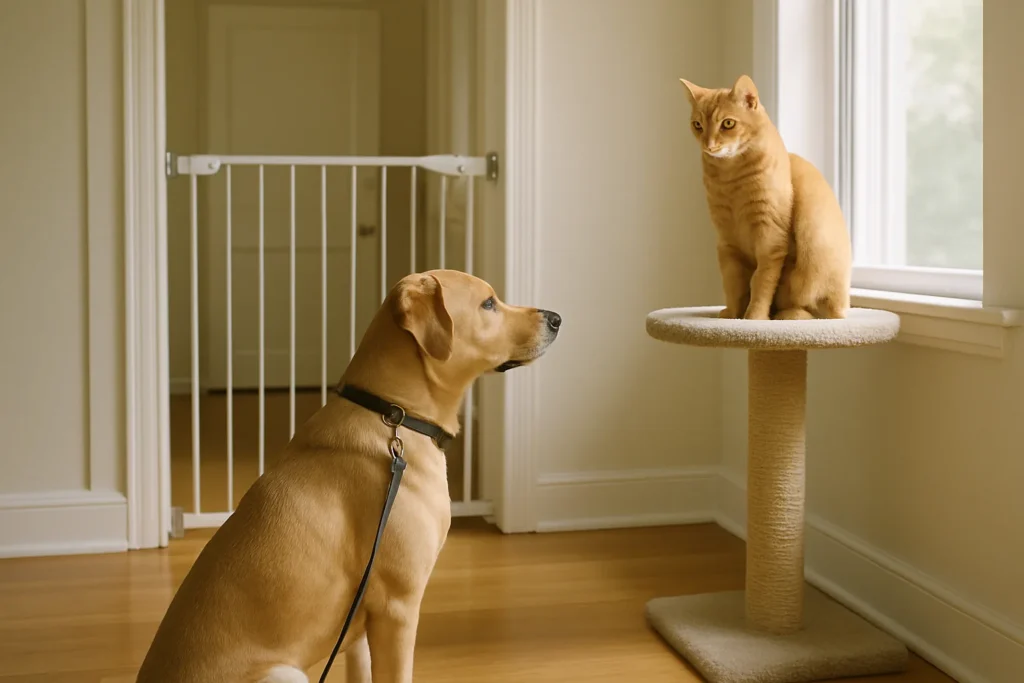
Initial visual exposure should occur through a sturdy barrier and at enough distance for both animals to remain calm. The dog can be leashed as an additional safeguard, but the leash should not replace a gate, door, or other reliable physical boundary.
Reward the dog for soft body language, checking in with the handler, responding to cues, and choosing to look away from the cat. Keep sessions brief and end before either animal becomes distressed or overexcited.
- Provide the cat with elevated perches and escape routes that do not require passing close to the dog.
- Use a crate only if the dog is already comfortable and relaxed inside it, and never allow the cat to approach a frustrated confined dog.
- Prevent every chase because rehearsing pursuit can strengthen the behavior and frighten the cat.
- Increase proximity only when the dog consistently disengages and the cat is eating, grooming, exploring, and using resources normally.
- Slow the process if the dog stares, stiffens, vocalizes, surges forward, ignores food, or stops responding to familiar cues.
- Slow the process if the cat crouches, hides continuously, swats defensively, stops eating, avoids the litter box, or cannot move comfortably through the home.
- Maintain separation whenever no responsible adult is actively supervising until long-term behavior supports greater freedom.
- Accept that unrestricted access may never be appropriate for a dog with persistent predatory behavior.
Signs a dog may not be safe to live with cats
Dogs that chase cats are not all motivated by the same thing, but repeated high-intensity pursuit is unsafe regardless of whether the cause is predation, play, frustration, or overarousal. The cat should not be used to diagnose the dog’s motivation through further uncontrolled exposure.
Predatory behavior can be quiet and focused rather than noisy or bouncy. Hard staring, slow stalking, a closed mouth, sudden acceleration, and attempts to grab can be especially concerning, although body-language signals must be interpreted together rather than in isolation.
Professional help is appropriate when intensity increases, barriers are failing, the cat’s welfare is declining, or the dog cannot disengage. A qualified reward-based trainer with cat-dog integration experience or a veterinary behavior professional can assess risk, but some situations require permanent separation or rehoming rather than additional introductions.
- The dog repeatedly freezes, stares, stalks, or tracks the cat’s every movement.
- The dog explodes into pursuit whenever the cat runs or jumps.
- The dog slams into, climbs, chews, or attempts to bypass barriers.
- The dog becomes more intense over time despite distance, reinforcement, and careful management.
- The dog refuses high-value food and cannot respond to well-practiced cues near the cat.
- The dog has previously caught or seriously injured cats or other small animals.
- The cat cannot eat, rest, play, explore, or use the litter box without monitoring the dog.
- Household members cannot maintain the physical separation required to prevent contact.
Best use of this list: avoiding poor matches, not labeling every dog
Cat owners can use breed background as an initial filter, particularly when they have several possible dogs to choose from. Selecting an adult with low arousal and a verified record around cats may be simpler and safer than attempting to manage an unknown high-drive dog.
The resident cat’s temperament also changes the equation. A confident, dog-experienced cat that holds its ground may trigger less pursuit than a fearful cat that bolts, but no cat should be expected to correct, train, or defend itself against a dog.
Some homes can support lifelong use of gates, separate rooms, leashes, rotations, and supervised access. Other households need animals that can eventually share space with minimal management, making a lower-prey-drive individual the more realistic choice.
- Breed risk should guide screening without replacing an individual behavioral assessment.
- A cat-friendly reputation should never excuse fixation, chasing, or poor impulse control.
- Successful coexistence should be measured by both animals feeling safe, not merely by the absence of injury.
- Owners should choose the dog whose demonstrated behavior fits their cat, home layout, experience, and management capacity.
Choose the individual dog, then manage the household.
The worst dog breeds for cats are more accurately understood as breeds or working groups with a higher probability of pursuit, fixation, or difficult-to-control arousal. Northern breeds, sighthounds, terriers, hounds, herding dogs, and powerful high-drive working lines may warrant extra caution, but no breed label provides certainty.
The safest decisions combine breed awareness with verified history, careful observation, protected cat spaces, gradual introductions, and realistic supervision. When a dog shows persistent predatory interest or the cat cannot live normally, permanent separation or a different household match may be the responsible outcome.
Frequently Asked Questions
Which dog breeds are not good with cats?
Breeds with strong pursuit, hunting, or vermin-control backgrounds may be harder to place with cats, including some Siberian Huskies, Alaskan Malamutes, sighthounds, working terriers, and other high-drive dogs. However, individual behavior and verified experience around cats are more useful than breed alone.
Can a high prey drive dog ever live safely with a cat?
Some high prey drive dogs live with familiar cats under careful management, especially when they have a long history of calm coexistence and can reliably disengage. A dog showing intense fixation, explosive pursuit, or attempts to grab a cat may require permanent separation, and training cannot guarantee that predatory behavior will disappear.
Are terriers always bad with cats?
Terriers are not always bad with cats, but some have inherited pursuit, grabbing, and persistence associated with vermin control. A terrier’s history, arousal, response to movement, and ability to disengage should be evaluated before direct access to a cat is considered.
Why are huskies so often mentioned in articles about cats?
Siberian Huskies are frequently mentioned because some individuals combine speed, stamina, independence, and strong prey drive. Some Huskies do live peacefully with cats, but early socialization alone does not guarantee safety, so verified history and controlled observation remain essential.
What should I do if my dog chases my cat?
Separate the animals immediately with secure doors or gates, prevent further chasing, and give the cat protected resources and elevated escape spaces. Reintroduce them only through a structured plan at a safe distance, and consult a qualified trainer or veterinary behavior professional if the dog fixates, lunges, cannot disengage, or has made physical contact.