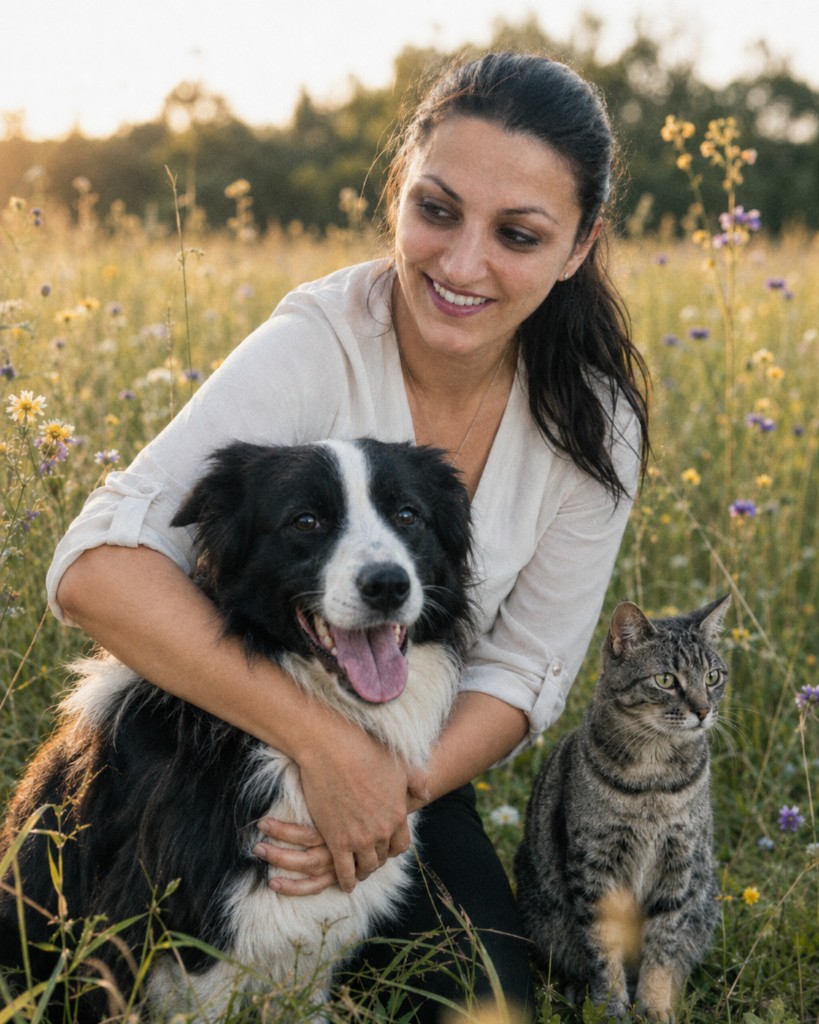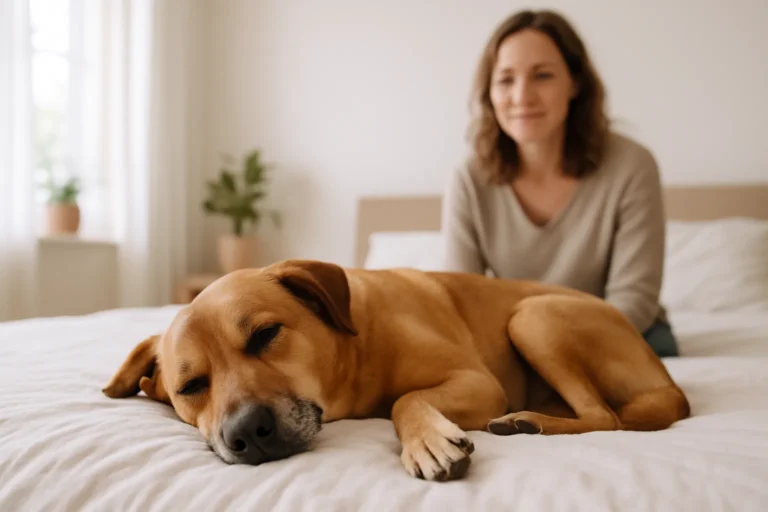
If you wonder why does my dog sleep touching me, the simplest answer is that your body feels safe, warm, and familiar while your dog is vulnerable. A dog sleeps pressed against me because physical contact can provide reassurance as well as companionship.
This behavior is usually normal and affectionate, but its meaning depends on the whole pattern. Pack-style sleeping instincts, thermoregulation, attachment, routine, and anxiety can all play a part, so the key is to notice whether your dog can also relax and settle independently.
What it usually means when your dog sleeps against you
When a dog sleeps against a person, it commonly reflects trust and comfort rather than a problem. Sleep leaves a dog less alert to its surroundings, so choosing close contact can mean your dog feels secure enough to relax beside you.
Dogs also have social sleeping instincts that developed from resting near members of their group. Modern dogs do not need to follow a strict pack hierarchy to enjoy this closeness, but shared rest can still feel natural and reassuring.
Warmth is another straightforward explanation. Your body is a dependable resource of warmth and safety, especially for short-coated dogs, puppies, older dogs, or dogs resting in a cool room.
The behavior may also be part of a routine that combines affection, a comfortable sleeping surface, and attention before bedtime. Context matters more than one single reason, so consider your dog’s age, personality, environment, and behavior when awake.
The most common reasons dogs sleep pressed against their people
Several motivations can overlap when your dog settles against you. Identifying the surrounding details can help you understand which explanation best fits your dog’s sleep habit.
- Your dog may choose contact because your presence lowers uncertainty and helps the body relax into deeper sleep.
- Your body heat may be especially appealing after exercise, during cold weather, or when your dog prefers a warm, enclosed sleeping place.
- Attachment can make your dog seek you out for comfort, affection, and the familiar scent associated with home and safety.
- Some dogs rest near their person while remaining mildly watchful, particularly in unfamiliar settings or when household sounds make them alert.
- The behavior can become a habit if sleeping against you consistently leads to petting, praise, bed access, or other rewarding attention.
- Breed, age, and personality influence the preference because companion breeds may seek frequent contact, while independent dogs may show affection with less physical closeness.
Why some dogs want to sleep on you, not just next to you
A dog wants to sleep on me when lying on top of your legs, chest, or lap offers the greatest amount of contact. The position may provide physical reassurance, warmth, your familiar scent, and the feeling of being enclosed by a trusted person.
Small dogs are particularly likely to climb onto laps or torsos because their size makes this position easy and because many have been bred for close human companionship. Larger dogs can do the same when they have learned that their person welcomes the behavior.
Sleeping on you may be mainly a heat-seeking choice, but it can also soothe mild stress or invite attention. Look at your dog’s body language: a loose body, soft eyes, normal breathing, and easy movement away suggest a comfortable preference.
Dependence becomes more concerning when your dog cannot settle beside you, becomes distressed when moved, or demands contact throughout the day. You can preserve affection while teaching a nearby settle spot if the behavior interferes with sleep or independence.
Does this mean you are your dog’s favorite person?
Dogs often choose the person connected with safety, predictable routines, calm interactions, and positive experiences. Sleeping near you can indicate a strong bond, but it does not prove that you are your dog’s only or absolute favorite person.
Feeding is only one part of a dog’s preference. A dog may sleep beside the person who provides the calmest body heat, moves least at night, offers the most soothing touch, or has shared the sleeping routine for the longest time.
Other signs of a bond include following you without frantic behavior, checking in during walks, relaxing in your presence, seeking you for comfort, responding readily to your cues, and choosing to interact with you when other options are available.
To understand how bonded your dog is, look for a balanced relationship rather than constant contact. A securely attached dog can seek you out and still eat, rest, play, and remain calm when you are in another room.
Why your dog sleeps next to you, at your feet, or with their body pressed into you
Sleep position meaning is best interpreted as a clue rather than a fixed translation. Temperature, available space, confidence, physical comfort, and attachment can all influence where your dog settles.
| Sleep position | What it may suggest |
|---|---|
| Pressed against your side | Your dog may be seeking social contact, reassurance, warmth, or a familiar boundary while resting. |
| At your feet | Your dog may want to stay close while preserving more space, avoiding movement near the upper body, or keeping a cooler position. |
| On your legs or chest | Your dog may prefer maximum contact, a warm surface, elevated closeness, or the soothing rhythm of your breathing. |
| Lightly touching you | A paw, back, or shoulder resting against you may provide reassurance without requiring full-body contact. |
| Leaning heavily into you | Heavy leaning can reflect comfort and affection, but stiffness, guarding, or inability to move away should be assessed in context. |
Why your dog may choose you over someone else in the bed
If your dog sleeps on you and not your husband or another household member, the choice may be practical rather than personal. Differences in body heat, sleeping position, movement, blankets, and mattress space can make one person more comfortable.
Your dog may also associate you with a calmer bedtime routine or with comfort during storms, illness, travel, or other stressful events. Past reinforcement matters too, because the person who has consistently allowed cuddling may become the preferred nighttime contact.
This preference does not necessarily mean your dog has a stronger overall bond with you. Dogs can choose one person for sleeping, another for play, and another for training or outdoor activities.
When sleeping close is normal and when it starts to look like clinginess
Normal affection usually comes with a relaxed body and flexible independence. Your dog may enjoy sleeping against you but should generally be able to move to another bed, settle in a different room, and rest without constant reassurance.
Clinginess is more concerning when your dog shows distress rather than simple preference. Warning signs can include following you constantly, becoming upset when you move, failing to settle alone, vocalizing, panting, pacing, scratching at barriers, or panicking when you leave.
These patterns can be linked with separation-related stress, a change in the home, fear, pain, aging, or another medical issue. Daytime behavior matters as much as nighttime cuddling, so note whether your dog is increasingly dependent, restless, fearful, or unable to relax in familiar situations.
Signs of secure closeness
A securely attached dog can enjoy contact, respond calmly when you adjust position, and choose another comfortable location when needed.
- Your dog has loose muscles, normal breathing, and a soft facial expression while resting.
- Your dog can settle on a nearby bed or mat without repeated prompting.
- Your dog remains comfortable eating, playing, and resting when you are briefly out of sight.
Why a dog suddenly starts sleeping much closer to you
A sudden increase in closeness can have an ordinary explanation. A colder room, changing weather, a new sleeping surface, household noise, visitors, a move, or a disrupted schedule can make your body seem like the safest and warmest place available.
Recent positive experiences can also strengthen the habit. If you have been comforting your dog more often, recovering from an illness together, or rewarding nighttime contact, your dog may simply have learned that close sleeping is especially pleasant.
A sudden change can sometimes reflect illness, pain, reduced mobility, sensory loss, cognitive changes, or fear. Contact a veterinarian if the new behavior occurs with appetite changes, altered sleep, panting, whining, difficulty rising, unusual restlessness, or other changes in normal behavior.
Should you let your dog sleep against you?
It is generally fine to let your dog sleep against you if both of you rest well, your dog can move freely, and the arrangement works for everyone in the household. Your decision can be based on sleep quality, hygiene, allergies, household rules, and physical safety rather than guilt.
Set boundaries if your dog guards the bed, crowds you, wakes you repeatedly, interferes with another pet, or cannot settle anywhere else. Puppies, dogs with mobility problems, and dogs that may jump from high furniture may also need a safer sleeping arrangement.
Consistency matters when you change the rule. Give your dog a comfortable nearby bed, reward calm use of that bed, and avoid switching unpredictably between allowing and forbidding contact.
You can preserve closeness without sharing every sleep space by offering cuddling before bedtime, relaxing together on a mat, or keeping your dog’s bed beside yours.
How to encourage closeness without creating overdependence
The goal is not to punish affection but to teach your dog that comfort is available in more than one place. Start when your dog is already calm, rather than waiting until contact seeking has become frantic.
- Teach a settle cue on a bed or mat beside the couch or your bed, and reward your dog for remaining relaxed there.
- Reinforce calm independence with quiet praise, treats, or gentle attention instead of rewarding every demand for immediate contact.
- Build predictable routines for exercise, meals, rest, and departures so your dog has fewer reasons to seek constant reassurance.
- Avoid forcing separation or ignoring signs of panic, because intense distress can worsen when a dog is moved too quickly away from its safe person.
- If you want to move your dog to its own bed, begin with a location beside you and increase distance gradually as calm behavior becomes reliable.
When to talk to your vet or a behavior professional
Ask your veterinarian about sudden clinginess accompanied by changes in appetite, sleep, movement, grooming, toileting, or signs of pain. Nighttime restlessness, panting, whining, confusion, or an inability to settle also deserves attention, especially in a senior dog.
Seek behavior support if your dog panics when separated, destroys items, vocalizes persistently, or becomes distressed when you establish reasonable boundaries. A qualified professional can help distinguish separation-related stress from attention-seeking, fear, frustration, or a learned sleeping habit.
Medical and behavior causes can overlap, so a veterinary check is a sensible first step when the change is sudden or intense. Early guidance is usually easier and kinder than waiting until the pattern affects sleep or daily life.
FAQ
These common questions cover the main ways dogs show closeness during sleep and the situations that may need closer observation.
The meaning of your dog’s nighttime closeness
When you ask why does my dog sleep against me, trust, warmth, attachment, comfort, and habit are usually more likely explanations than anything mysterious. The exact sleep position can add context, but relaxed behavior and the ability to settle independently are the most useful clues.
Enjoy the contact if it suits your household, or guide your dog toward a nearby bed with patient, consistent rewards. If closeness appears suddenly with distress, physical changes, or separation panic, involve a veterinarian or qualified behavior professional.
Frequently Asked Questions
Do dogs sleep with their favorite person?
Dogs may sleep with the person they associate with the most safety, calm, warmth, or predictable bedtime comfort. Sleeping choice can reflect a strong bond, but it does not prove that person is the dog’s overall favorite in every situation.
Why do dogs push against you when they sleep?
Dogs may push against you for social contact, warmth, reassurance, or a physical boundary that helps them relax. A loose body and normal breathing usually suggest comfort, while stiff posture or distress when contact stops may indicate a problem.
Why does my dog sleep on me and not my husband?
Your dog may prefer your body heat, sleeping position, movement pattern, scent, bedtime routine, or history of receiving comfort from you. The preference is not necessarily a measurement of the dog’s complete bond with either person.
Why does my dog sleep at my feet instead of next to me?
Sleeping at your feet lets your dog remain close while keeping more personal space or finding a cooler position. It may also provide a clear view of the room or reduce disturbance from movement near your upper body.
Why is my dog suddenly sleeping so close to me?
A dog may suddenly sleep closer because of colder temperatures, household changes, stress, a new routine, or recently reinforced cuddling. If the change comes with pain, appetite or sleep changes, panting, confusion, or distress when alone, contact a veterinarian.