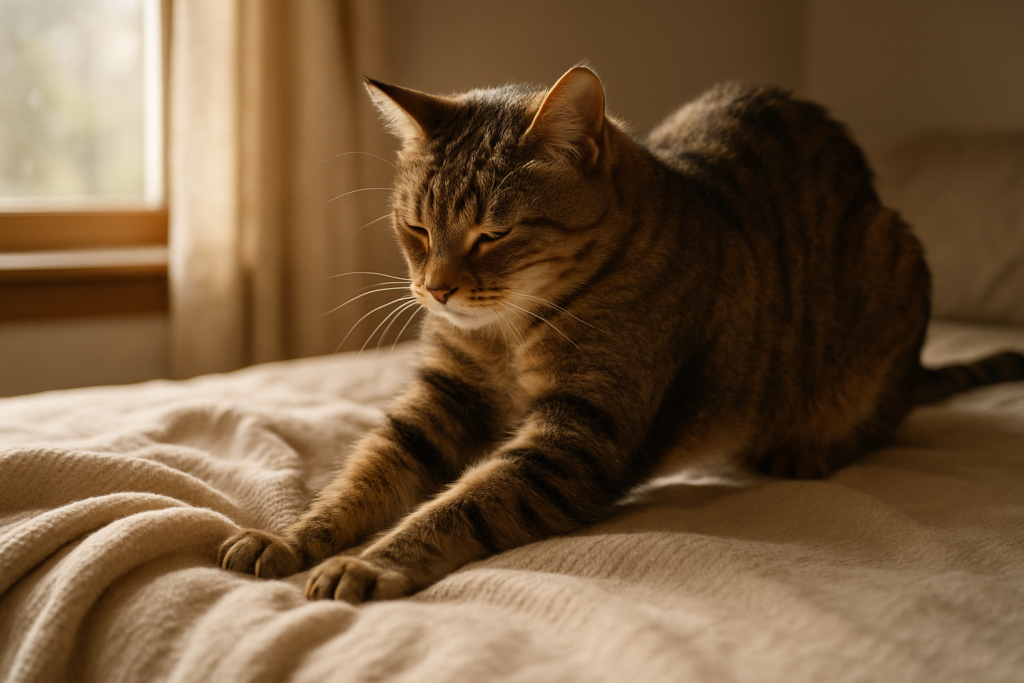
Kneading is the rhythmic motion a cat makes by pressing its front paws alternately into a person, blanket, bed, or other soft surface. Often called “making biscuits,” this familiar cat behavior usually indicates comfort, instinct, or preparation for rest rather than a problem.
There is no single kneading meaning that applies in every situation. A cat’s posture, surroundings, timing, vocalizations, and related actions can help you determine whether the behavior reflects relaxation, affection, self-soothing, scent marking, or occasional stress.
What is kneading in cats?
Cat kneading is an alternating push-and-release motion of the front paws. The movement resembles kneading dough, which explains why many people call it making biscuits.
Cats commonly knead blankets, beds, clothing, laps, and other soft or warm surfaces. Some extend their claws with each push, while others keep their claws mostly retracted.
Kneading may occur with purring, drooling, slow blinking, or a loose and relaxed posture. A cat may knead briefly before settling down or continue for several minutes as part of a familiar comfort routine.
Why do cats knead?
Cats may knead for several overlapping reasons, and researchers cannot assign one universal purpose to every episode. The most likely explanation depends on the individual cat and the circumstances.
- Kneading begins as a kitten nursing instinct because kittens press around the mother’s mammary glands while feeding.
- Adult cats may retain the motion because it has a lasting association with comfort, warmth, safety, and relaxation.
- Scent glands around the paw pads may leave a subtle scent on a frequently kneaded person or surface, making kneading a form of territory marking.
- Pressing and circling on a soft surface may be related to an instinctive tendency to prepare a comfortable sleeping spot.
- The repeated motion stretches the toes, paws, forelegs, and shoulders after rest.
- When directed toward a trusted person, kneading may accompany affection and social bonding.
How can you tell what your cat’s kneading means in the moment?
The paw motion alone cannot reveal exactly what a cat feels, so consider the entire situation. Relaxed muscles, soft eyes, forward or neutral ears, a loosely resting tail, and steady purring generally suggest contentment.
Tension changes the interpretation. Flattened ears, a twitching or lashing tail, wide pupils, skin rippling, growling, or repeated attempts to leave may indicate overstimulation, conflict, or stress rather than peaceful relaxation.
Surface and timing also provide body language clues. Kneading a bed before sleep may be nesting behavior, kneading a lap during petting may be social, and kneading after a disruptive event may help the cat self-soothe.
| Context clue. | Likely interpretation. |
|---|---|
| The cat has soft eyes, loose muscles, purring, and a resting posture. | The kneading most likely accompanies comfort and relaxation. |
| The cat kneads a bed or blanket before lying down. | The cat may be preparing a sleeping spot while settling itself. |
| The cat kneads a familiar person during calm petting. | Warmth, bonding, scent marking, and a learned cuddle routine may all contribute. |
| The cat suckles, drools, or mouths soft fabric while kneading. | The behavior probably has a strong comfort association connected with kittenhood. |
| The cat appears tense or shows other changes in appetite, grooming, or hiding. | Kneading may be self-soothing within a broader stress response. |
Why do cats knead on blankets, soft clothes, and fuzzy fabrics?
Soft, fuzzy materials yield under the paws in a way that may evoke the physical comfort of nursing and resting against the mother. Warm blankets also provide an inviting surface on which to stretch and prepare for sleep.
Clothing can be especially appealing because it carries a familiar person’s scent. That combination of softness, warmth, and recognizable scent can make a worn sweater or favorite blanket feel secure.
Some cats repeatedly select one fabric because its texture has become part of a learned relaxation routine. Repetition is generally harmless unless the cat chews and swallows fibers, damages its skin, or becomes unable to settle without the ritual.
Why do cats knead people?
A person’s lap, stomach, or chest offers warmth, softness, and physical closeness. If a cat kneads while cuddling with relaxed body language, the behavior commonly reflects contentment and trust.
Kneading a person can also produce attention because owners often respond with petting, conversation, or access to a comfortable blanket. The response can turn kneading into a predictable social routine even if attention was not its original purpose.
Cats may prefer one person because that individual is calmer, warmer, more available, or associated with feeding and rest. This preference does not necessarily mean the cat dislikes everyone else.
Why do cats knead and purr?
Kneading and purring often occur together because both behaviors can accompany security, comfort, and social contact. A relaxed cat may purr while rhythmically pressing its paws before settling beside or on a trusted person.
Both actions may also help a cat regulate its emotional state. A cat can use a familiar motor pattern and vocal vibration while calming down after excitement or uncertainty.
Purring is not proof of happiness in every case because cats may also purr when anxious, unwell, or in pain. Posture, appetite, activity, breathing, and other behavior changes are more informative than purring alone.
Why do cats knead their owners at night or in the morning?
Nighttime kneading often functions as a winding-down ritual. A warm bed and a motionless person provide the soft, secure conditions many cats seek before sleep.
Morning kneading may be a greeting, a request for attention, or a learned way to start breakfast. If kneading reliably makes a person wake up, speak, cuddle, or serve food, the cat has a strong reason to repeat it.
Predictable kneading at the same time each day usually suggests habit. A sudden increase accompanied by restlessness, nighttime vocalizing, hiding, appetite changes, or other unusual behavior deserves closer attention.
Why do cats knead and suckle?
Kneading and suckling are closely connected to kittenhood because nursing kittens perform both actions together. Some adult cats preserve the pairing as a powerful comfort behavior, particularly when relaxing on fuzzy blankets, clothing, or soft toys.
The habit does not automatically mean a cat was separated from its mother too early. Early experiences may influence it, but individual temperament, genetics, preferred textures, and reinforcement can also play roles.
Occasional suckling without fabric ingestion or injury is often harmless. Consult a veterinarian if the cat swallows fibers, damages its mouth or skin, becomes distressed when interrupted, or spends so much time suckling that eating, sleeping, play, or normal interaction is disrupted.
Do cats knead when stressed?
A cat may knead to calm itself, so the behavior can sometimes increase during stress. This does not make kneading an inherently anxious behavior, because the same motion frequently occurs when a cat feels completely safe.
Look for additional stress signals such as hiding, flattened ears, defensive aggression, excessive vocalizing, overgrooming, house-soiling, reduced play, sleep disruption, or appetite changes. Potential triggers include a move, construction noise, schedule changes, unfamiliar visitors, conflict between pets, or inadequate access to food, water, litter boxes, resting places, and hiding areas.
Reduce pressure by providing a predictable routine, quiet retreats, elevated resting spaces, play, and separate resources in multi-pet homes. Do not punish kneading, because punishment can increase fear without addressing the source of stress.
Why does my cat knead me with claws?
Claws may extend naturally as the toes spread during each push. A deeply relaxed or excited cat may press harder without understanding that the motion hurts human skin.
Place a thick folded blanket between your lap and the cat before kneading begins. If you need to move the cat, stop petting and reposition it slowly rather than pushing, shouting, or grabbing its paws.
Regular nail care can blunt sharp tips, while sturdy scratching surfaces support normal claw maintenance and stretching. Ask a veterinary professional to demonstrate safe trimming if you are unsure how to avoid the sensitive quick inside each nail.
- Keep a designated kneading blanket beside the cat’s preferred resting place.
- Reward the cat with calm attention when it kneads the blanket instead of bare skin.
- Pause petting if twitching skin, tail lashing, or increasing pressure suggests overstimulation.
- Avoid physically punishing the cat because the claws are usually part of a normal paw movement rather than an attempt to cause harm.
Why does my cat knead a blanket and hump it?
Kneading followed by gripping and pelvic thrusting may involve sexual arousal, general excitement, overstimulation, or a repeated comfort habit. Both male and female cats can show mounting behavior, and it can occur even after spaying or neutering.
Common targets include thick blankets, stuffed objects, and soft bedding that can be gripped with the paws. Episodes may appear during energetic play, social excitement, frustration, or a familiar settling routine.
If redirection is necessary, calmly interrupt the situation by offering play or guiding the cat toward another activity without scolding. Discuss frequent, sudden, difficult-to-interrupt, or injurious episodes with a veterinarian so medical discomfort, hormonal influences, anxiety, and compulsive behavior can be considered.
Is kneading normal for all cats?
Kneading is normal, but it is not universal. Some cats make biscuits several times a day, some do so only before sleep, and others rarely or never display the behavior.
Frequency varies with personality, early experiences, surface preferences, household routine, and how owners respond. A cat that does not knead may express comfort through slow blinking, purring, sleeping nearby, grooming, head rubbing, or another individual behavior.
The absence of kneading alone is not a health or relationship problem. A change matters more when it is sudden and appears alongside physical or behavioral symptoms.
When should you worry about kneading?
Most kneading requires no intervention, but a new or dramatic change can be significant when it accompanies other symptoms. Pay attention to whether the cat can stop, relax, eat, sleep, groom, play, and interact normally.
Arrange veterinary advice if kneading appears with pain, limping, paw swelling, skin damage, appetite loss, lethargy, disorientation, persistent vocalizing, major sleep changes, or sudden aggression. Excessive suckling that leads to fabric ingestion also requires prompt attention because swallowed material can cause a dangerous digestive obstruction.
A veterinarian can evaluate possible medical causes before the behavior is treated as purely emotional. If physical problems are excluded, a qualified cat behavior professional can help identify triggers and create a humane management plan.
- Sudden kneading combined with other changes is more concerning than a lifelong comfort ritual.
- Compulsive kneading may continue for long periods and interfere with normal daily activities.
- Repeated humping, self-injury, or distress when interrupted warrants professional guidance.
- Signs of anxiety or pain should be assessed instead of being dismissed as quirky behavior.
How should you respond when your cat kneads?
Allow relaxed kneading when it is safe because it is a normal outlet for many cats. Provide washable blankets, padded beds, or other soft surfaces where the cat can perform the behavior comfortably.
Protect your lap with a thick barrier and maintain the cat’s nails instead of trying to eliminate the behavior. If kneading becomes painful or unwanted, gently move the preferred blanket beside you and reward the cat for using it.
Redirect persistent suckling, humping, or overstimulated kneading with a calm play session or another familiar activity. Consistent, low-pressure responses preserve trust and are more effective than yelling, spraying water, or physical correction.
- Offer a safe and washable surface with a texture the cat already prefers.
- Place a folded blanket over your lap before inviting the cat to settle.
- Trim sharp nail tips regularly or request help from a veterinary professional.
- End petting calmly if the cat’s muscles tense or its tail begins to lash.
- Reinforce calm alternatives by giving attention when the cat uses its own bed or blanket.
What does your cat’s kneading tell you?
Kneading usually reflects a blend of early nursing instinct, comfort, stretching, nesting, scent marking, and social bonding. Its meaning becomes clearer when you consider the cat’s body language, chosen surface, timing, and related behaviors.
You can support normal kneading with soft surfaces, gentle handling, and sensible nail care. Seek professional advice when the behavior changes suddenly, becomes compulsive, causes injury, involves swallowed fabric, or appears with signs of pain or anxiety.
Frequently Asked Questions
Is kneading a sign that my cat loves me?
Kneading a person during relaxed contact can indicate trust, comfort, and social bonding, which owners reasonably interpret as affection. However, kneading can also be motivated by warmth, softness, scent marking, or habit, so it should be read alongside the cat’s complete body language.
Should I let my cat knead me?
You can let your cat knead you if both of you are comfortable and the behavior does not cause injury. Use a thick blanket as a barrier and redirect the cat gently if extended claws make kneading painful.
Why does my cat’s kneading hurt?
Kneading hurts when a cat extends its claws or places substantial weight behind each push. The cat is generally performing a normal paw motion rather than intentionally hurting you, so nail maintenance and a folded blanket are better solutions than punishment.
Why does kneading sometimes come with drooling?
Some relaxed cats drool because kneading is strongly associated with nursing, comfort, and anticipation. Occasional light drooling during an established relaxation routine may be harmless, but new or heavy drooling can indicate dental disease, nausea, oral irritation, or another medical problem and should be discussed with a veterinarian.
Can stressed cats knead more often?
Cats can knead more often as a form of self-soothing during environmental or social stress. Increased kneading is more likely to reflect stress when it occurs with hiding, overgrooming, appetite changes, house-soiling, tension, or disrupted sleep.
Why do some cats knead only certain fabrics?
A particular fabric may have the softness, warmth, thickness, or familiar scent that a cat associates with security. Repeated use can strengthen the preference until that material becomes part of the cat’s usual resting routine.
Do all cats knead?
Not all cats knead, and frequency varies widely among individuals. Rare or absent kneading is normal when the cat otherwise appears healthy and behaves as usual.
When is kneading a problem?
Kneading may be a problem when it becomes compulsive, causes skin or paw injuries, includes fabric ingestion, repeatedly progresses to disruptive humping, or appears suddenly with signs of pain, illness, or anxiety. A veterinarian should assess these changes, with behavioral support added when appropriate.