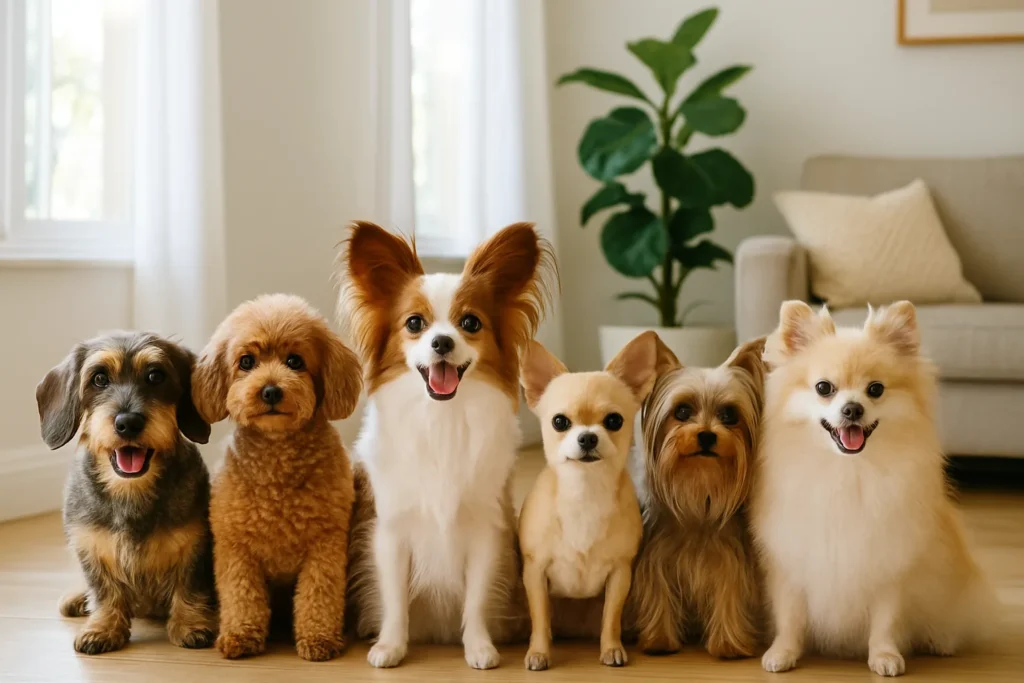
The different types of small dogs range from delicate toy companions to energetic terriers, scent-driven hounds, watchdogs, and compact working breeds. This guide organizes them by size, purpose, temperament, trainability, grooming needs, and household fit rather than presenting an unhelpful list of names.
No single guide can account for every individual dog or developing crossbreed, but the groups below cover the widely recognized pure breeds people usually mean when asking about all breeds of small dogs. They also answer practical questions about which breeds may suit families, apartments, calm homes, and first-time owners.
What counts as a small dog?
A small dog generally weighs less than about 25 to 30 pounds as an adult, although registries and housing providers do not use one universal cutoff. Height, bone structure, and body length also matter because a sturdy 28-pound dog has different handling and space requirements from a delicate 6-pound dog.
Toy dogs form the smallest size group and were primarily developed as companions, although some retain watchdog or vermin-hunting instincts. Many weigh less than 12 pounds, but the word “toy” can also be part of an officially recognized size variety, as it is with the Toy Poodle.
The word “miniature” does not automatically identify a separate breed. The Miniature Schnauzer is a distinct breed, while the Dachshund has size varieties, and marketing labels such as “teacup,” “micro,” or “mini Pomeranian” usually do not describe separately recognized breeds.
Published breed ranges are useful estimates rather than guarantees. Sex, ancestry, nutrition, health, and mixed-breed parentage can all affect an adult dog’s height and weight.
- Toy dogs commonly weigh approximately 4 to 12 pounds, although individual dogs can fall outside that range.
- Other small breeds commonly weigh approximately 12 to 25 pounds.
- Compact breeds approaching 30 pounds may be considered small in some contexts and medium-sized in others.
- A veterinarian and responsible breeder or rescue can provide a more realistic adult-size estimate for an individual puppy.
Small dog breeds at a glance
This breeds of small dogs list compares representative choices across the major groups. Weight ranges are approximate, and an individual dog’s behavior can differ from the general breed pattern because of genetics, socialization, training, age, and health.
| The breed appears in this column. | The typical adult weight appears in this column. | The usual energy level appears in this column. | The usual grooming load appears in this column. | The general trainability appears in this column. | A suitable household appears in this column. |
|---|---|---|---|---|---|
| The breed is the Chihuahua. | Typical adult weight is approximately 3 to 6 pounds. | Energy is moderate, with short active periods. | Grooming is low to moderate, depending on coat type. | Trainability is moderate with patient, reward-based lessons. | The breed may suit an attentive adult home that can protect a tiny dog. |
| The breed is the Pomeranian. | Typical adult weight is approximately 3 to 7 pounds. | Energy is moderate to high. | Grooming is high because of the dense double coat. | Trainability is generally good, although alert barking needs attention. | The breed may suit an engaged owner who enjoys grooming and training. |
| The breed is the Maltese. | Typical adult weight is approximately 4 to 7 pounds. | Energy is moderate. | Grooming is high when the coat is kept long. | Trainability is generally good with consistency. | The breed may suit a companion-focused home prepared for coat care. |
| The breed is the Papillon. | Typical adult weight is approximately 5 to 10 pounds. | Energy is moderate to high. | Grooming is moderate. | Trainability is high for a toy breed. | The breed may suit an active owner seeking a small, responsive companion. |
| The breed is the Yorkshire Terrier. | Typical adult weight is approximately 4 to 7 pounds. | Energy is moderate to high. | Grooming is moderate to high. | Trainability is moderate because terrier confidence can create distractions. | The breed may suit an owner who wants a tiny but bold dog. |
| The breed is the Toy Poodle. | Typical adult weight is approximately 4 to 10 pounds. | Energy is moderate to high. | Grooming is high because regular clipping is necessary. | Trainability is high. | The breed may suit a training-oriented home that can budget for grooming. |
| The breed is the Shih Tzu. | Typical adult weight is approximately 9 to 16 pounds. | Energy is low to moderate. | Grooming is high, especially with a long coat. | Trainability is moderate with short and positive sessions. | The breed may suit a calm companion home that manages heat carefully. |
| The breed is the Cavalier King Charles Spaniel. | Typical adult weight is approximately 13 to 18 pounds. | Energy is moderate. | Grooming is moderate. | Trainability is generally good. | The breed may suit a sociable household that prioritizes health screening. |
| The breed is the Bichon Frise. | Typical adult weight is approximately 12 to 18 pounds. | Energy is moderate. | Grooming is high because trimming and brushing are necessary. | Trainability is generally good, although housetraining can require patience. | The breed may suit a social first-time owner prepared for professional grooming. |
| The breed is the Havanese. | Typical adult weight is approximately 7 to 13 pounds. | Energy is moderate. | Grooming is moderate to high. | Trainability is generally good. | The breed may suit a home seeking an affectionate and adaptable companion. |
| The breed is the Boston Terrier. | Typical adult weight is approximately 12 to 25 pounds. | Energy is moderate. | Grooming is low. | Trainability is generally good. | The breed may suit a family or apartment home that can manage heat exposure. |
| The breed is the Pug. | Typical adult weight is approximately 14 to 18 pounds. | Energy is low to moderate. | Grooming is moderate because the coat sheds and skin folds need care. | Trainability is moderate. | The breed may suit a companion home prepared for significant flat-faced health considerations. |
| The breed is the Jack Russell Terrier. | Typical adult weight is approximately 9 to 18 pounds. | Energy is very high. | Grooming is low to moderate. | Trainability is high when sufficient activity and structure are provided. | The breed may suit an experienced and highly active household. |
| The breed is the Miniature Schnauzer. | Typical adult weight is approximately 11 to 20 pounds. | Energy is moderate to high. | Grooming is high because clipping or hand-stripping is necessary. | Trainability is generally high. | The breed may suit an involved family that tolerates alert barking. |
| The breed is the Beagle. | Typical adult weight is approximately 20 to 30 pounds. | Energy is high. | Grooming is low to moderate. | Trainability is moderate because scents readily compete for attention. | The breed may suit an active home with secure outdoor space and noise tolerance. |
| The breed is the Dachshund. | Typical adult weight varies from under 11 pounds for many miniatures to approximately 16 to 32 pounds for standards. | Energy is moderate. | Grooming is low to moderate, depending on coat type. | Trainability is moderate because the breed can be independent. | The breed may suit a patient home that protects the dog’s back. |
| The breed is the French Bulldog. | Typical adult weight is usually under 28 pounds. | Energy is low to moderate. | Grooming is low to moderate. | Trainability is moderate. | The breed may suit a low-impact household prepared for flat-faced health risks and heat sensitivity. |
| The breed is the Italian Greyhound. | Typical adult weight is approximately 7 to 14 pounds. | Energy is moderate, with brief fast-running periods. | Grooming is low. | Trainability is moderate because housetraining and recall can be challenging. | The breed may suit a gentle home that can protect a fine-boned dog from cold and injury. |
Toy breeds: the tiniest different types of small dogs
Toy breeds are easy to carry and require less physical space, but tiny size does not make them effortless pets. They still need daily exercise, training, dental care, socialization, and protection from falls, rough handling, extreme weather, and larger animals.
Many toy dogs are strongly attached to their people and make alert watchdogs. Without calm exposure to visitors, sounds, grooming, and time alone, that attachment can contribute to excessive barking, fearfulness, or separation-related distress.
- The Chihuahua is exceptionally small, expressive, and often devoted to one or two people, but it needs careful handling and early socialization.
- The Pomeranian is lively, intelligent, and conspicuous despite its size, but its coat and tendency to alert bark require regular management.
- The Maltese is affectionate and playful, while its continuously growing coat needs frequent brushing or routine trimming.
- The Papillon is athletic and highly trainable, making it a strong choice for owners interested in obedience, tricks, or small-dog sports.
- The Yorkshire Terrier combines toy size with terrier confidence, so owners should expect curiosity, vigilance, and more boldness than a typical lap-dog stereotype suggests.
- The Toy Poodle is intelligent, responsive, and low-shedding, but it needs mental exercise and scheduled professional grooming.
- The Japanese Chin is a sensitive, catlike companion that often prefers gentle play and a relatively peaceful home.
- The English Toy Spaniel is typically affectionate and less athletic than many tiny breeds, although individual health and sociability still matter.
Compact companion breeds
Compact companion dogs are generally sturdier than the smallest toy breeds while remaining manageable in modest homes. Some are content with gentle walks and lap time, whereas others are playful social dogs that need games, training, and regular outings.
These breeds often thrive when included in family routines. However, companionship should not become constant dependence, so owners should gradually teach them to settle alone for reasonable periods.
- The Shih Tzu is usually affectionate and moderately active, but coat care, eye protection, dental care, and heat management are continuing responsibilities.
- The Cavalier King Charles Spaniel is commonly friendly and adaptable, but prospective owners should place exceptional emphasis on responsible health screening.
- The Bichon Frise is cheerful and sociable, with a low-shedding coat that still requires frequent brushing and professional trimming.
- The Havanese is trainable and people-oriented, although its coat mats without consistent maintenance.
- The Boston Terrier is playful and relatively easy to groom, but its short muzzle can limit safe exercise in warm or humid weather.
- The Pug is often charming and companionable, but shedding, skin-fold care, weight control, breathing difficulty, and heat intolerance can make ownership more demanding than expected.
- The Coton de Tulear is a friendly companion with a soft coat that requires diligent brushing and mat prevention.
- The Tibetan Spaniel is independent for a companion breed and can be an observant watchdog in a calm household.
Small terriers and bold little dogs
Small terriers were often developed to pursue vermin, which helps explain their persistence, fast reactions, digging, vocal behavior, and interest in moving animals. They can be affectionate family dogs, but their needs differ substantially from those of less driven lap dogs.
Terriers generally benefit from brisk walks, scent games, food puzzles, structured play, and short training sessions. Reliable fences and leashes are important because prey drive can overpower recall, even in a well-practiced dog.
- The Jack Russell Terrier is an intense athlete that usually suits an active, training-focused owner better than a household seeking a quiet lap dog.
- The Cairn Terrier is hardy, curious, and playful, with enough independence to require consistent boundaries.
- The West Highland White Terrier is confident and social, but it may bark, dig, or chase without suitable outlets.
- The Miniature Schnauzer is bright and trainable, although regular grooming and alert barking are important considerations.
- The Norfolk Terrier is compact, energetic, and generally sociable, but it retains strong hunting instincts.
- The Norwich Terrier is bold and active, requiring more exercise and engagement than its short legs might suggest.
- The Border Terrier is often even-tempered for a terrier, but it remains an energetic hunter that needs secure containment.
- A terrier may not be the best choice for someone who wants minimal barking, dependable off-leash behavior, or peaceful coexistence with small prey animals.
Small hounds and scent-driven breeds
Small hounds make choices through their noses and hunting instincts. Their independence is not a lack of intelligence, but it means training must compete with smells, wildlife, and opportunities to follow a trail.
Beagles and Dachshunds can be affectionate, entertaining companions, yet both may be vocal. Food rewards, scent games, secure leashes, and fenced areas are usually more effective than expecting automatic obedience around distractions.
- The Beagle is social, active, and scent-focused, but its baying voice and tendency to follow odors may be difficult in noise-sensitive housing.
- The Dachshund is brave, clever, and available in different sizes and coat types, but jumping, obesity, and unsuitable handling can increase stress on its long back.
- The Petit Basset Griffon Vendéen is a small-to-medium hound with a lively personality, substantial exercise needs, and an independent working style.
- A small hound often fits best with a patient household that enjoys outdoor walks, accepts gradual recall training, and uses secure containment.
Other kinds of dogs that are small but not typical lap dogs
Some kinds of dogs that are small were developed as watchdogs, herders, ratters, or specialized athletes rather than passive companions. Their body shape and original purpose can affect exercise, handling, health, and behavior as much as their weight does.
Small size can reduce food use and make transportation easier, but it does not guarantee low energy, quiet behavior, low veterinary costs, or simple training. In particular, flat-faced breeds, long-backed breeds, and fine-boned breeds have care needs that owners should understand before choosing them.
- The French Bulldog is a muscular companion with moderate exercise needs, but breathing restrictions, spinal concerns, and heat sensitivity can create substantial care requirements.
- The Schipperke is an alert, active watchdog with a strong personality, so it needs training, mental work, and secure boundaries.
- The Italian Greyhound is a fast but sensitive sighthound that enjoys comfort indoors, although cold weather, fragile limbs, and housetraining can be challenging.
- The Lhasa Apso is an independent sentinel breed rather than a universally outgoing lap dog, and its coat requires significant maintenance.
- The Brussels Griffon is expressive and closely bonded to its people, but it can be sensitive and may not tolerate rough handling.
- The Pembroke Welsh Corgi commonly weighs up to about 30 pounds and may sit at the boundary between small and medium categories, while its herding drive, shedding, and exercise needs are larger than its short stature implies.
- The Cardigan Welsh Corgi is generally heavier than the Pembroke and is more often treated as a medium-sized dog despite its low height.
- The Chinese Crested may be hairless or coated, and both varieties need thoughtful skin, dental, temperature, and grooming care.
Best small dog breeds for families, apartments, and first-time owners
The best breed is the one whose exercise, handling, grooming, noise, and social needs match the household. Breed tendencies can narrow the search, but adult temperament, health, training history, and the behavior of individual family members remain decisive.
Families should supervise every interaction between children and dogs. A friendly small dog can still be injured by grabbing, dropping, chasing, or rough play, and every dog needs an undisturbed place to rest.
Small dogs for families with children
Havanese, Bichon Frise, Boston Terriers, Miniature Poodles, and well-socialized Cavalier King Charles Spaniels are often considered for families because they tend to be social and trainable. A sturdy individual is generally safer around young children than a very fine-boned toy dog.
- Parents should teach children to leave dogs alone while they eat, sleep, hide, or chew valued items.
- An adult should actively supervise rather than expecting either the child or dog to manage the interaction.
- Families should assess health and temperament instead of selecting a puppy solely for appearance.
Small dogs for apartments
Havanese, Shih Tzus, Bichon Frises, Maltese, and some Boston Terriers can adapt well to apartments when their exercise and companionship needs are met. Barking level, elevator access, toilet routines, and the dog’s ability to settle matter more than body size alone.
- A quiet moderate-energy dog may be easier in shared housing than a tiny but highly vocal watchdog.
- Daily walks and enrichment remain necessary even when a dog has access to an indoor toilet area.
- Flat-faced breeds need climate-controlled exercise plans rather than merely shorter walks.
Calm and friendly small dog options
Shih Tzus, Japanese Chins, English Toy Spaniels, and many adult Cavalier King Charles Spaniels are commonly less intense than terriers. Bichon Frises, Havanese, Papillons, and Boston Terriers are often friendly but may be more playful and energetic.
- An adult rescue dog with an established temperament may offer more predictability than a puppy.
- Pain, fear, insufficient exercise, and separation distress can make any breed appear restless or irritable.
- Friendly behavior depends on socialization and safe experiences as well as inherited temperament.
Easy-to-train small breeds
Toy and Miniature Poodles, Papillons, Havanese, Miniature Schnauzers, and Bichon Frises are often responsive to reward-based training. Ease of training should include housetraining, calmness, grooming cooperation, and recall rather than measuring trick learning alone.
- Short sessions help small dogs learn without becoming tired or frustrated.
- Owners should reward calm behavior and polite greetings instead of accidentally reinforcing barking or jumping.
- Small dogs need the same consistent household rules as larger dogs.
Good small dogs for first-time owners
Havanese, Bichon Frises, Papillons, Toy or Miniature Poodles, and carefully matched adult Shih Tzus can suit committed first-time owners. The right choice depends on whether the person is prepared for grooming, training, companionship, veterinary expenses, and daily exercise.
- A low-shedding coat usually requires more clipping and brushing rather than less maintenance.
- A low-energy dog can still have complex medical or companionship needs.
- First-time owners should avoid choosing an intense terrier or independent hound unless they genuinely want its working traits.
Smallest dog breeds and most popular small dog breeds
Chihuahuas, Pomeranians, Yorkshire Terriers, Maltese, and Toy Poodles are commonly named among the top five smallest dog breeds. Papillons, Japanese Chins, Russian Toys, and other tiny breeds may overlap these weight ranges, so the exact order changes according to the breed standard and individual dog.
Popular small breeds include French Bulldogs, Dachshunds, Poodles, Chihuahuas, Shih Tzus, Pomeranians, Yorkshire Terriers, Pugs, Boston Terriers, and Miniature Schnauzers. Popularity reflects visibility and availability, not universal suitability.
- The Chihuahua is frequently the lightest widely recognized breed, but its tiny frame requires careful handling.
- The Pomeranian is very small but needs considerable coat care and can be an enthusiastic alarm barker.
- The Yorkshire Terrier is portable but retains a bold terrier temperament.
- The Maltese is companionable but requires coat maintenance and consistent dental care.
- The Toy Poodle is highly trainable but needs regular clipping, activity, and mental stimulation.
- French Bulldogs and Pugs are popular and moderately active, but their short muzzles can be associated with serious breathing and heat-management concerns.
- Dachshunds are recognizable and entertaining, but owners must manage back protection, weight, barking, and hunting instincts.
- A tiny dog is not automatically calm, and a low-exercise breed is not automatically low-maintenance.
How to choose from all breeds of small dogs
Choosing from all breeds of small dogs becomes easier when practical limits are identified before appearance or popularity enters the decision. Prospective owners should compare an ordinary weekday with the dog’s likely needs, not imagine only weekends, holidays, or puppyhood.
Meeting adult dogs of the breed and discussing health, temperament, grooming, and daily routines with responsible breeders or rescue staff can reveal issues that a photograph cannot. Every candidate should also be assessed as an individual.
1. Match energy and size to daily life.
Estimate how much time is genuinely available for walking, play, enrichment, and training. A high-energy terrier can require more active engagement than a much larger but calmer dog.
2. Assess the household’s barking tolerance.
Terriers, hounds, watchdog breeds, and many toy dogs can be vocal for different reasons. Shared walls, sleeping schedules, visitors, and neighborhood noise should influence the choice.
3. Compare grooming work and shedding.
Poodles and Bichon Frises shed relatively little but need clipping, while Pugs and other short-coated breeds can shed substantially despite requiring little trimming. Owners should budget both time and money for the coat type they select.
4. Consider sturdiness and handling needs.
Very small or fine-boned dogs can be vulnerable around young children, larger pets, steep stairs, and furniture. A slightly larger, stable small dog may be safer for an active household.
5. Review health risks and lifetime costs.
Routine expenses include food, preventive care, dental care, training, grooming, supplies, and insurance or emergency savings. Breed-related concerns involving breathing, the spine, knees, eyes, heart, skin, or teeth may add substantial costs.
6. Choose temperament and purpose over looks.
Prospective owners should decide whether they want a cuddly companion, playful family dog, trainable sport partner, independent hound, or intense terrier. Selecting the function and personality first produces a more useful types of small dogs list than choosing by coat color or popularity.
FAQ about small dog breeds
These answers address common comparison questions about the best, calmest, smallest, and most popular small breeds. They describe broad tendencies rather than guarantees for an individual dog.
Small Dog Breeds: Complete List of Small and Toy Dogs: The Bottom Line
Frequently Asked Questions
What are the 10 best small dogs?
Ten broadly appealing choices are the Havanese, Bichon Frise, Papillon, Toy or Miniature Poodle, Shih Tzu, Boston Terrier, Miniature Schnauzer, Maltese, Cavalier King Charles Spaniel, and Chihuahua. No breed is best for everyone, so grooming, health, barking, exercise, trainability, and household sturdiness should determine the final choice.
What is the calmest small dog?
The Shih Tzu is often considered one of the calmer small breeds, while Japanese Chins and English Toy Spaniels may also suit quieter homes. Age and individual temperament matter greatly, so a calm adult dog with a known history may be more predictable than any puppy selected by breed alone.
What are the top 5 smallest dog breeds?
Chihuahuas, Pomeranians, Yorkshire Terriers, Maltese, and Toy Poodles are commonly included among the five smallest breeds. Exact rankings vary because breed standards overlap, individual weights differ, and breeds such as the Russian Toy, Papillon, and Japanese Chin can also be extremely small.
What are some popular small dog breeds?
Popular small dog breeds include French Bulldogs, Dachshunds, Poodles, Chihuahuas, Shih Tzus, Pomeranians, Yorkshire Terriers, Pugs, Boston Terriers, Beagles, Bichon Frises, and Miniature Schnauzers. Popularity should not replace careful evaluation of health, energy, noise, grooming, and temperament.
What are the different breeds of miniature dogs?
Recognized miniature-named dogs include the Miniature Schnauzer, Miniature Pinscher, Miniature American Shepherd, and Miniature Bull Terrier, while Poodles and Dachshunds have recognized size varieties. Labels such as teacup, micro, and mini are not automatically recognized breed names and may simply describe unusually small dogs.
Are small dogs low-maintenance?
Small dogs usually eat less and need less physical space, but they are not necessarily low-maintenance. Grooming, dental disease, barking, housetraining, separation distress, injury prevention, and breed-related medical conditions can require considerable time and expense.