When dogs fighting at home turn a familiar room into a dangerous space, the first priorities are protecting people, creating distance, and preventing another confrontation. If you are wondering what to do when your dogs fight, do not reach between them or grab collars near their mouths; use barriers and distance whenever you can do so safely.
Understanding why your dogs are fighting is essential because the visible conflict may involve food, pain, fear, crowding, redirected excitement, or several sources of stress at once. Some dogs can eventually share a home again with careful management and behavior support, but dogs involved in severe or repeated fights may need complete separation while you seek professional help.
Quick answer: To interrupt a fight, stay at a safe distance and use a door, baby gate, board, chair, laundry basket, blanket, or another available barrier to block contact without placing your hands near either dog’s mouth. A brief sound or other distance-creating interruption may help only if it can be attempted from a protected position without increasing danger. Move the dogs into fully separate, secured spaces, check both dogs for injuries, contact a veterinarian about bite wounds, and do not force an immediate reunion.
Important: Never put your hands, face, or body between fighting dogs, and never reach for collars near their mouths. Seek urgent veterinary care for uncontrolled bleeding, breathing difficulty, collapse, pale gums, severe pain, eye injuries, deep punctures, extensive swelling, or possible shock.
What to Do When Your Dogs Fight Right Now
A dog fight can redirect toward a person in seconds, including when the dogs normally behave gently with people. Your goal is not to determine which dog started the conflict or to physically restrain them; your goal is to create separation without entering the bite zone.
1. Stay as calm as possible.
Take a breath, keep children and other animals away, and quickly identify doors, gates, furniture, or solid objects that could divide the dogs. Avoid frantic movement and continuous screaming, which can add to the noise and arousal.
2. Keep your hands away from collars and mouths.
Do not grab either dog’s collar with bare hands, even if the collar appears easy to reach. A highly aroused dog may bite reflexively or redirect onto you without recognizing who you are.
3. Place a barrier between the dogs if it is safe.
From the safest position available, use a door, baby gate, large board, chair, laundry basket, or similar object to block visual and physical contact. A blanket may interrupt contact if it can be tossed from a distance, but do not approach the dogs or remain within reach to place it.
4. Try a distance-creating interruption only when safe.
A sudden sound made from behind a secure barrier may create a brief pause, but yelling repeatedly can intensify the situation. Use any pause to close a door or position a barrier rather than moving closer to the dogs.
5. Secure the dogs in fully separate areas.
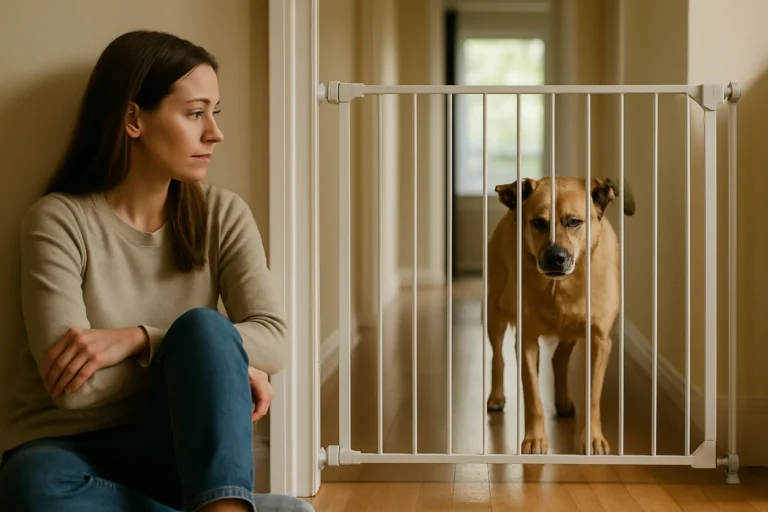
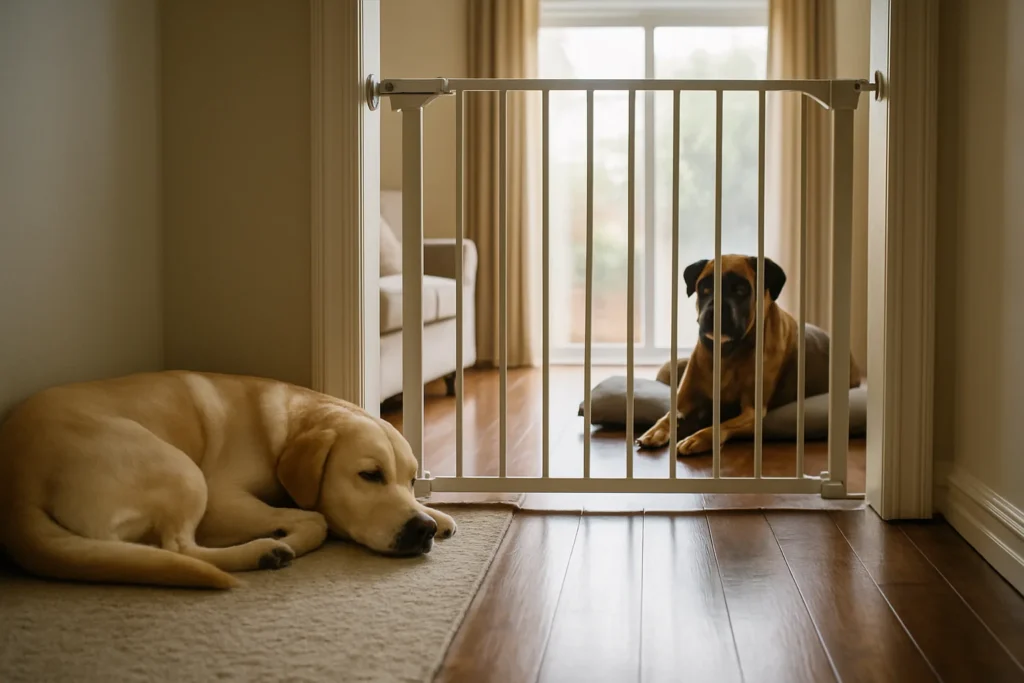
Once contact ends, place each dog behind a closed, secure door or in another area where neither dog can push through a gate or stare at the other. Confirm that every person in the home knows which spaces are occupied before opening any door.
6. Prevent an immediate reunion.
Do not test whether the dogs have calmed down by bringing them face to face again. Stress hormones and pain can keep arousal elevated after the visible fight has ended, making another conflict more likely.
What Never to Do During a Dog Fight
Instinct may tell you to pull the dogs apart, but physical intervention creates a serious risk of redirected bites. Common punishment-based reactions can also increase fear and make future warning signals less obvious.
- Never put your hands, legs, or body between fighting dogs.
- Never reach for collars or harnesses when your hands would be close to either dog’s mouth.
- Never place your face near the dogs or lean over them.
- Do not hit, kick, or repeatedly scream at the dogs because pain and noise may intensify arousal or redirect aggression.
- Do not punish either dog after the fight because punishment does not resolve the trigger and may create additional fear.
- Do not force the dogs to stay together or let them “work it out,” because another encounter may cause more serious injuries.
Check for Injuries and Calm the Environment Afterward
Knowing what to do after a dog fight at home includes checking both dogs separately once they are secured. Adrenaline can hide pain, and small punctures in thick fur may conceal deeper tissue damage or infection risk.
Call a veterinarian about any bite wound, even if the skin opening appears minor. Seek emergency care for heavy bleeding, labored breathing, pale or bluish gums, weakness, collapse, severe swelling, eye trauma, abdominal wounds, obvious fractures, or signs of shock.
Keep the environment quiet while the dogs decompress in different areas with water and comfortable resting places. Do not give human pain medication unless a veterinarian specifically instructs you to do so.
- Look through the coat for punctures, torn skin, swelling, tenderness, and active bleeding.
- Watch for limping, reluctance to move, unusual posture, rapid breathing, or sensitivity when touched.
- Check the eyes, ears, neck, chest, abdomen, and legs without forcing a painful dog to accept handling.
- Write down where the fight happened, what resources were present, who approached whom, and what each dog did before the first lunge.
- Record recent changes in health, medication, sleep, routine, visitors, or household stress while the details remain fresh.
Why Dogs Fight Each Other in the Same Household
If you are asking why dogs fight each other, the answer is rarely a simple desire to be “alpha.” Conflict usually develops when a dog feels threatened, frustrated, painful, crowded, or at risk of losing something valuable.
Advice about how to stop dogs from fighting for dominance can be misleading when it encourages punishment or forces dogs to compete. A safer approach identifies the circumstances surrounding the conflict and changes the environment so neither dog has to defend access or personal space.
- Resource guarding can involve meals, dropped food, toys, chews, beds, couches, doorways, or attention from a favorite person.
- Redirected arousal can occur when dogs become excited by a visitor, delivery, animal outside, doorbell, or fence-line encounter and then turn on each other.
- Fear can cause a dog to defend space when cornered, startled, restrained, or unable to move away.
- Pain or illness can reduce tolerance for touch, play, crowding, or ordinary social contact.
- Rough play can escalate when one dog ignores pauses, becomes overaroused, or continues after the other dog attempts to disengage.
- Dogs with incompatible play styles, communication patterns, energy levels, or needs for personal space may experience ongoing social tension.
- Barriers and tight spaces can create frustration or prevent one dog from retreating, especially around gates, hallways, stairs, and doorways.
Why Are My Dogs Fighting All of a Sudden?
A sudden behavior change deserves attention because the trigger may be medical even when the dog otherwise appears healthy. Pain from dental disease, arthritis, an ear infection, an injury, or another condition can make normal contact feel threatening.
Environmental changes can also produce stacked stress, in which several manageable events accumulate until a small incident triggers a fight. The final trigger may look insignificant because the dogs were already coping with disrupted sleep, visitors, noise, reduced exercise, or repeated excitement.
- Schedule a veterinary examination when aggression begins suddenly, especially if you notice appetite, mobility, sleep, hearing, vision, or temperament changes.
- Consider whether aging, sensory decline, cognitive changes, or reduced mobility has made one dog easier to startle or less able to retreat.
- Review recent routine changes involving feeding, walks, work schedules, confinement, or access to preferred resting areas.
- Account for a new dog, guest, baby, caregiver, move, renovation, or other change in the household.
- Recognize that social relationships may change as adolescent dogs reach maturity, particularly in same-sex pairs.
- Look for several recent stressors rather than assuming the last visible event was the only cause.
Common Triggers to Look For Before the Next Fight
Most fights are not truly unpredictable, although early signals can be subtle. Watch for closed mouths, hard staring, freezing, hovering, blocking, stiff posture, raised lips, low growling, or one dog repeatedly trying to leave.
Keep a written incident log that records time, location, nearby people, available resources, outside activity, and each dog’s body language. Patterns across several events can help a veterinarian or behavior professional build a safer plan.
- Meal preparation and feeding can create competition before the bowls even reach the floor.
- High-value chews, food puzzles, stolen objects, and favorite toys can trigger guarding.
- Doorways, hallways, stairs, gates, and other narrow areas can prevent avoidance and increase pressure.
- Owner arrivals, visitors, doorbells, and excited greetings can raise arousal rapidly.
- Couches, beds, laps, sunny patches, and preferred resting spots may become guarded resources.
- Dogs seen through windows or fences can trigger barking, fence running, and redirected aggression toward a housemate.
- Petting one dog, attaching leashes, loading a vehicle, or moving toward the door can create competition for attention or access.
How to Get My Dogs to Stop Fighting at Home
A home-management plan reduces opportunities for another fight while medical and behavioral causes are assessed. Management is not a failure or a cure by itself; it is the safety structure that prevents the dogs from rehearsing dangerous behavior.
Every household member should follow the same plan. A single open gate, shared chew, or unsupervised greeting can undo weeks of careful separation.
- Feed the dogs in separate rooms behind closed doors, and remove bowls before reopening either area.
- Pick up bones, chews, food puzzles, and toys that have caused tension or could become valuable enough to guard.
- Use secure gates, closed doors, pens, or a crate-and-rotate schedule when the dogs cannot interact safely.
- Supervise every interaction closely enough to notice tension and separate the dogs before it escalates.
- Use leashes only as controlled management tools under adult supervision, and do not leave leashes attached where they could snag or create conflict.
- Give each dog protected rest, individual exercise, enrichment, and attention without making the other dog crowd nearby.
- Create predictable times for meals, walks, toileting, training, and sleep so the dogs face fewer surprises.
- Check gates, latches, and doors regularly, and use more than one barrier when the consequences of accidental contact would be severe.
How to Stop Dogs From Fighting Over Food, Toys, and Attention
Learning how to stop dogs from fighting over food starts with preventing competition, not testing whether they can tolerate closer bowls. The same principle applies to toys, resting places, and human attention: provide access in ways that do not require the dogs to negotiate under pressure.
Manage food and chews safely.
Prepare and serve meals with the dogs already separated, and keep them apart until every bowl and dropped piece of food has been removed. Offer bones, stuffed toys, and other high-value chews only during complete separation.
- Prevent access to trash, counters, dropped food, and unattended feeding areas.
- Do not remove guarded food by force, because confrontation can strengthen defensive behavior.
- Ask a qualified professional for a structured resource-guarding plan if a dog guards from people as well as other dogs.
Control access to toys.
Put away toys that create tension, and offer enrichment separately until a professional determines that shared access is appropriate. If low-value toys are eventually reintroduced, provide ample space and end the session at the first sign of staring, freezing, hovering, or blocking.
Reduce competition for attention.
Avoid allowing both dogs to crowd around you in narrow spaces or during exciting greetings. Teach each dog separately to settle on a mat, wait behind a boundary, and take turns approaching for attention, then reward calm behavior without forcing close contact.
Can Dogs Live Together After Fighting?
Some dogs can live together after fighting, particularly when the trigger is clear, injuries were minor, warning signals remain intact, and the household can maintain effective management. Repeated severe fights, gripping or shaking bites, unpredictable attacks, or one dog persistently targeting the other make the outlook more guarded.
Reintroduction should be gradual, controlled, and based on professional guidance rather than a quick face-to-face test. Depending on the case, early work may involve parallel activity at a comfortable distance, barriers, short sessions, and rewards for calm disengagement.
Success does not always mean the dogs will share food, toys, furniture, and unsupervised time. A realistic plan may require lifelong separation during meals, absences, greetings, or other predictable high-risk situations.
Quality of life must remain central to the decision. If one dog is constantly vigilant, confined for long periods, or repeatedly placed at risk, permanent household separation or carefully planned rehoming may be safer and kinder.
When to Get Professional Help
Begin with a veterinarian when fighting starts suddenly, follows a health change, or involves an older dog. A medical examination can identify pain, sensory decline, neurological problems, medication effects, or illness that behavior training alone cannot resolve.
For the behavior plan, look for a qualified reward-based trainer or behavior consultant with documented experience in aggression between dogs living together. Severe, complex, or medically influenced cases may require a veterinary behaviorist who can diagnose behavior disorders and prescribe medication when appropriate.
Do not wait for another fight simply to gather more information. Videos of calm interactions, photographs of the environment, veterinary records, and a detailed incident log can help a professional assess the case without deliberately exposing the dogs to each other.
- Seek professional help after multiple fights or any pattern of increasing frequency or intensity.
- Get help promptly after puncture wounds, gripping, shaking, pinning, or attacks that are difficult to interrupt.
- Request an assessment when fights appear unpredictable or early warning signals are difficult to identify.
- Take conflict between same-sex household dogs seriously, particularly when it begins around social maturity or continues to escalate.
- Obtain professional guidance when guarding involves children, adults, or anyone who cannot reliably follow the management plan.
- Use complete separation while waiting for help if another encounter could cause injury.
Signs You Should Keep the Dogs Fully Separated for Now
Full separation means preventing visual or physical access with secure doors, gates, pens, or a carefully coordinated rotation schedule. It is appropriate whenever the dogs cannot remain relaxed together or the household cannot reliably prevent another attack.
- Keep the dogs apart if you observe hard staring, freezing, stalking, blocking, cornering, muzzle punching, or repeated attempts to control movement.
- Keep the dogs apart if one dog hides, avoids normal activities, scans constantly, or cannot sleep and relax around the other.
- Keep the dogs apart if conflict restarts soon after a barrier is removed.
- Keep the dogs apart if one dog repeatedly seeks out or targets the other rather than disengaging.
- Keep the dogs apart if punctures, eye injuries, fractures, or other significant injuries have already occurred.
- Keep the dogs apart if children, older adults, or other household members could accidentally open barriers or become caught in another fight.
- Keep the dogs apart until a veterinarian and qualified behavior professional can assess any sudden, severe, or escalating aggression.
Build Safety Before Rebuilding Trust
The safest answer to how to get dogs to stop fighting begins with distance, secure separation, injury assessment, and prevention of another rushed encounter. Once the immediate danger has passed, identify patterns involving resources, pain, excitement, space, and household changes.
Management protects both dogs while you determine whether controlled behavior work is appropriate. When fights are repeated, severe, sudden, or difficult to predict, involve a veterinarian and an experienced behavior professional rather than asking the dogs to resolve the conflict themselves.
Frequently Asked Questions
Can dogs live together after fighting?
Some dogs can live together after fighting when the trigger can be managed and a professional guides gradual reintroduction. Dogs involved in repeated severe attacks, serious injuries, or persistent targeting may need lifelong management, permanent separation, or carefully considered rehoming.
Is it normal for two dogs that live together to fight?
Brief disagreements can occur, but physical fights should not be dismissed as normal or allowed to continue. Any fight warrants separation, injury checks, trigger review, and stronger management, while repeated or escalating fights require professional assessment.
What triggers a dog fight?
Common triggers include food, toys, chews, resting spots, owner attention, tight spaces, pain, fear, rough play, visitors, outside dogs, and redirected excitement. Several recent stressors can combine, so the final visible trigger may be only one part of the problem.
What are two things you should never do to break up a dog fight?
Never put your hands or body between fighting dogs, and never reach for collars near their mouths. Both actions place you within the bite zone and create a high risk of serious redirected injury.
Why are my two male dogs fighting all of a sudden?
Two male dogs may begin fighting because of pain, illness, maturity-related social changes, resource guarding, competition, environmental stress, or a disrupted routine. Same-sex conflict can become serious, so arrange a veterinary examination, keep the dogs separated, and seek qualified behavior support instead of testing them together.