Crate training works best when a puppy learns that the crate is a safe, predictable place to eat, rest, and settle—not somewhere they are forced to stay. You can begin when your puppy comes home, but every introduction should be brief, positive, and appropriate for the puppy’s bladder control and emotional comfort.
Some puppies willingly nap in a crate on the first day, while others need several days or weeks before they can relax with the door closed. Crying and temporary setbacks are common. A consistent routine is more important than trying to complete the entire process in one night.
Quick answer: The fastest humane way to crate train a puppy is to begin with treats, meals, and voluntary exploration. Practice several short sessions before attempting longer confinement. Close the door for only a few seconds while you remain nearby, reopen it before the puppy becomes distressed, and gradually increase both duration and distance. Schedule frequent potty breaks, use the crate for well-timed naps, and keep it near your bed during the first nights. Never use the crate as punishment or leave a frightened puppy to panic.
Before You Start: Choose the Right Crate and Setup
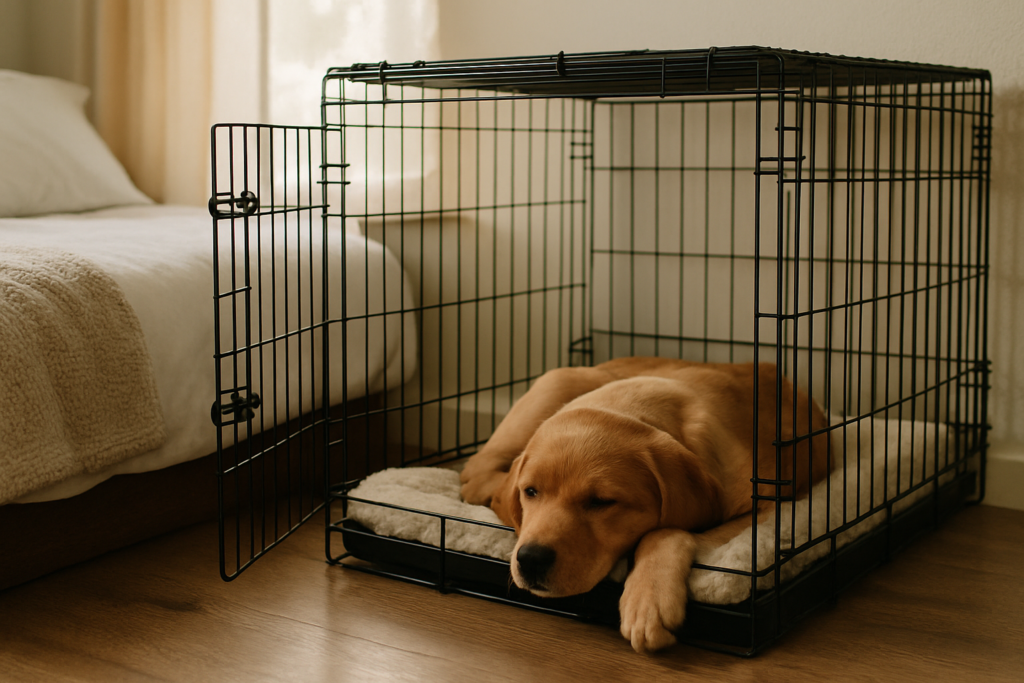
The crate should be large enough for your puppy to stand without crouching, turn around comfortably, and lie down in a relaxed position. A crate with substantially more floor space may allow the puppy to sleep at one end and eliminate at the other, so an adjustable divider is often more practical than buying several progressively larger crates.
VCA Animal Hospitals recommends a crate that gives a puppy enough room to stand, turn around, and lie down without providing excessive space that may complicate potty training.
Wire crates provide ventilation and visibility, and many include adjustable dividers. Plastic crates feel more enclosed and are often easier to transport. Either style can work if it is sturdy, correctly sized, stable on the floor, free of sharp edges, and introduced gradually.
During the day, place the crate in a comfortable area where your puppy can observe ordinary household activity without being surrounded by constant noise. At night, beginning with the crate beside your bed makes it easier to provide quiet reassurance and respond to genuine potty needs before an accident occurs.
A washable mat or thin bed can make the space more comfortable, but remove it if your puppy repeatedly urinates on it or tears and swallows the material. Introduce food toys and chews under supervision first. Do not leave a new item with an unattended puppy until you understand how the puppy chews it and have confirmed that its size, construction, and intended use are appropriate.
A breathable crate cover can reduce visual stimulation for some puppies, but it should never block ventilation, restrict airflow, or cause the crate to become hot. Other puppies become more anxious when fully covered, so observe your puppy’s response rather than assuming a cover will always help.
Remove collars, harnesses, identification tags, leashes, loose fabric, and anything else that could become caught on the crate. Water requirements depend on the puppy’s age, health, activity, weather, diet, and the length of confinement. Do not routinely restrict normal access to water simply to prevent accidents.
- Choose a crate that allows standing, turning, and a fully relaxed sleeping position.
- Use a secure divider to limit excess space while preserving comfort.
- Place the crate away from radiators, direct sunlight, cold drafts, and busy walkways.
- Check bedding, food toys, and chews regularly for damaged or loose pieces.
- Remove collars, harnesses, tags, and leashes before an unsupervised crate session.
- Make sure every family member treats the crate as a quiet, punishment-free space.
How to Crate Train a Puppy Step by Step
Begin each practice after an appropriate potty trip and when your puppy is calm enough to learn. A puppy who is bursting with energy, extremely hungry, frightened, or already overtired will have more difficulty settling. Several easy sessions usually teach more than one long session that ends in distress.
1. Invite Voluntary Exploration
Secure the crate door open so it cannot swing toward your puppy. Allow the puppy to investigate without being pushed, pulled, or carried inside. Toss a treat near the entrance and then just inside, allowing the puppy to leave whenever they choose. Reward looking at, approaching, sniffing, or stepping into the crate.
If your puppy refuses to approach, place treats at a comfortable distance and work gradually toward the entrance. The goal is to create curiosity and confidence, not to trick the puppy into entering and immediately close the door.
2. Build Positive Associations With Food and Toys
Serve meals near the entrance until your puppy eats comfortably, then move the bowl progressively farther inside over several meals. You can also reserve a safe food toy for supervised crate practice so that entering the crate consistently predicts something enjoyable.
Do not close the door simply because your puppy has entered. Complete several voluntary entries and exits first so the puppy does not learn that stepping inside always results in immediate confinement.
3. Close the Door for a Few Seconds
Once your puppy is comfortably eating or investigating inside, close the door for one or two seconds and reopen it before concern develops. Remain beside the crate and gradually work toward several calm seconds, followed by a minute or two.
Watch your puppy’s body language. If they stop eating, freeze, crouch, pant when the room is not hot, repeatedly turn toward the exit, or scramble to escape, the exercise became too difficult. Shorten the next repetition rather than waiting for the behavior to intensify.
4. Increase the Duration in Small Increments
Add time unevenly instead of making every repetition longer. For example, follow a calm 30-second session with 45 seconds, then return to 20 seconds. Varying the duration prevents the puppy from learning that each entry inevitably leads to a progressively longer wait.
Increase only one challenge at a time. If you are extending the duration, remain nearby. If you are increasing your distance from the crate, keep the session short.
5. Practice Moving Out of Sight
Stand up, take one step away, and return while your puppy remains relaxed. Progress to walking across the room, briefly stepping through a doorway, and taking short trips into another room. Mix these absences with sessions in which you sit nearby so that every crate entry does not predict isolation.
Return while the puppy is still comfortable whenever possible. If your puppy becomes worried as soon as you move, practice standing up and sitting down without leaving before attempting greater distance.
6. Use the Crate for Well-Timed Naps
After gentle play, a brief training session, and a successful potty trip, guide a sleepy puppy into the crate with a treat. Remain nearby while they settle. A planned nap is more likely to succeed than crating a puppy who is under-stimulated, urgently needs to eliminate, or is experiencing a burst of excitement.
Young puppies need substantial sleep, but crate training should not mean forcing every nap to occur behind a closed door. Include supervised naps outside the crate so the puppy can also learn to settle in other safe locations.
7. Keep Crate Exits Calm
When your puppy’s needs have been met and the behavior is only mild protest, wait for one or two seconds of quiet before opening the door. You do not need to wait for a long period of silence from a puppy who is still learning.
Open the door without fanfare and take the puppy directly to the potty area. Calm exits reduce demand barking and help prevent release from becoming the most exciting part of every session. However, do not delay a necessary potty trip or leave a panicking puppy confined merely to obtain a moment of silence.
A Realistic Crate Training Plan for the First 7 Days
This seven-day plan is a flexible starting point, not a deadline or a universal rule. The RSPCA’s crate-training guidance emphasizes short, gradual sessions and notes that a puppy may become comfortable within minutes or require several days.
Repeat an easier stage whenever your puppy becomes worried. Continue providing frequent potty opportunities, play, socialization, training, companionship, and rest outside the crate.
Day 1: Introduce the Crate
Leave the crate in the living area with the door securely fastened open. Reward voluntary approaches throughout the day. Feed beside the entrance or inside if your puppy is comfortable. Practice several door closures lasting only one or two seconds and consider one supervised crate nap after a successful potty trip.
At bedtime, position the crate near your bed. Many young puppies need one or more overnight potty trips. The first night should establish safety and routine rather than test how long the puppy can hold their bladder or tolerate isolation.
Days 2 to 3: Add Short Closed-Door Sessions
Continue feeding in the crate and complete several short practices while you remain nearby. Build from seconds to a few calm minutes only while the puppy stays loose-bodied, eats willingly, and can settle.
Introduce a simple cue such as “crate” immediately before tossing a treat inside. The cue should predict voluntary entry. It should never be followed by pushing, pulling, or physically placing the puppy inside.
Days 4 to 5: Step Out Briefly
Once your puppy can relax with you nearby, practice standing, walking away, and briefly leaving the room. Return before whining escalates and vary the duration. Balance crate practice with play, social contact, training, appropriate exercise, and regular potty trips.
If your puppy cannot tolerate a one-second absence, continue calm closed-door sessions while remaining visible. Progress should be measured by relaxed behavior rather than the number of minutes reached.
Days 6 to 7: Build Predictable Rest Periods
Use the crate for a longer nap only if earlier sessions have remained comfortable. You may test a very brief departure from home after your puppy has successfully handled comparable out-of-sight practice.
Use a secure camera if one is available and observe the puppy’s behavior rather than assuming silence means relaxation. Return within the puppy’s demonstrated emotional and bladder limits, and do not make the first real absence a lengthy errand.
By the end of the week, aim for a predictable routine rather than complete independence. Many puppies still need overnight potty breaks, a crate near the bed, and gradual daytime training well beyond day seven.
How to Crate Train a Puppy at Night
Place the crate beside your bed during the first nights. Your presence can help a newly separated puppy settle, while proximity makes it easier to notice restlessness and respond to genuine potty needs. Once your puppy sleeps comfortably and follows a reliable potty routine, move the crate a small distance every few nights if you want it in another location.
Create a consistent bedtime sequence. Finish lively play early enough for excitement to decrease, offer a final calm potty trip, dim the room, and guide the puppy into the crate with a small treat. Trying to physically exhaust a puppy immediately before bed can backfire because overtired puppies may become more restless and less able to settle.
Very young puppies commonly need one or more overnight potty trips. Timing depends on age, size, health, recent drinking, previous routine, and whether the puppy successfully eliminated before bed. If accidents occur at a predictable time, set an alarm shortly before that point and gradually extend the interval as the puppy matures.
If the puppy wakes and cries, consider the time since the last potty trip and whether the puppy has been sleeping. When a potty need is plausible, calmly carry or lead the puppy outside, keep lights and conversation minimal, allow a few minutes to eliminate, and return directly to the crate. The trip should be reassuring but intentionally boring.
Do not move the crate farther away while your puppy is regularly panicking or having accidents. Establish several comfortable nights first and then increase the distance gradually. Moving too quickly can increase distress and make early potty signals harder to hear.
How to Handle Crying in the Crate Without Making It Worse
Not all crate crying means the same thing. Before deciding how to respond, consider whether your puppy is mildly protesting, needs to eliminate, is uncomfortable, or is genuinely frightened.
Mild protest may occur when attention ends. It often comes in intermittent bursts, and the puppy may still accept food, change positions, or lie down. A potty signal may appear after waking, eating, drinking, or active play and can include sudden restlessness, circling, sniffing, or escalating vocalization.
Fear or panic is more likely when crying is accompanied by frantic escape attempts, heavy panting unrelated to temperature or activity, drooling, trembling, repeated biting of the crate, refusal of high-value food, elimination despite a recent potty trip, or an inability to settle.
For mild demand whining after all physical needs have been met, wait for even one or two seconds of quiet before opening the door. If an urgent potty need is plausible, take the puppy outside promptly rather than waiting for silence and risking an accident.
You may sit beside the crate, speak softly once, or rest your hand nearby without turning the moment into playtime. Gradually reduce this support as the puppy becomes more comfortable. If your presence increases frustration, sit slightly farther away while making the next session shorter.
Do not use prolonged “cry it out” sessions when a puppy is showing panic. Repeated distress can strengthen a negative association with confinement. The American Veterinary Society of Animal Behavior notes that dogs with separation or confinement anxiety may become more distressed when crated rather than calmer.
If panic occurs, end the session as safely and calmly as possible, address potty or physical needs, and restart later with a substantially easier exercise. Repeated panic requires a different management plan and professional guidance, not longer forced confinement.
Exercise can support healthy sleep, but exhausting a puppy does not teach emotional comfort with confinement. Appropriate play, sniffing, reward-based training, chewing, social contact, and sufficient sleep should accompany gradual crate practice.
- Take the puppy outside promptly when timing, recent activity, or body language suggests elimination is likely.
- Wait for a very brief pause before release when all needs have been met and the behavior appears to be mild protest.
- Reduce the next session if whining repeatedly begins at the same duration or when you move the same distance away.
- Do not punish barking, whining, or crate accidents.
- Stop treating the problem as ordinary protest if the puppy drools, injures themselves, soils the crate despite appropriate breaks, or attempts frantic escape.
How Long Can a Puppy Stay in a Crate?
There is no universally safe crate duration based only on a puppy’s age. Bladder control, bowel habits, body size, health, hydration, emotional tolerance, recent activity, sleep, and previous crate training all matter.
The commonly repeated “age in months plus one” formula may be useful as a loose planning reference for some puppies, but it is not a training goal or a guarantee. It can substantially overestimate how long an awake, active, recently fed, or newly crate-trained puppy can remain comfortable.
Very young puppies may need daytime potty opportunities every 45 to 60 minutes while awake, particularly after sleeping, eating, drinking, training, or playing. Other puppies may comfortably wait longer. Observe your puppy’s actual elimination pattern rather than testing the maximum time they can endure.
Even as bladder control improves, routinely confining a puppy for an entire workday is inappropriate. VCA recommends providing a separate elimination area when a puppy must be left longer than they can control their bladder and describes crates as suitable for comparatively short periods rather than prolonged daytime confinement.
Nighttime intervals may be longer because a sleeping puppy is inactive, but this does not mean a young puppy should immediately be expected to sleep through the night. Use the puppy’s recent accident-free pattern and veterinary guidance to plan overnight breaks.
Repeated accidents, intense vocalization, drooling, frantic escape attempts, reluctance to enter, stiffness after release, or explosive behavior whenever the door opens can indicate that sessions are too long, too frequent, or poorly timed. Crating should never replace exercise, social interaction, training, exploration, or regular access to an appropriate potty area.
Plan the day as a repeating cycle of waking, going outside, eating or playing, going outside again, and resting. Take the puppy outside promptly after release. For absences longer than your puppy can safely manage, arrange help from a responsible person or use a properly puppy-proofed area with a separate sleeping and toilet setup.
Common Crate Training Mistakes That Slow Progress
Most crate-training setbacks occur when the crate begins to predict isolation, unmet physical needs, fear, or a sudden loss of control. Correcting the routine is more productive than labeling the puppy stubborn or manipulative.
- Using the crate only when leaving teaches the puppy that entering predicts separation. Include meals, brief rest periods, and short practices while you remain home.
- Closing the door every time the puppy enters can make voluntary exploration feel like a trap.
- Opening the door during escalating demand barking can reinforce noisy releases, but waiting through genuine fear or an urgent potty need can make the problem worse.
- Increasing duration and distance simultaneously can overwhelm a puppy who was comfortable with only one of those challenges.
- Extending sessions too quickly creates avoidable failures and negative associations.
- Using the crate for punishment damages its value as a secure resting place.
- Skipping potty trips, age-appropriate activity, enrichment, or companionship leaves the puppy unprepared to settle.
- Forcing or pushing the puppy inside removes choice and can create resistance around the doorway.
- Expecting a very young puppy to sleep through the night increases the risk of distress and crate-soiling.
- Leaving a collar, harness, identification tag, unsafe chew, or damaged toy with an unsupervised puppy creates avoidable injury risks.
- Using the crate as a substitute for training or supervision can result in excessive confinement.
When Crate Training Is Not Going Smoothly
If your puppy refuses to enter, temporarily stop closing the door. Feed at the distance where the puppy remains comfortable, reward approaches, and scatter treats near the crate rather than placing every reward at the back. Check for frightening noises, an unstable crate floor, uncomfortable temperatures, unpleasant odors, or a previous incident that may have made the crate feel unsafe.
After an accident, take the puppy outside and clean the crate with a pet-safe enzymatic cleaner according to the product directions. Reassess crate size, bedding, meal timing, recent water intake, potty frequency, and session length. Never punish the puppy for an accident because punishment can increase anxiety and encourage hidden elimination.
Accidents despite frequent breaks may have a medical cause, especially when accompanied by straining, diarrhea, excessive thirst, frequent small urinations, blood, pain, vomiting, lethargy, or a sudden change from an established routine. Contact a veterinarian rather than assuming the problem is purely behavioral.
Frantic escape attempts, bent crate bars, damaged teeth or nails, heavy drooling, persistent elimination, or escalating panic are not ordinary adjustment behaviors. Stop unsupervised crating, use a safer management arrangement, and seek help from a veterinarian and a qualified reward-based trainer or veterinary behavior professional.
A camera can help determine whether distress is caused by the crate itself, your departure, outside noises, or another trigger. Review the puppy’s behavior from the beginning of the absence instead of relying only on what you see when you return.
Once your puppy is reliably comfortable, house-trained, and able to rest safely outside the crate, begin fading dependence. Leave the crate door open during supervised naps, offer a puppy-proofed resting area, and test short periods of freedom after a potty trip. Expand access gradually instead of moving directly from full confinement to the entire home.
Build Comfort, Not Just Confinement
Successful crate training is not a race to keep a puppy enclosed for the longest possible time. The goal is a puppy who enters voluntarily, rests without fear, and trusts that potty breaks, activity, and companionship will arrive predictably.
Meet your puppy’s physical and emotional needs before each session, keep early practices short, and increase difficulty only while the puppy remains comfortable. A gradual approach may take longer than a rigid shortcut, but it creates a safer and more useful skill for bedtime, travel, veterinary recovery, emergencies, and everyday rest.