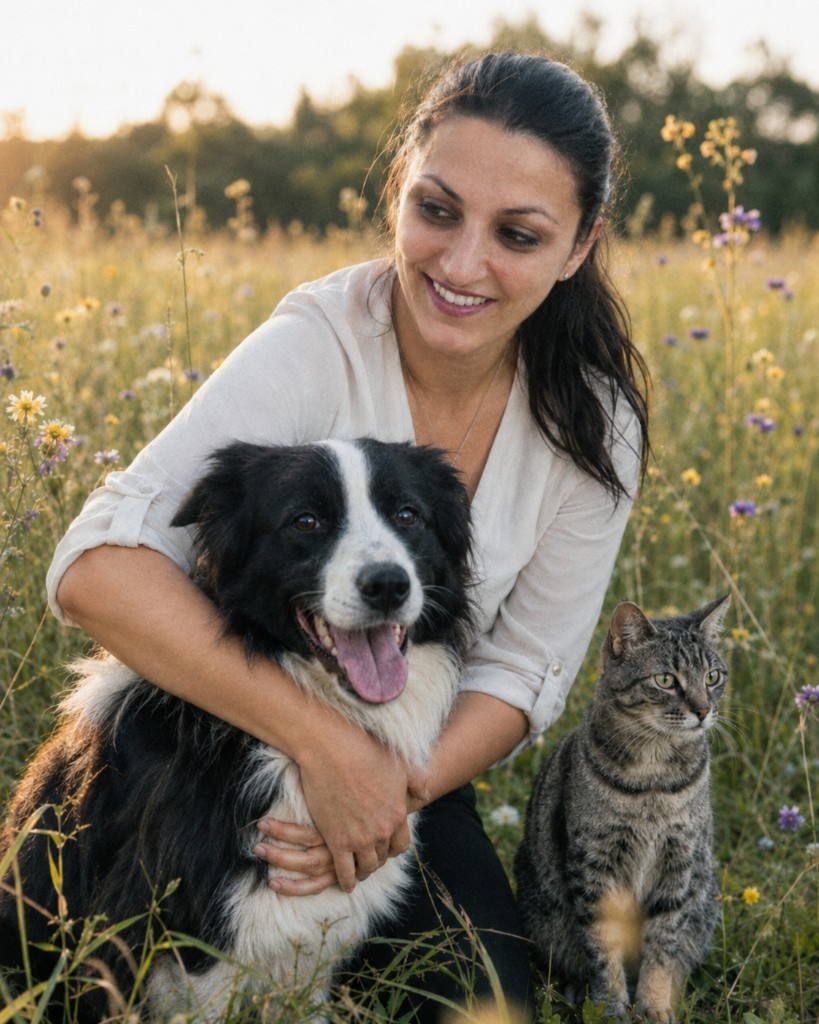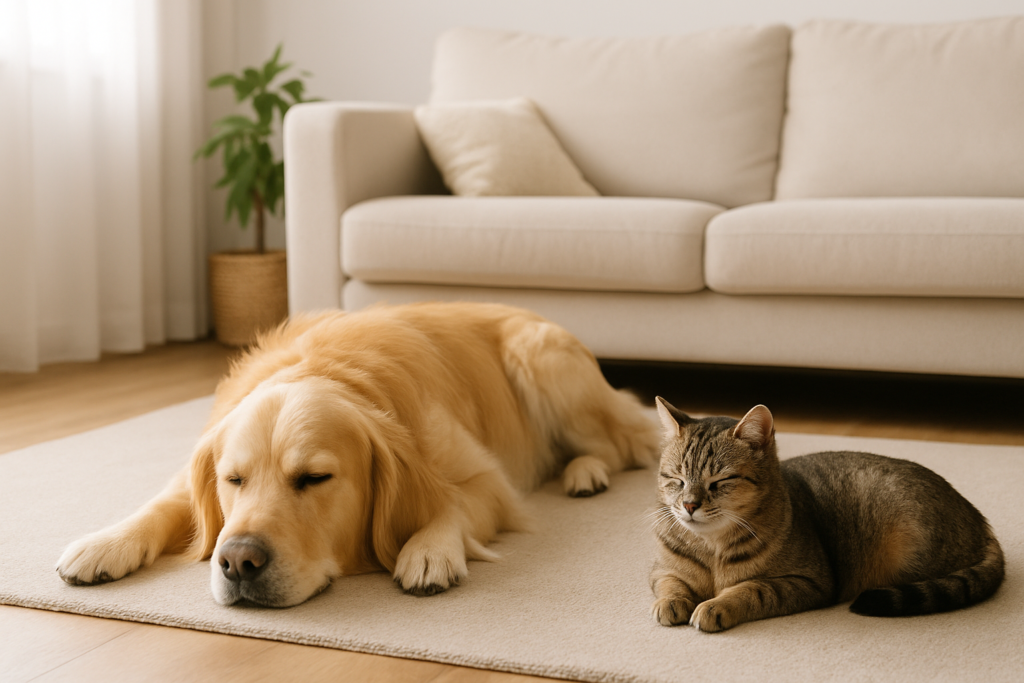
The best dog breeds for cats tend to include individuals that are socially tolerant, responsive to training, able to settle indoors, and less likely to fixate on or chase smaller animals. Labrador Retrievers, Golden Retrievers, Cavalier King Charles Spaniels, Pugs, Basset Hounds, Beagles, Collies, Bulldogs, and some well-socialized Boxers are among the breeds that may adapt successfully to feline housemates.
Breed is only a starting point. When deciding which dogs are good with cats, consider the individual dog’s prey drive, play style, impulse control, training history, age, and previous exposure to cats. The cat’s confidence, age, health, and experience matter too. Even a dog from a typically cat-friendly breed requires careful selection, supervision, and gradual introductions.
Quick answer: Dogs that are good with cats are usually easy to redirect, calm after excitement, respectful of space, and unlikely to become intensely focused on fast movement. Companion breeds and sociable sporting or family dogs often fit this description. However, a calm adult dog with a verified history of living peacefully with cats is usually more predictable than an untested puppy or adult from a breed with a cat-friendly reputation.
Important: Immediately separate a dog that freezes, stalks, lunges, snaps, chases, or remains intensely fixated on a cat. Do not test whether the cat can outrun the dog or allow chasing as play. Slow the introduction and seek guidance from a veterinarian, veterinary behaviorist, or qualified reward-based trainer when the behavior persists or safety is uncertain.
How to Choose the Best Dog Breed for a Home With Cats
Begin with temperament rather than a breed stereotype. Breed tendencies can help narrow your search, but dogs within the same breed vary considerably in sociability, impulse control, energy, play style, and interest in other animals.
Prey drive and chase behavior deserve particular attention. A dog that notices movement but readily returns attention to a handler is generally easier to manage than one that stiffens, lowers its body, stalks, trembles, lunges, or cannot disengage.
Herding, scenting, retrieving, and playful chasing are not automatically signs of aggression. However, a dog does not need to appear angry to injure a cat. Silent fixation, stalking, grabbing, or persistent pursuit can present a serious risk even when the dog is not barking or growling.
Consider the physical and behavioral match as well. A large, exuberant dog may accidentally injure a small cat during play, while a small dog can repeatedly bark at, corner, or pursue a cat. Compatible play styles, reliable responses to cues, and the ability to relax are more informative than size alone.
An adult dog with a documented record of living calmly with cats provides more behavioral information than a young puppy. However, success with one familiar cat does not guarantee safety with every cat. Behavior can change when a new cat runs, reacts defensively, or behaves differently from the dog’s previous feline housemate.
Puppies can learn appropriate behavior around cats, but they may also chase, mouth, body-slam, and pester cats as they mature. Raising a puppy alongside a cat still requires active training, management, and protected areas for the cat.
Finally, assess the resident cat. A confident adult with previous dog experience may adapt more easily than a shy cat, frail senior, kitten, or cat with a medical condition. Vulnerable cats may need a particularly calm dog and a substantially longer period of separation.
| Factor | More Promising Signs | Reasons for Caution |
|---|---|---|
| Interest in small animals | The dog notices movement but can look away and resume another activity. | The dog stalks, trembles, lunges, chases, or remains intensely fixated. |
| Responsiveness | The dog follows familiar cues around mild distractions and accepts rewards. | The dog cannot hear or respond to the handler once the cat appears. |
| Play style | The dog uses loose movements, approaches in curves, and respects pauses or withdrawal. | The dog body-slams, corners, pins, mouths, or persistently pursues the cat. |
| Indoor behavior | The dog can rest while the cat moves through the room. | The dog patrols, blocks access, or reacts to every feline movement. |
| Previous experience | The dog has lived peacefully with cats of a similar age, size, and temperament. | The dog’s history is unknown or includes chasing, grabbing, or harming smaller animals. |
| Recovery after excitement | The dog relaxes promptly after noticing or briefly interacting with the cat. | Arousal continues to increase even after distance is created. |
Traits That Make Dogs More Likely to Get Along With Cats
Dogs that get along with cats most reliably tend to interact without persistent pressure. Their bodies remain loose, their attention shifts easily, and they recover when a cat runs, jumps, vocalizes, or chooses to leave.
When evaluating a dog through a breeder, foster home, rescue, or shelter, ask for specific observations instead of accepting a general label such as “cat-friendly.” Find out how the dog reacts when a cat moves quickly, jumps onto furniture, approaches food, enters a narrow space, or refuses interaction.
A controlled cat assessment may provide useful information, but one calm encounter cannot guarantee long-term safety. Behavior may change as a dog becomes more comfortable in the home, and a dog’s reaction to an unfamiliar outdoor cat may differ from its behavior toward a familiar indoor cat.
According to the American Kennel Club’s guidance on dogs that live with cats, breed tendencies, individual personality, training, early socialization, proper introductions, and escape routes for the cat all influence compatibility.
- Soft body language includes relaxed muscles, curved approaches, blinking, sniffing, and the ability to look away.
- Low fixation means the dog can notice the cat without tracking every movement.
- Responsiveness to cues allows the handler to interrupt staring, crowding, or unwanted play.
- Calm recovery means excitement decreases promptly instead of continuing to escalate.
- Respect for distance means the dog allows the cat to retreat without following or blocking the escape route.
- A peaceful history with cats provides useful evidence, although it does not guarantee behavior with every individual cat.
- The ability to settle indoors allows the cat to move normally without becoming a constant source of stimulation.
Best Dog Breeds for Cats by Overall Temperament
Several breed groups commonly include dogs that coexist successfully with cats. Companion dogs were developed to live closely with people, many sporting dogs are sociable and trainable, and some family-oriented breeds can adapt well to multi-pet households.
The following recommendations describe common tendencies rather than guarantees. Every candidate still requires individual assessment, especially when the dog’s background is unknown or the resident cat is elderly, very young, fearful, or physically vulnerable.
| Breed | Why the Breed May Suit Cats | Important Consideration |
|---|---|---|
| Cavalier King Charles Spaniel | This affectionate companion breed is often gentle, sociable, responsive, and physically manageable around the home. | Young dogs may still chase or pester a cat during play. The breed also has significant health considerations that prospective owners should research carefully. |
| Pug | Many Pugs enjoy companionship and moderate indoor activity rather than prolonged pursuit. | An energetic individual can still chase or crowd a cat. Breathing, heat-tolerance, eye, skin, and weight-related needs require appropriate veterinary care. |
| English Bulldog | Some Bulldogs have a calm, unhurried indoor style that may suit a relaxed feline household. | Individuals vary, and physical limitations do not replace training or supervision. Airway, heat, skin, eye, joint, and mobility concerns also require consideration. |
| Basset Hound | Many Basset Hounds are easygoing indoors and socially tolerant of other household animals. | Scent-hound instincts can make them persistent when following an interesting trail, and their interactions with cats still require assessment. |
| Beagle | Sociable Beagles may accept cats as members of the household, particularly after positive early experience. | A strong interest in scent and movement means chasing should never be encouraged or dismissed as harmless. |
| Labrador Retriever | Trainability, sociability, and a generally friendly temperament can make a well-mannered Labrador adaptable to a multi-pet home. | Adolescent enthusiasm, mouthiness, size, and vigorous play can overwhelm a cat without sufficient exercise and impulse-control training. |
| Golden Retriever | Many Golden Retrievers are responsive, gentle, and tolerant of other household animals. | Young dogs can be energetic and physically overwhelming, so they need help learning to settle and give the cat space. |
| Boxer | A carefully selected and well-socialized Boxer may be affectionate and accepting of feline family members. | Bouncy movement and vigorous play may be unsuitable for shy, elderly, physically fragile, or very small cats. |
| Collie | Collies are often attentive to people, responsive to training, and capable of learning household boundaries. | Herding tendencies may appear as staring, following, blocking, or attempting to control the cat’s movement. |
Small, Medium, and Large Dogs That Are Good With Cats
Size affects household management, but it does not reliably predict compatibility. Small dogs can frighten or harass cats through barking and chasing, while large dogs may coexist quietly but cause more serious injury if an interaction goes wrong.
Choose according to temperament, play style, impulse control, training, and the physical vulnerability of the cat. Every cat needs dog-free resting areas, reliable litter access, protected feeding space, and elevated escape routes regardless of the dog’s size.
| Size Group | Potential Options | Best Household Fit |
|---|---|---|
| Small dogs | Cavalier King Charles Spaniels and some Pugs are commonly considered for feline households. | These dogs may suit smaller homes when the individual can remain calm and respect the cat’s movement and personal space. |
| Medium-sized dogs | Beagles, Basset Hounds, and some Collies can adapt with appropriate assessment and training. | These breeds are more suitable for owners prepared to manage scenting, chasing, following, vocalizing, or herding behavior. |
| Large dogs | Labrador Retrievers, Golden Retrievers, and carefully selected Boxers may become gentle feline companions. | These dogs need reliable impulse control because enthusiastic play, pawing, mouthing, or accidental collisions can injure a cat. |
Best Dogs for Cats and Kids in the Same Home
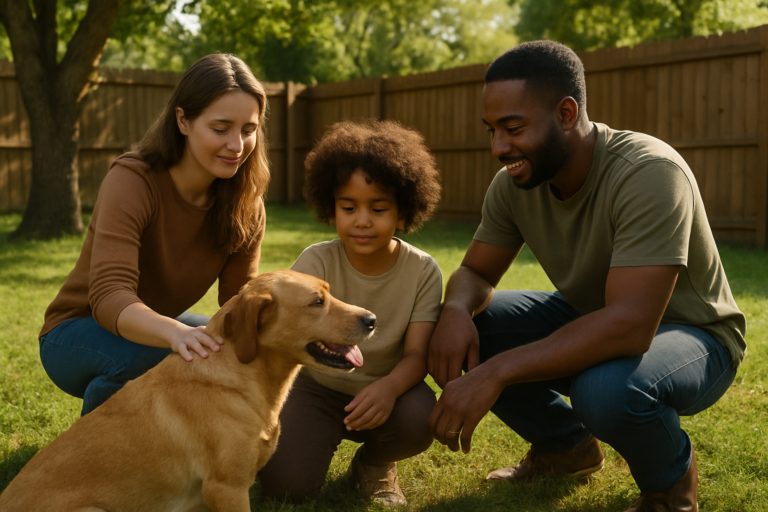
The best dog breeds for cats and children need more than a reputation for friendliness. Look for a stable dog that tolerates ordinary household activity, recovers from excitement, responds to adults, and can rest without constantly joining every game.
Labrador Retrievers, Golden Retrievers, Cavalier King Charles Spaniels, Collies, and some Boxers may fit family homes when their energy, size, and play style match both the children and the cat. A calm adult from another breed or mixed background can be equally suitable when its behavior and history are known.
Adults should supervise interactions and teach children not to chase, carry, corner, restrain, climb on, or disturb either animal while it eats or sleeps. The dog and cat should each have private resting places, and children should never be responsible for controlling early introductions.
- Match an energetic dog with a family that can provide exercise and play away from the cat.
- Choose a physically gentle dog when the household includes kittens, senior cats, or very young children.
- Use gates and separate rooms so both animals can withdraw from noisy family activity.
- Keep food, litter boxes, chews, and high-value items away from shared traffic areas.
- Supervise children and pets together even after the dog and cat appear comfortable.
Dog Breeds That May Need Extra Caution Around Cats
Any dog with intense prey drive, persistent chase behavior, poor impulse control, or rough play requires extra caution around cats. These traits can occur in purebred and mixed-breed dogs, so breed labels should never replace direct behavioral assessment.
Dogs developed to pursue, catch, control, or react quickly to moving animals may be more likely to notice and follow a running cat. This does not mean every individual from a hunting, terrier, sighthound, or herding background is unsuitable. It does mean owners should take fixation, stalking, lunging, grabbing, and escalating excitement seriously.
Management may matter more than the breed name. Secure barriers, leashes, reward-based training, appropriate exercise, separate feeding, and cat-only spaces reduce opportunities for conflict. Some dogs should never have unsupervised access to cats, and some individual matches are not safe enough to continue.
- Treat silent stalking, a closed mouth, forward weight, and rigid fixation as seriously as barking or lunging.
- Do not assume a wagging tail means the dog has friendly intentions because tail movement can also accompany arousal or intense focus.
- Do not allow rough pursuit simply because the cat has not yet fought back.
- Do not use a cat’s defensive behavior to “teach the dog a lesson.” Either animal could be seriously injured.
- Base decisions on repeated behavior in controlled settings rather than one apparently successful meeting.
How to Introduce a Dog to a Cat Safely
A safe dog-cat introduction may take days, weeks, or months. Progress according to body language rather than a fixed schedule, and return to an earlier stage whenever either animal becomes distressed or overly excited.
The Best Friends Animal Society introduction guide recommends gradual scent exposure, controlled visual contact, loose-leash sessions, reinforcement for disengaging from the cat, and continued separation whenever safety remains uncertain.
1. Prepare Separate Safe Zones
Give the cat a secure dog-free room containing food, water, bedding, scratching surfaces, hiding places, and a litter box. Add stable elevated perches and more than one escape route so the cat is never forced to approach or pass the dog.
The dog should also have a comfortable resting area away from the cat. Rotate access to shared parts of the home during the earliest stage so both animals can investigate scent without direct contact.
2. Begin With Scent Swapping
Exchange bedding or use separate clean cloths to collect each animal’s scent, then place the items where the other pet can investigate voluntarily. Pair calm investigation with treats, meals, or quiet praise. Do not push either animal toward a scented item.
You can also feed the animals on opposite sides of a closed door, beginning far enough away that both remain comfortable. Gradually reduce the distance only while each animal continues to eat and behave normally.
3. Allow Visual Contact Through a Secure Barrier
Use a secure tall gate, screen, glass door, or another arrangement that prevents physical contact and chasing. Make sure the dog cannot knock down or jump over the barrier and the cat can move away without becoming trapped.
Begin at enough distance for the dog to accept food and respond to familiar cues. The cat should be free to explore, observe, eat, or leave. End the session before either animal becomes overwhelmed.
4. Keep the Dog Leashed and Reward Calm Behavior
During closer sessions, keep the dog on a loose leash attached to secure, properly fitted equipment. Reward looking away from the cat, responding to its name, settling on a mat, sniffing the floor, or following another familiar cue.
Do not use the leash to force a nose-to-nose greeting, hold the dog close to the cat, or keep the cat in someone’s arms. Restraining the cat removes its ability to retreat and may cause panic or defensive aggression.
5. Watch Both Animals for Stress
Increase distance if the dog stiffens, stares continuously, closes its mouth, lowers its body, stalks, trembles, whines persistently, lunges, or ignores food and familiar cues. The dog should remain far enough away to notice the cat without becoming consumed by it.
Give the cat more distance if it crouches, freezes, hides persistently, flattens its ears, lashes its tail, growls, hisses repeatedly, stops eating, overgrooms, urinates outside the litter box, or avoids previously used parts of the home.
6. Progress to Short Supervised Sessions
When both animals consistently remain relaxed behind a barrier, allow brief sessions in a shared room with the dog leashed and the cat free to retreat. Keep escape routes open and prevent the dog from blocking doorways, stairs, litter boxes, or elevated perches.
End while everyone is calm and increase duration gradually. A short successful session is more useful than a long interaction that ends in stalking, chasing, hissing, or panic.
7. Increase Freedom Gradually
Consider supervised off-leash time only after many calm sessions and reliable responses around normal feline movement. Begin in an open room where the cat has several escape options and a responsible adult can intervene immediately.
Continue separating the animals whenever no responsible adult is actively supervising until peaceful behavior is firmly established. Some dogs and cats should remain separated during absences permanently. When you are not confident the dog can safely share space with the cat, separation is the responsible choice.
How to Tell if the Match Is Working
Successful dog-cat relationships do not need to involve cuddling, grooming, or playing together. Calm coexistence, voluntary distance, relaxed movement through shared rooms, and the ability to eat, sleep, and use normal household resources are meaningful signs of progress.
Brief hissing, avoidance, or alert observation may occur during adjustment when it decreases over time and both animals can disengage. The process is moving too quickly when stress intensifies, the dog repeatedly pursues the cat, or the cat stops using normal areas of the home.
Peaceful separation can also be a responsible outcome. Some pairs can live safely with divided spaces and structured routines even when unrestricted contact is inappropriate.
| Observation | Likely Meaning | Recommended Response |
|---|---|---|
| Both animals relax at a comfortable distance. | They are developing tolerance and predictability. | Continue short, supervised sessions without forcing closer contact. |
| The dog notices the cat and readily looks away. | The dog is showing useful disengagement and impulse control. | Reward calm choices and maintain sufficient distance. |
| The cat eats, grooms, rests, explores, and uses the litter box normally. | The cat is maintaining normal routines and may be adjusting successfully. | Preserve escape routes and dog-free resources. |
| The dog repeatedly corners, stalks, blocks, or chases the cat. | The interaction presents a safety risk. | Separate the animals and obtain qualified professional guidance. |
| The cat hides constantly or stops normal activities. | The cat may be experiencing significant stress or illness. | Increase separation and contact a veterinarian if behavioral or physical changes persist. |
| Either animal guards food, beds, doorways, people, or litter access. | Resource conflict may be developing. | Separate valuable resources and seek professional help if the behavior continues. |
Mistakes to Avoid When Bringing a Dog Home to Cats
Many introductions fail because people move faster than the animals can tolerate. Preventing repeated chasing and fear is easier than changing an established pattern later.
- Do not let the dog chase the cat for fun because every repetition can strengthen the behavior and undermine the cat’s sense of safety.
- Do not remove hiding places or elevated escape routes in an attempt to force interaction.
- Do not arrange an unsupervised first meeting or allow immediate access to the entire home.
- Do not hold the cat while the dog approaches because the cat needs control over its distance and escape.
- Do not punish growling, hissing, barking, or retreat. Punishment can suppress warning signals and increase fear without creating safe behavior.
- Do not choose a dog based only on appearance, popularity, size, or a general breed reputation.
- Do not place food bowls, beds, chews, toys, or litter boxes where one animal can block the other’s access.
- Do not assume early tolerance means supervision and management are no longer necessary.
- Do not continue direct introductions when either animal is unable to eat, respond, or recover at the current distance.
Choosing a Dog That Can Live Peacefully With Cats
The best candidate is not simply a member of a popular cat-friendly breed. Look for a dog with loose body language, manageable energy, low fixation, reliable responses to familiar cues, and a demonstrated ability to settle around smaller animals.
Breed tendencies can guide your search, but individual assessment and gradual introductions determine whether the match succeeds. Protect the cat’s ability to escape, reward the dog for calm choices, and accept that safe coexistence may range from close companionship to respectfully sharing separate areas.
Frequently Asked Questions
What Dogs Are Good With Cats?
Gentle, trainable dogs that can disengage from movement and settle indoors are often good candidates. Labrador Retrievers, Golden Retrievers, Cavalier King Charles Spaniels, Pugs, Basset Hounds, Beagles, Collies, Bulldogs, and some Boxers may do well. Individual temperament, play style, impulse control, and previous cat experience matter more than the breed label alone.
What Small Dogs Are Good With Cats?
Cavalier King Charles Spaniels and some Pugs are commonly considered for cat households because many are companionable and physically manageable. However, a small dog can still bark at, corner, or chase a cat, so calm behavior and responsiveness remain essential.
Are Big Dogs Ever Good With Cats?
Yes. Labrador Retrievers, Golden Retrievers, and other calm large dogs can live peacefully with cats. Because a large dog can cause accidental or intentional injury more easily, owners should prioritize gentle play, reliable impulse control, careful introductions, escape routes for the cat, and ongoing supervision.
Are Puppies Better With Cats Than Adult Dogs?
Not necessarily. Puppies can learn around cats from an early age, but chasing, mouthing, rough play, and adolescent excitement require substantial management. A calm adult with a verified history of living safely with cats may provide a more predictable match.
Can High-Energy Dogs Live With Cats?
High-energy dogs can live with cats when they receive appropriate exercise, enrichment, reward-based training, impulse-control practice, and opportunities to settle. Compatibility becomes less likely when energy appears as persistent chasing, rough play, stalking, or fixation that the owner cannot interrupt.
What if My Cat Has Never Lived With a Dog Before?
Choose a calm dog with little interest in chasing and begin with complete separation, scent swapping, and distant visual contact. Let the cat control its approach, preserve elevated escape routes, and expect the process to take longer for a shy, senior, medically vulnerable, or easily stressed cat.