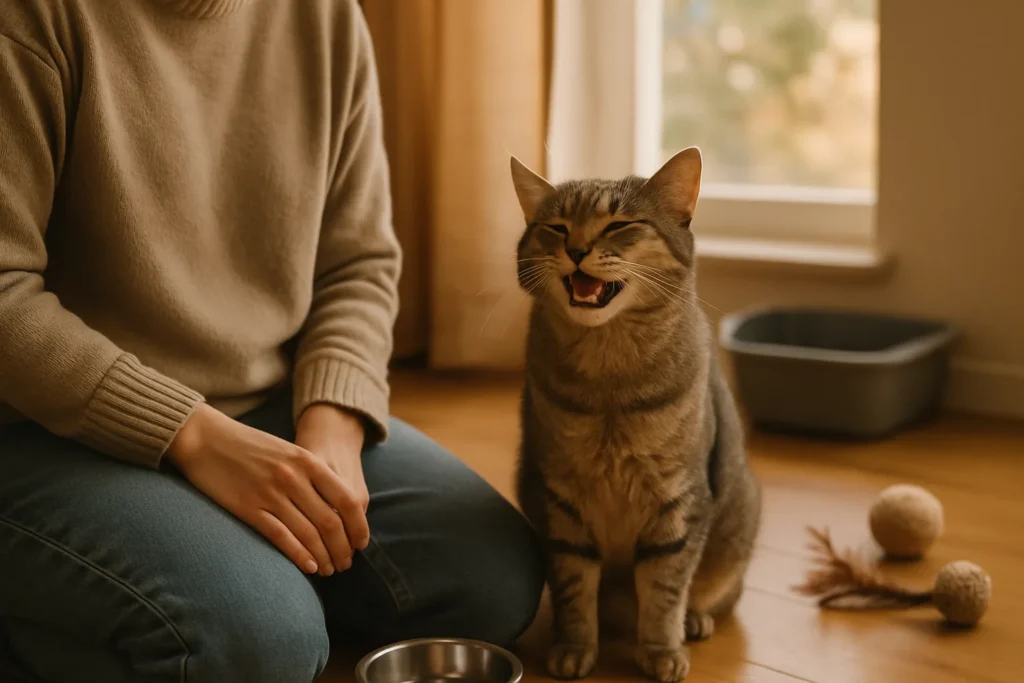
If you are wondering why your cat is meowing so much, the answer may be as simple as a learned mealtime routine—or as important as pain, stress, or another health change. Cats use vocalization to communicate with people, and some are naturally much more talkative than others.
The most useful clues are the sound, timing, body language, and whether the behavior is new. This guide explains how to distinguish ordinary meowing from crying, yowling, or screaming; which patterns deserve veterinary attention; and what you can do at home without accidentally rewarding distress.
How to Tell Whether Your Cat’s Meowing Is Normal or Excessive
A meow is usually directed at people and may mean a greeting, request, protest, or invitation to interact. A cry can sound more plaintive, while yowling is often longer and louder. Screaming is an especially intense vocalization and should not be dismissed when it is new or paired with signs of discomfort.
There is no single number of meows that defines excessive vocalization. Consider frequency, volume, persistence, and change from your cat’s usual pattern. A naturally chatty cat may be healthy, whereas a quiet cat that suddenly becomes loud needs closer attention.
Ask what happens immediately before and after the sound. Does your cat approach the food area, stare at a closed door, watch another animal through a window, visit the litter box, or seem unable to settle? Context can reveal whether the meow is a request, a learned habit, fear, frustration, or a possible symptom.
Start Here: Red Flags That Mean It’s Time to Call a Vet
A sudden increase in meowing deserves more attention than a long-standing vocal personality. Contact a veterinarian if the change occurs with hiding, unusual tiredness, vomiting, appetite changes, litter box changes, or breathing difficulty.
Possible signs of pain include restlessness, a hunched posture, reluctance to move, avoiding touch, or crying during movement or handling. Do not rely on training techniques alone when vocalization appears distressed or your cat seems physically different.
Senior cats may need prompt evaluation for new nighttime calling, pacing, staring, confusion, or difficulty finding familiar resources. These signs can have several possible causes, including sensory changes, discomfort, or age-related cognitive changes.
A weak, raspy, or absent meow also merits veterinary advice when it persists, follows heavy vocalizing, or occurs with coughing, swallowing difficulty, nasal signs, reduced appetite, or breathing changes. Seek urgent care for significant breathing trouble or severe distress.
Common Reasons Cats Meow So Much
Cats often meow because a behavior has worked before. If vocalizing reliably produces food, a door opening, play, or attention, your cat may repeat it. This is not spite; it is communication shaped by consequences.
Hunger and routine demands are common triggers. A cat may call before a regular meal, wake a person who usually feeds it, or ask for food after learning that extra vocalizing earns a snack. Check that food and water are available as expected, but do not assume every food-related meow means hunger.
Attention seeking can reflect affection, loneliness, or separation from a preferred person. Some cats call when someone leaves the room, while others vocalize because they want petting or interactive play. Meeting social needs at predictable times can reduce repeated demands.
Boredom and under-stimulation can make an indoor cat meow more often. Limited opportunities to chase, climb, investigate, and rest in safe locations may leave a cat looking for activity from its human family.
Stress can follow a move, visitors, schedule changes, conflict between pets, construction noise, or a new animal. Stress-related meowing may occur alongside hiding, vigilance, overgrooming, changes in appetite, or altered litter box habits.
Heat and mating behavior can cause loud calling, restlessness, rolling, rubbing, and attempts to get outside in intact cats. A male may also respond to a nearby female, territorial competition, or unfamiliar cats. Sex alone does not explain vocalization; reproductive status and the surrounding situation matter.
When the Pattern Gives You the Clue
Pattern-based observation is more useful than guessing from the sound alone. Note when the meowing starts, what your cat is looking at, and whether the body is relaxed, tense, crouched, or restless.
- At night: A cat may have unused energy, expect food at a particular hour, react to outdoor animals, or become unsettled by confusion or reduced sensory cues. New nighttime vocalizing in a senior cat deserves veterinary discussion.
- All of a sudden: A cat meowing all of a sudden may be responding to pain, illness, a household disruption, a strange animal outside, or territorial stress. Look for accompanying physical or behavioral changes rather than treating the noise as simple attention seeking.
- Randomly: What seems random may follow hidden triggers such as a sound in the walls, a bird at the window, a person preparing food, or anticipation of play. A short video and written log can reveal a repeated sequence.
- Indoor cats: An indoor cat may meow more because of boredom, reliance on human routines, frustration at closed doors, or limited access to climbing and investigation. Enrichment can help, but a new increase still warrants a health check.
- With purring: Cat meowing and purring a lot can indicate social contact, comfort seeking, or excitement. Purring does not always prove that a cat feels well, so consider posture, appetite, movement, and touch sensitivity too.
Female, Male, and Reproductive Triggers to Consider
A female cat in heat may call loudly, become restless, roll, raise her hindquarters, rub against people or objects, and try to escape. These signs can be mistaken for a sudden behavior problem, but the reproductive pattern is often distinctive.
Male cats may vocalize after detecting a nearby female or another cat in their territory. Window access, outdoor scents, and competition can increase calling, roaming attempts, or marking-related behavior.
If you notice a female cat meowing and rubbing everything, heat is one possibility, but scent marking, social contact, and stress can look similar. A veterinarian can help determine whether reproductive status, illness, or the environment is driving the change.
If Your Cat Cries or Screams All the Time, Think Beyond Behavior
Ordinary meowing is often brief and connected to a clear interaction. Yowling or screaming may be louder, longer, and more distressed. The difference is not just volume: a change in expression, posture, or daily function makes the situation more concerning.
Persistent calling can occur with pain, urinary problems, thyroid-related illness, high blood pressure, sensory loss, or neurological problems. These possibilities cannot be sorted out reliably at home, especially when the vocalization is new, intense, or accompanied by changes in drinking, eating, movement, vision, or litter box use.
If your cat cries all the time or seems to scream without settling, arrange a veterinary assessment instead of attempting to suppress the sound. Punishment can increase fear and may hide useful clues about discomfort.
Why Your Cat Can’t Meow Anymore or Sounds Different
A cat that has vocalized heavily may develop temporary hoarseness, but a lost, weak, raspy, or silent meow can also reflect irritation or inflammation in the upper airway or throat. Trauma, a foreign material, or another medical issue may also affect the voice.
Pay attention to associated signs such as sneezing, coughing, nasal discharge, difficulty swallowing, drooling, reduced appetite, lethargy, or noisy breathing. These details help a veterinarian judge how quickly your cat should be seen.
If you are asking why your cat can’t meow anymore, do not force the voice, inspect the throat, or give human medication. Contact a veterinarian if the change persists, follows an injury, or occurs with breathing or swallowing problems.
What to Do at Home to Reduce Excessive Meowing
Start with a calm needs check. Confirm that your cat can reach fresh water, appropriate food, a clean litter box, comfortable resting areas, and the rooms or people it normally accesses. Look for a trapped pet, a closed door, an unusually hot or cold space, or an outdoor animal creating tension.
Add predictable activity rather than responding only when the meowing begins. Short play sessions that allow chasing and catching, food puzzles, safe climbing areas, elevated resting spots, and managed window access can provide useful outlets. Change enrichment gradually and observe whether it helps.
Respond to the cause, not just the noise. Offer attention when your cat is calm, use a consistent routine, and avoid shouting or punishment. If demand meowing is the issue, repeatedly giving food or play during loud calling can strengthen the pattern; wait for a brief quiet moment when it is safe to do so, then provide the planned response.
Keep an observation log for several days if your cat is otherwise comfortable. Record the time, duration, trigger, sound, body language, appetite, drinking, activity, and litter box habits. Video clips can be particularly useful when the behavior happens at night or only when you are away.
Do not use behavior training to delay care when the meowing is sudden, distressed, or paired with physical changes. First rule out a health problem; then adjust routines and enrichment with guidance from your veterinarian if needed.
How Vets Diagnose Excessive Vocalization
A veterinary visit usually begins with a detailed history. Be ready to describe when the meowing started, whether it is getting worse, what the sound resembles, and what happens immediately before and after it.
The examination may include an assessment of posture, movement, hydration, mouth and throat, eyes, ears, abdomen, and signs of pain. Depending on the cat’s age and symptoms, the veterinarian may also check blood pressure and recommend laboratory testing to investigate internal illness.
Senior cats or cats with sudden changes may need a broader evaluation because several conditions can produce similar behavior. Bring your symptom log and videos, and mention changes that seem unrelated, such as altered sleep, appetite, grooming, drinking, or litter box use.
A diagnosis is based on the whole pattern rather than the meow alone. Once medical causes are addressed, your veterinarian can help identify environmental triggers, routine problems, reproductive behavior, or anxiety-related patterns.
The Best Next Step Depends on the Change
A talkative cat may simply have learned that people respond to its voice, but excessive vocalization is more meaningful when it is sudden, intense, persistent, or paired with changes in health or body language. Use the timing and context to identify likely triggers without assuming the cause.
Check basic needs, improve predictable enrichment, and track the pattern. If your cat seems painful, confused, unwell, unable to breathe comfortably, or suddenly loses its normal voice, contact a veterinarian rather than trying to train the sound away.
Why is my cat so vocal all of a sudden?
A sudden change may follow a household disruption, outdoor animal, learned routine, or unmet need, but it can also occur with pain or illness. Check the context and accompanying signs, and arrange a veterinary assessment if the change persists or your cat seems unwell.
Why is my indoor cat meowing so much?
Indoor cats may vocalize because of boredom, limited climbing or play opportunities, frustration at doors or windows, loneliness, or strong dependence on human routines. Add predictable enrichment, but have a new increase checked if it does not fit your cat’s usual behavior.
Why won’t my cat shut up?
Persistent meowing is communication, not misbehavior to punish. Check food, water, litter, access, stress, and enrichment first; avoid rewarding demand vocalization during loud episodes. If the sound is new, distressed, or paired with physical changes, contact a veterinarian.