Most adult housecats weigh about 8 to 12 pounds, or roughly 3.6 to 5.4 kilograms. A weight near 10 pounds, about 4.5 kg, is common for a medium-sized domestic cat, but it is not a universal ideal.
The healthiest weight depends on breed, age, sex, body frame, muscle mass, activity, and body condition. A large Maine Coon may be healthy above the usual housecat range, while a petite female may be healthy below it.
What Is the Average Weight of a Housecat?
The average adult domestic cat weighs approximately 8 to 12 pounds, equivalent to about 3.6 to 5.4 kg. Around 10 pounds, or 4.5 kg, is a useful midpoint when discussing a typical indoor housecat.
An average is a population measurement, not a target for every individual cat. The same scale number can represent a healthy weight for one cat and excess weight for another, depending on skeletal size, breed, and muscle distribution.
To judge whether a cat is healthy, use the number as a starting point and then assess body shape, rib coverage, waist, and changes over time.
Daily calorie needs depend on body weight, life stage, and activity. This article explains how veterinarians estimate energy requirements without publishing a precise chart here. Ask your veterinarian for individualized feeding guidance.
Average Cat Weight in Kg and Pounds
For readers searching for the average weight of a cat in kg, the common adult housecat range of 8 to 12 pounds converts to approximately 3.6 to 5.4 kg. A 10-pound cat weighs about 4.5 kg.
For additional context, 15 pounds is about 6.8 kg, 17 pounds is about 7.7 kg, and 20 pounds is about 9.1 kg. These figures describe the same body weight in different units; they do not indicate whether a cat is healthy.
When comparing a cat’s weight, consider the animal’s breed, frame, and body condition rather than matching a number to a generic chart.
What Changes a Normal Cat Weight?
There is no single normal weight for every cat. Breed and overall size establish a broad starting point, while age, sex, frame, muscle, and activity help explain why healthy cats can differ substantially on the scale.
Indoor cats may gain weight more easily when food energy consistently exceeds activity. Neutering, reduced play, free-choice feeding, and limited environmental stimulation can all make daily energy balance harder to maintain, so portions and activity should be reviewed as a cat’s routine changes.
Body condition is more useful than weight alone. Two cats can weigh the same while one has a well-defined waist and easily felt ribs and the other carries excess fat.
- Breed: Larger breeds naturally have heavier bones and more muscle.
- Age: Kittens are growing, while seniors may lose muscle even if their weight changes little.
- Sex: Male cats often weigh somewhat more on average, although overlap is normal.
- Frame: A long, broad cat and a small-boned cat should not be judged by the same target.
- Activity: Indoor lifestyle and low exercise can contribute to gradual gain.
- Condition: Rib feel, waist shape, and abdominal profile help interpret the scale.
Cat Weight Norms by Breed
Breed is one of the most important reasons a cat may fall outside the usual 8-to-12-pound housecat range. Breed standards provide context, but they should not replace an individual assessment of body condition.
Domestic shorthairs and domestic longhairs are useful housecat baselines because they vary widely in size and build. A small Siamese may be lean and healthy at a noticeably lighter weight than a broad American Shorthair.
Large breeds such as Maine Coons, Norwegian Forest Cats, and Ragdolls can be healthy well above the average domestic-cat range. Their size, bone structure, and muscular build make a direct comparison with a petite mixed-breed cat misleading.
Mixed-breed cats should be judged primarily by frame, muscle, waist, ribs, and weight trend. A breed label or coat length does not determine an ideal number on its own.
Cat Weight by Age: Kittens, Adults, and Seniors
Kitten weight changes quickly, so an adult range is not an appropriate cat weight chart by age. A kitten’s expected progress depends on age, birth size, nutrition, health, and development, and should be monitored as a trend rather than judged against an adult midpoint.
Most cats approach adult size after the main growth period, but larger breeds may continue developing for longer than smaller domestic cats. Your veterinarian can use growth history and body condition to determine whether development is on track.
Senior cats may become lighter because of muscle loss, dental problems, reduced appetite, or illness. A stable body condition matters more than preserving a particular number, and unplanned change deserves attention even when the cat remains within a broad average range.
Average Male vs. Female Cat Weight
Male cats often weigh somewhat more than female cats on average because they are frequently larger-framed and more muscular. Female cats are often slightly lighter, particularly when they have a petite build.
The ranges overlap considerably, so sex alone cannot establish a healthy target. Breed, skeletal frame, muscle mass, and body condition usually provide more useful guidance than comparing a cat with a general male or female average.
Is 15, 17, or 20 Pounds Big for a Housecat?
A 15-pound cat may be normal for a large-framed or giant-breed cat, but it is above the usual range for many average domestic cats. If a medium-sized housecat reaches 15 pounds, body condition and recent weight gain should be reviewed.
At 17 pounds, most ordinary-sized housecats are above average. The weight may be appropriate for an unusually large, muscular cat, but excess fat is more likely when the ribs are difficult to feel, the waist has disappeared, or the abdomen is rounded.
A 20-pound cat is heavy for most housecats, although a very large breed may naturally weigh more than a typical domestic cat. The scale should prompt a body-condition assessment rather than an automatic diagnosis.
A cat can be overweight at 15 pounds and healthy at 17 pounds if the two animals have very different frames. Conversely, a large cat can still carry excess fat at 20 pounds. A veterinarian can distinguish size from obesity more reliably than weight alone.
How to Tell Whether Your Cat Is a Healthy Weight
Look at your cat from above while it is standing. A healthy cat usually has a visible waist behind the ribs, although the shape can be less pronounced in some naturally broad or heavily coated cats.
Run your hands gently over the rib cage. The ribs should be easy to feel beneath a light layer of fat, but they should not be sharply visible in a normally coated adult cat.
From the side, look for an abdominal tuck rising from the rib cage toward the hind legs. A loose lower-belly pouch can be a normal anatomical feature and is not automatically the same as excess abdominal fat.
Rapid gain or loss matters even if the current weight appears average. A consistent trend, photographs of body shape, and regular weigh-ins can reveal changes that are difficult to notice day to day.
How to Weigh a Cat at Home
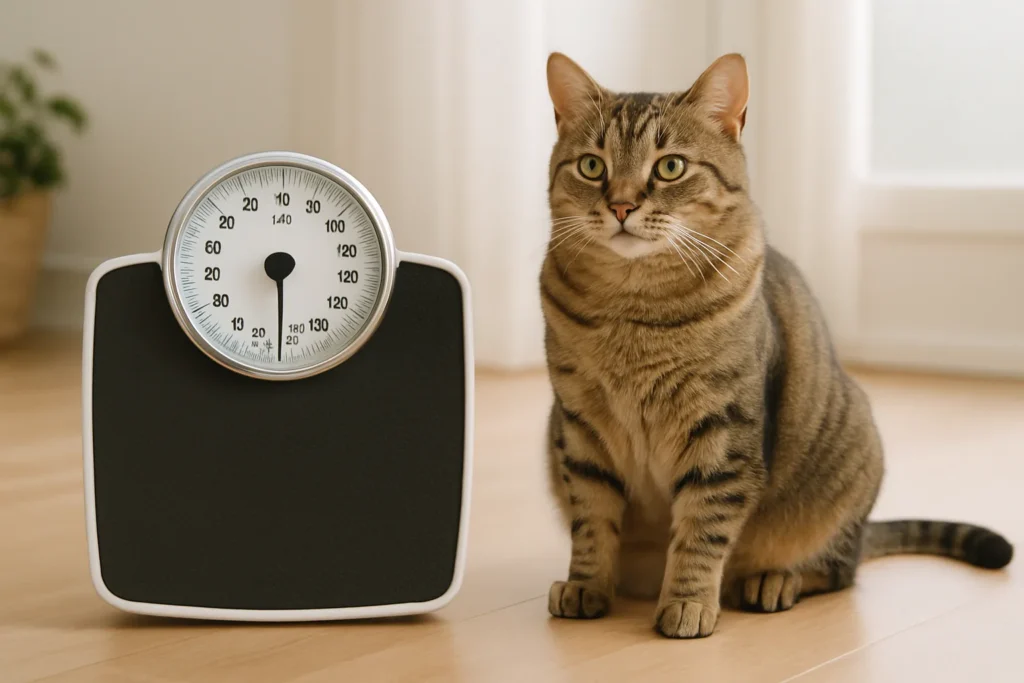
A digital household scale can help you monitor a cat between veterinary visits, especially when you use the same scale and method each time. Choose a calm setting and avoid weighing immediately after a large meal when possible.
First, weigh yourself and record the result. Then pick up your cat, step onto the scale again, and record the combined weight. Subtract your own weight from the combined reading to estimate your cat’s weight.
Repeat the process at a similar time of day and under similar conditions. If your cat will not settle safely in your arms, do not force the attempt; ask a veterinary team about a safer weighing method.
A home scale can show a trend, but it cannot replace a professional body-condition assessment when weight is changing or the cat’s shape is difficult to evaluate.
When Cat Weight Becomes a Health Concern
Arrange veterinary guidance for sudden weight loss, steady unexplained gain, or a noticeable change in body shape. Weight change can reflect feeding, activity, dental, digestive, metabolic, or other health issues, so the surrounding symptoms matter.
Pay particular attention when weight change occurs with loss of appetite, increased appetite, low energy, vomiting, diarrhea, or drinking more than usual. A cat that stops eating also needs prompt professional advice rather than a prolonged wait-and-see approach.
Long-term excess weight can place added strain on a cat’s mobility and overall health. Weight management should be gradual and individualized; do not sharply restrict food without veterinary direction.
Average Housecat Weight at a Glance
Most adult housecats weigh about 8 to 12 pounds, or approximately 3.6 to 5.4 kg. A midpoint near 10 pounds, or 4.5 kg, is common for a medium-sized domestic cat.
Larger breeds can be healthy above that range, while small-framed cats can be healthy below it. The most useful answer to how much a housecat weighs is therefore a range interpreted alongside body condition.
Check the ribs, waist, abdominal profile, and weight trend, and ask a veterinarian for guidance when your cat’s shape or weight changes unexpectedly.
- Typical adult housecat range: about 8 to 12 lb.
- Metric equivalent: about 3.6 to 5.4 kg.
- Large breeds may weigh considerably more.
- A healthy body condition matters more than a single scale reading.
The Best Housecat Weight Is Individual
For a typical adult indoor cat, 8 to 12 pounds, or 3.6 to 5.4 kg, is a useful general reference. It is not a universal target: breed, frame, age, sex, muscle, and activity all change what is normal.
Use regular weigh-ins together with rib feel and body shape to track your cat. If weight changes quickly or comes with appetite, energy, digestive, or drinking changes, contact your veterinarian.
Is 17 lbs big for a cat?
Seventeen pounds is above average for most ordinary-sized housecats. It may be healthy for a large-boned or giant-breed cat, but difficult-to-feel ribs or a missing waist can indicate excess weight.
How heavy is the average indoor cat?
Many adult indoor housecats weigh about 8 to 12 pounds, or roughly 3.6 to 5.4 kg. Indoor lifestyle affects activity and weight gain, but breed and body frame remain important.
Is 15 pounds big for a house cat?
Fifteen pounds is above the usual range for many housecats, though it can be normal for a large-framed cat. Body shape, rib feel, breed, and recent weight trend provide better context.