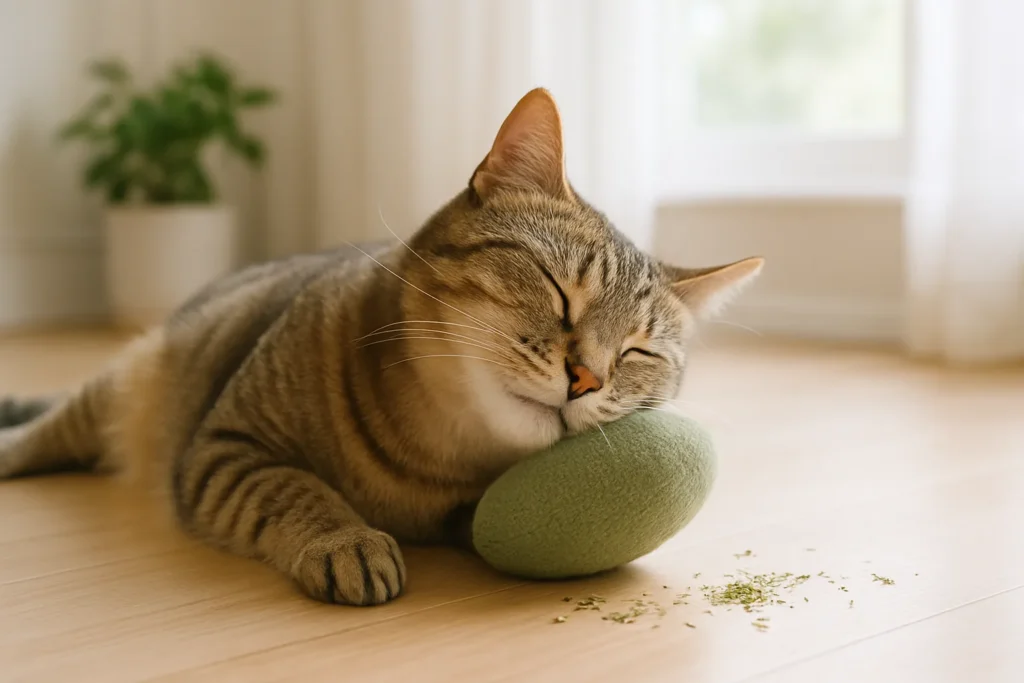
Most catnip effects last about 5 to 15 minutes. After that brief response, many cats need roughly 30 minutes to 2 hours before they react strongly to catnip again. The exact catnip response time depends on genetics, age, the amount offered, the form of catnip, and your cat’s mood.
A cat may roll, rub, zoom, play, become mellow, or show no reaction at all. This guide explains the catnip reset period, how smelling differs from eating it, when kittens may respond, and how to keep catnip toys enjoyable and safe.
How Long Does Catnip Last on Cats?
For most responsive cats, the noticeable effect lasts around 5 to 15 minutes. Some reactions are milder and end sooner, while an especially active response may seem to linger a little longer. The behavior usually fades on its own as the cat loses interest.
Many cats will not respond to another offering immediately. A refractory or reset period of about 30 minutes to 2 hours is common, although individual cats vary. Waiting for that window to pass is more useful than adding more catnip, since a larger amount does not reliably extend the experience.
The duration of the cat’s reaction is different from the lifespan of the catnip itself. A toy may remain scented for days or weeks, while a particular play response still lasts only a few minutes.
| Part of the experience | Typical expectation |
|---|---|
| Active response | About 5 to 15 minutes |
| Reset period | About 30 minutes to 2 hours |
| Response after reset | Varies by cat, freshness, amount, and setting |
How Catnip Works in the Body and Behavior
Catnip contains aromatic compounds that trigger a sensory response when a cat smells them. The scent can lead to rubbing, rolling, batting, chasing, vocalizing, or sudden bursts of activity. These behaviors are temporary and are not the same as intoxication from a dangerous drug.
Smelling catnip is more likely to produce the familiar playful or excited response. Eating it may lead to a calmer, more mellow state in some cats, although other cats simply chew it because they enjoy the texture and taste.
People sometimes call the reaction a brief “high,” but that description can be misleading. Catnip does not affect every cat in the same way, and a quiet response can be just as normal as energetic play.
What Changes How Long the Effects Last?
Genetics is one of the biggest factors. Some cats are highly responsive, some barely react, and some appear to be genetic non-responders. A cat’s response can also vary from one exposure to the next depending on whether it is tired, stressed, distracted, or eager to play.
Age matters as well. Very young kittens often show little or no interest, while sensitivity may become more obvious as they mature. The amount offered is another variable, but giving more does not necessarily create a longer or better response.
The delivery method changes the experience. Dried herb, fresh leaves, catnip spray, and catnip-filled toys release scent differently. A familiar room, a busy household, or an already-excited cat can also change how quickly the response starts and ends.
- Genetics: responsiveness ranges from strong to absent.
- Age: kittens may not have developed sensitivity yet.
- Amount: extra catnip does not reliably prolong the reaction.
- Form: dried, fresh, sprayed, and toy-filled catnip differ in scent release.
- Environment: stress, sleepiness, and distractions may reduce interest.
How Long Does Catnip Take to Kick In?
Many cats react within seconds to a minute after sniffing fresh, appealing catnip. They may approach, sniff repeatedly, rub their cheeks on the source, or begin rolling and playing. Other cats investigate slowly and may need more time before showing an obvious response.
If nothing happens, do not keep adding larger amounts. Your cat may be a non-responder, too young to react, uninterested at that moment, or exposed to catnip that has lost much of its aroma. Offer it another day or check whether the material has been stored tightly and away from heat and light.
Why Do Cats Eat Catnip?
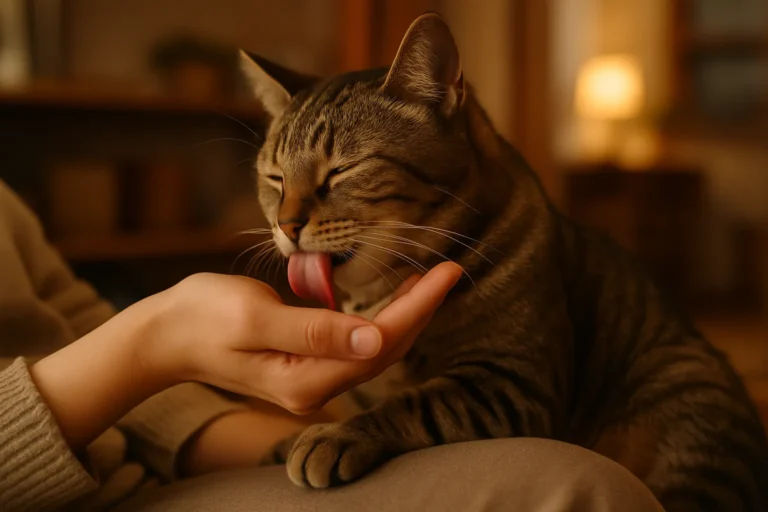
Some cats lick or chew catnip because they enjoy its smell and texture. Eating it can produce a calmer response than sniffing it, while other cats may simply mouth the herb without any noticeable behavioral change.
Small amounts are generally fine for most healthy cats, but too much may cause temporary digestive upset. Offer a modest portion and remove the herb or toy if your cat seems uncomfortable, becomes overly aroused, or starts playing too roughly.
Eating catnip is not required for the effect. If your cat prefers rubbing against a catnip toy or smelling a small amount from a scratcher, that is a normal way to interact with it.
Can You Give a Kitten Catnip?
You can introduce a small amount of catnip during gentle, supervised play, but many kittens under about 3 to 6 months show little or no response. Sensitivity often becomes clearer as cats mature, so a kitten’s lack of interest does not necessarily mean it will never respond.
For a first introduction, place a tiny amount in a toy or on a suitable scratching surface rather than covering the kitten in catnip. Keep the session brief and observe body language. If the kitten seems uninterested, stop and try age-appropriate play with a wand, soft toy, or other enrichment instead of repeating the exposure.
Is Catnip Bad for Cats?
Catnip is generally considered safe for most healthy cats when offered in moderation. The usual concerns are temporary tummy upset after too much is eaten and overstimulation during intense play.
Do not force exposure if your cat seems stressed, frightened, aggressive, or uncomfortable. Some cats become possessive or play roughly when excited, so use extra caution in multi-cat homes. Separate cats if a shared catnip session turns into chasing, guarding, or fighting.
Supervise active play and remove damaged toys, loose stuffing, or excessive herb. Contact a veterinarian if your cat develops persistent vomiting, diarrhea, unusual distress, or behavior that does not settle after the session ends.
How Long Does Catnip Stay Potent in Toys, Dried Herbs, and Spray?
A cat’s five- to fifteen-minute response should not be confused with catnip potency. Dried catnip gradually loses strength, especially when air, light, heat, or moisture reduce its aroma. If the herb no longer has a noticeable scent, your cat may ignore it even if the material looks unchanged.
Catnip-filled toys can lose their scent faster with frequent play, handling, and washing. A refillable toy can be refreshed with a small amount of fresh herb when appropriate. Catnip spray usually creates a shorter-lived surface scent than loose herb, so it may need to be reapplied according to its label.
Keep dried catnip and refills sealed tightly in a cool, dark place. Store catnip toys where they stay dry, and avoid washing them more often than necessary if their scent is still useful. Always follow the care and use instructions supplied with a particular item.
| Catnip form | What affects potency |
|---|---|
| Dried herb | Air, light, heat, and moisture gradually weaken the aroma |
| Catnip-filled toy | Frequent play and washing can reduce the scent |
| Catnip spray | The surface scent is usually shorter-lived than loose herb |
| Fresh catnip | Freshness and storage conditions affect its appeal |
How to Use Catnip With Toys for Longer, Better Play Sessions
Use catnip as an occasional enrichment activity rather than leaving a strongly scented toy out all day. Rotating toys helps preserve novelty and gives your cat time to lose interest naturally before the next session.
For refillable toys, use a small amount rather than overloading the filling. You can also try catnip spray on a scratching post, bed, or designated play area, provided the surface is suitable and your cat responds well to it.
Stop when your cat loses interest, becomes too rough, or shows signs of irritation. Let the reset window pass before offering catnip again. The goal is a calm, positive play session, not the strongest possible reaction.
- Rotate catnip toys instead of leaving them available constantly.
- Use small amounts to preserve novelty and reduce waste.
- Refresh refillable toys rather than packing them with excess herb.
- Try spray on an appropriate scratcher or bed as well as on toys.
- End play when interest fades or body language becomes tense.
When Catnip Does Nothing
A lack of response is normal for some cats. Genetic non-responders may never show the classic rolling or playful behavior, while young kittens may simply be too immature to react yet.
Weak aroma is another possibility. Old or poorly stored catnip may have lost much of its appeal. Try a fresh, properly stored supply on another occasion, but do not assume that more will solve the problem.
If your cat consistently ignores catnip, offer other forms of enrichment. Some cats prefer interactive play, food puzzles, scratching activities, or alternatives such as silvervine. Follow your cat’s preferences rather than treating a catnip reaction as a measure of health or happiness.
Common Catnip Myths to Clear Up
Catnip does not affect every cat the same way. One cat may race around while another becomes quiet, and a third may walk away. None of these responses automatically means something is wrong.
A stronger reaction is not always better. More excitement can increase rough play or discomfort without making the effects last longer. Modest, supervised exposure is usually the more useful approach.
- A cat that does not react may simply be a non-responder or too young.
- A stronger reaction is not necessarily healthier or more enjoyable.
- More catnip does not reliably make the effects last longer.
The Bottom Line on Catnip Duration
Most cats experience catnip for about 5 to 15 minutes, then need a reset period of roughly 30 minutes to 2 hours. Age, genetics, freshness, delivery method, amount, and mood can all change the response.
Offer small amounts during supervised play, rotate scented toys, and stop if your cat becomes distressed or overly rough. If catnip has no effect, that can be normal; try other enrichment rather than forcing a reaction.
Can You Give a Kitten Catnip?
A small amount can be introduced during gentle, supervised play, but many kittens under about 3 to 6 months show little or no response. Stop if the kitten seems stressed or uninterested, and use other age-appropriate enrichment instead.
How Long Does Catnip Spray Last?
Catnip spray usually creates a shorter-lived surface scent than loose herb. Its useful duration depends on the surface, airflow, handling, and the spray’s instructions. Reapply only as directed, and stop using it if your cat seems uncomfortable or overstimulated.
Is Catnip Bad for Cats?
Catnip is generally safe for most healthy cats when offered in moderation. Too much may cause temporary tummy upset or overstimulation. Do not force it, and supervise cats that become aggressive, possessive, frightened, or unusually rough during play.