Yes, cats generally do control their tails, but tail movement is not always a fully conscious decision. A cat can deliberately lift, curl, wrap, or swish its tail, while other motions happen automatically during balance corrections, excitement, irritation, sleep, or a sudden response to touch or sound.
So, do cats control their tail in the same way they control a paw? Not exactly. The tail is an extension of the spine with muscles and nerves that allow precise movement, yet emotions and reflexes can trigger motion before a cat appears to make a deliberate choice. What does a cat use its tail for? It helps with balance, coordination, and communication with people and other animals.
Yes, Cats Usually Control Their Tails, but Not Every Movement Is Fully Deliberate
Cats have meaningful control over their tails. They can raise a tail to greet someone, curve the tip while walking, wrap it around their body, or move it into a useful position during a jump. These are examples of voluntary tail movement: actions the cat can initiate and adjust.
Other movements are less deliberate. A cat may flick its tail when highly focused, lash it when emotionally aroused, or twitch the tip after hearing a sound. These responses can be driven by reflexes, sensory input, or the nervous system’s reaction to mood. The cat is not necessarily choosing each individual twitch.
This is why tail signals can look mixed. A cat may want attention but become overstimulated by repeated petting, or remain relaxed while its tail makes small movements during sleep. The tail should be read alongside the cat’s ears, eyes, posture, muscle tension, and the situation around it.
How a Cat’s Tail Works: Bones, Muscles, and Nerves
A cat’s tail is a flexible continuation of the spinal column. It contains a chain of small vertebrae, along with joints, muscles, connective tissues, and nerves. This structure lets the tail bend, curve, lift, lower, and move from side to side rather than acting like a rigid rod.
Muscles near the base provide much of the tail’s power and positioning, while smaller muscles help create finer movements farther along the tail. Nerves connect the tail with the spinal cord and brain, coordinating movement and carrying information about sensation.
The tail therefore works as part of the cat’s wider movement system. During a turn, leap, climb, or rapid change of direction, the cat adjusts its body and tail together. Because nerves are involved, an injury near the tail or its base can affect sensation, posture, movement, or other functions. A tail that suddenly hangs differently or becomes unusually sensitive should be treated cautiously.
What Does a Cat Use Its Tail For?
A cat’s tail has several overlapping jobs. It is not only a mood indicator. The tail helps the cat position its body, respond to movement, and communicate without making a sound.
During running, jumping, climbing, and turning, the tail can act as a counterweight. Small adjustments help the cat coordinate its center of mass with the rest of its body. The tail may also help a cat make quick corrections when moving along a narrow surface or landing after a leap.
The tail is also a visible social signal. Its height, curve, speed, and level of tension can provide information to another cat or to a person. A tail held high may accompany a friendly approach, while a puffed or tucked tail can appear during fear or defensiveness. These signals are not fixed translations, so context remains essential.
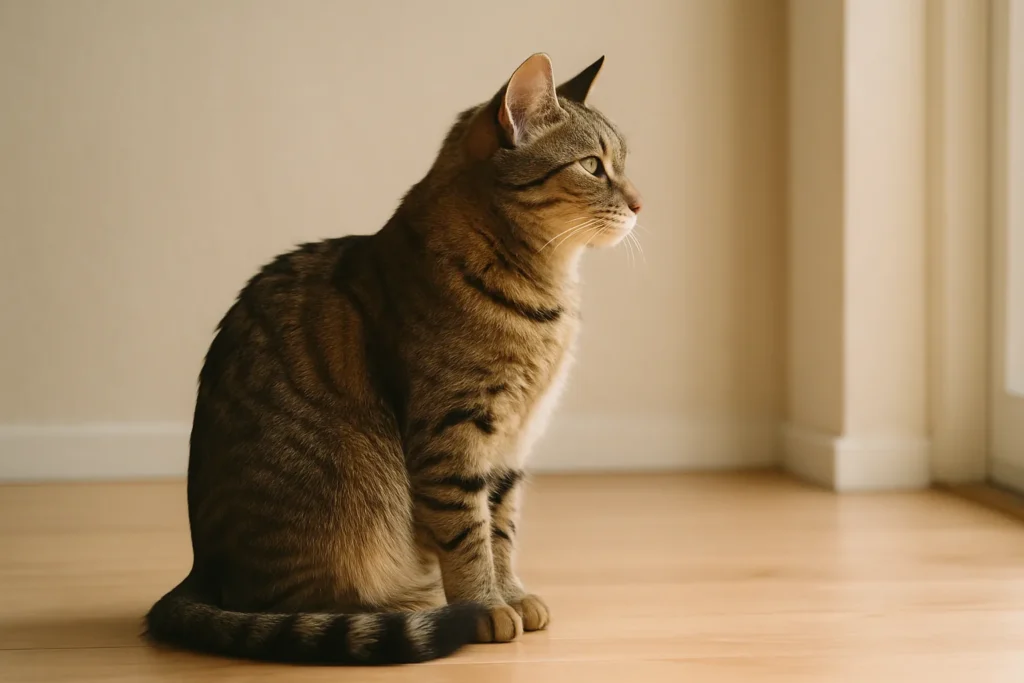
Cats also use their tails to occupy space and position themselves socially. A tail wrapped around the body can help a resting cat settle into a compact posture, while a tail wrapped around a person or another cat may occur during a calm, affiliative interaction.
Do Cats Control Their Tails Consciously?
Cats can control some tail movements consciously, but conscious control is not an all-or-nothing process. A cat may intentionally raise its tail when approaching a familiar person or deliberately wrap it around its paws while resting. It can also alter the tail’s position to support movement.
At the same time, emotional arousal changes the way the tail moves without requiring a carefully planned decision. Excitement, frustration, fear, intense focus, and irritation can produce quick flicks, a stiff posture, lashing, or puffing. These movements may begin as automatic responses even though the cat can later change position.
Reflexive tail movement can also follow touch, a nearby sound, or a sudden shift in the environment. The most accurate answer is that cats have voluntary control layered over automatic nervous-system responses. Their tails are neither entirely independent nor consciously choreographed at every moment.
Cat Tail Language: What Common Tail Positions and Movements Mean
Cat tail language is useful when treated as a set of clues rather than a dictionary. Look at the whole cat and consider what happened immediately before the movement. A tail position that appears friendly in one setting may reflect tension in another.
- Tail held high: Often seen during a confident or friendly approach, especially when the rest of the body looks loose and relaxed.
- Question-mark tail: A raised tail with a curved tip may accompany a social greeting or curious interest. It is not a guarantee that the cat wants to be touched.
- Slow swish: Can occur during concentration, uncertainty, mild excitement, or growing irritation. Check the ears and facial expression before responding.
- Fast lashing or thumping: Usually indicates strong arousal, which may include frustration, agitation, or overstimulation. Give the cat more space if the body is tense.
- Puffed-up tail: Makes the cat appear larger and commonly accompanies fear, alarm, or defensive arousal. Avoid cornering or handling a cat in this state.
- Low or tucked tail: May signal fear, uncertainty, discomfort, or an attempt to appear less noticeable. The surrounding posture helps distinguish these possibilities.
- Tail wrapped around the body or a person: May occur during rest or a calm social interaction. Look for relaxed muscles, soft eyes, and comfortable movement.
- Twitching tail tip during focus: A small, controlled-looking twitch can appear while a cat watches prey, a toy, or an interesting moving object. It reflects intense attention rather than one simple emotion.
Why Your Cat Wags or Twitches Their Tail When You Pet Them
A cat wagging its tail is not necessarily expressing happiness in the way people often associate with a dog’s wag. When a cat’s tail moves during petting, the meaning may range from relaxed engagement to uncertainty or irritation.
A gently moving tail, relaxed body, soft eyes, and a cat that stays near you may indicate that the interaction is acceptable or enjoyable. However, a faster, wider, or increasingly forceful movement can signal rising stimulation. Other warning signs include ears turning sideways or backward, skin rippling, a tense body, a sudden pause in purring, vocalization, or an attempt to move away.
When these signs appear, stop petting and let the cat choose whether to remain nearby. Avoid interpreting a cat’s decision to stay still as permission to continue. Some cats tolerate contact for only a short time, particularly around sensitive areas or after repeated strokes.
The safest approach is to watch for changes rather than waiting for a swat or bite. Pet briefly, pause, and see whether the cat seeks more contact. This gives the cat a way to communicate before overstimulation becomes a problem.
Do Cats Control Their Tails While Sleeping?
Cats may move their tails while sleeping, but those movements are not necessarily deliberate. Small twitches can occur during light sleep or dream-related activity, and a resting cat may also react automatically to a nearby sound, touch, or change in the environment.
A relaxed tail position, occasional mild twitch, and otherwise comfortable sleep are usually less concerning than repeated rigid movements or signs that the cat is disturbed. Do not wake a sleeping cat by pulling or restraining its tail; allow it to wake naturally, particularly if it seems startled.
Pay attention if tail movement at rest is new, persistent, accompanied by sensitivity, or paired with changes in walking, posture, appetite, grooming, or social behavior. Those changes are reasons to contact a veterinarian for advice rather than assuming the movement is simply a dream twitch.
When Tail Movement May Signal Pain, Stress, or Injury
Tail movement becomes more concerning when it changes suddenly or appears alongside other unusual behavior. A cat in pain may avoid having the tail handled, react sharply to touch, hide, move differently, or groom the area excessively. Pain can also make an otherwise social cat withdraw.
Possible signs of a tail injury include a limp tail, swelling, an unusual bend, dragging, reduced movement, or marked sensitivity. Injuries near the tail base may be particularly important because the nerves in that area connect with more than tail movement. If a tail has been caught, pulled, crushed, or struck, seek veterinary guidance promptly.
Stress can also alter tail behavior. A low or tucked tail, puffed fur, crouched posture, flattened ears, wide eyes, and defensive vocalization suggest that the cat needs distance and a quieter environment. Do not force contact while the cat is frightened.
A sudden change in tail use should not be dismissed as a new personality trait. Keep the cat in a safe area, avoid manipulating the tail, and contact a veterinarian when there is pain, visible injury, impaired movement, or a behavior change that does not settle.
What About Tailless Cats or Cats With Short Tails?
Tailless and short-tailed cats can still move effectively and communicate. Some are born with naturally short tails or no visible tail, while others may have a shortened tail for individual or medical reasons. Their balance strategies differ from those of long-tailed cats, but they can use their trunk, legs, head, and inner-ear balance systems to coordinate movement.
A cat with little or no tail may rely more heavily on posture, ear position, facial expression, body orientation, and movement speed when communicating. This does not mean the cat lacks social signals; it means people need to pay closer attention to the rest of the body.
As with any cat, a sudden change from the individual’s normal movement matters more than comparison with another cat. A short tail that has always looked and moved the same way is different from a tail that suddenly becomes painful, weak, or less mobile.
The Bottom Line on Cat Tail Control
Cats generally control their tails and use them for balance, coordination, and communication. Some movements are intentional, while others are reflexive or shaped by emotional arousal, sensory input, and sleep. That combination explains why a tail can seem expressive one moment and automatic the next.
To understand what a cat’s tail means, read it with the ears, eyes, posture, and context. Give the cat space when the tail movement is tense or forceful, and seek veterinary advice for sudden changes, pain, weakness, dragging, swelling, or other signs of injury.
Do cats control their tails consciously?
Cats can consciously position and move their tails, such as raising the tail during a greeting or adjusting it while jumping. Emotional responses and reflexes can also trigger movement automatically, so conscious control is present but not responsible for every twitch or swish.
Why does my cat wag his tail when I pet him?
Tail movement during petting may indicate engagement, excitement, uncertainty, or overstimulation. A relaxed body suggests the interaction may be comfortable, while fast lashing, tense muscles, backward ears, skin rippling, or moving away means you should stop and give the cat space.
Do cats feel pain when you pull their tail?
Yes. A cat’s tail contains bones, muscles, and nerves, so pulling it can cause pain and injury. Never pull or restrain a cat by the tail. Contact a veterinarian if the tail becomes limp, swollen, unusually bent, sensitive, or difficult for the cat to move.
Do cats realize their tail is theirs?
Cats receive sensory information from the tail and coordinate it with the rest of their body, so they respond to its movement and position. They do not necessarily think about body ownership in human terms, but they can perceive and use the tail as part of their body.