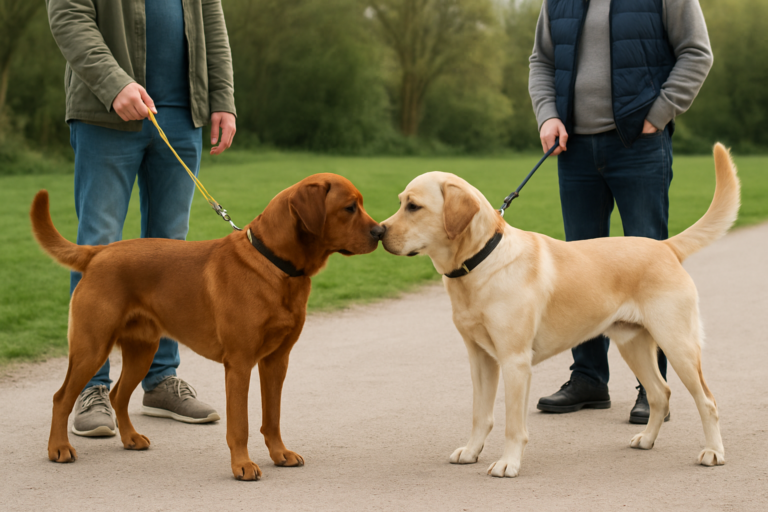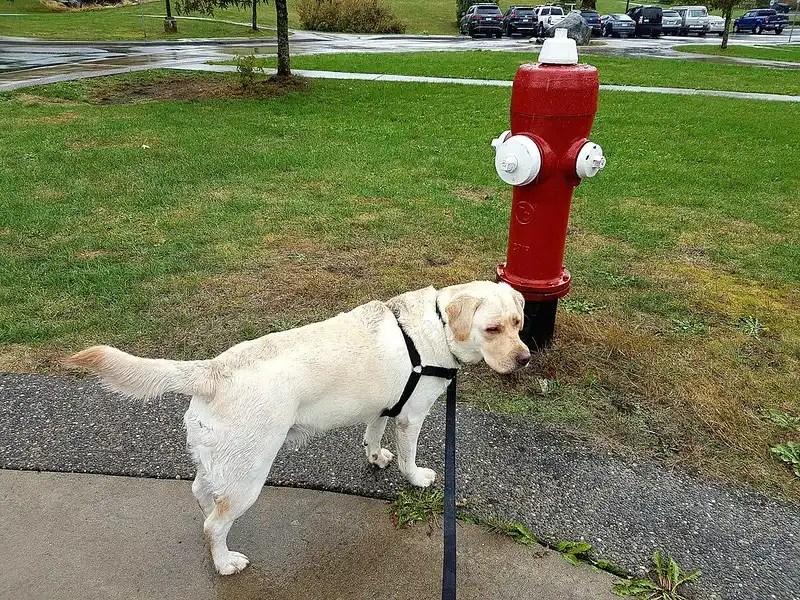
If your dog seems determined to inspect every fire hydrant on the block, there is probably nothing unusual about the behavior. To a dog, a fire hydrant is more than street equipment. It is a prominent vertical object covered with interesting scent information.
Dogs rely heavily on smell when exploring their environment and communicating with other dogs. A hydrant that has already been investigated or marked by several neighborhood dogs can become an especially interesting stop during a walk.
Quick answer: Dogs are attracted to fire hydrants primarily because they are convenient vertical scent-marking locations, other dogs often urinate on them, and urine marking allows dogs to leave and investigate social information. Hydrants are not uniquely irresistible because they are red or because dogs supposedly like the smell of paint.
Most dogs that sniff and leave a small amount of urine on a hydrant are displaying normal canine scent-marking behavior. The situation deserves more attention when a dog suddenly starts urinating much more frequently, strains to urinate, produces blood in the urine, or shows other signs of illness.
Why Do Dogs Love Fire Hydrants? 5 Reasons
Dogs do not necessarily have a special biological attraction to fire hydrants themselves. What makes hydrants interesting is the combination of location, shape, scent, and previous dog activity.
| Reason | Why It Matters to Dogs |
|---|---|
| 1. Vertical surface | Dogs commonly direct urine marks toward upright objects such as posts, trees, fences, and hydrants. |
| 2. Other dogs have marked it | Existing urine scents can encourage investigation and additional marking. |
| 3. Scent communication | Urine marking allows dogs to leave chemical information without meeting another dog directly. |
| 4. Predictable neighborhood landmark | Hydrants sit along frequently traveled walking routes where many dogs repeatedly pass. |
| 5. Hormones, excitement, and social context | Some dogs mark more frequently depending on sex, reproductive status, environmental changes, and nearby dogs. |
1. Fire Hydrants Are Perfect Vertical Marking Surfaces
One of the simplest explanations is also one of the most important: dogs commonly urine-mark vertical objects.
Trees, fence posts, utility poles, bushes, walls, signposts, and fire hydrants can all become marking targets.
VCA notes that some dogs, particularly males, repeatedly mark vertical surfaces while outdoors. AKC similarly identifies vertical objects such as fence posts and tree trunks as common marking locations.
A fire hydrant has several features that make it particularly convenient:
- It is easy for a dog to approach.
- It provides a large upright surface.
- It is usually positioned beside a sidewalk or walking route.
- Other dogs can easily sniff it.
- It remains in exactly the same location from one walk to the next.
In other words, dogs do not need to understand what a fire hydrant is. From a dog’s perspective, it functions much like any other convenient vertical scent post.
2. Other Dogs Have Probably Already Marked the Hydrant
A fire hydrant beside a popular walking route may be visited by many dogs every day.
That makes it much more interesting than a random object nobody else has investigated.
Dogs have an extraordinary sense of smell and spend considerable time investigating scents left by other animals. VCA describes this behavior as dogs checking their “pee-mail” before sometimes depositing a urine mark of their own.
This is known as overmarking when a dog deposits urine at or near an existing scent mark.
A typical sequence might look like this:
- Your dog approaches the hydrant.
- They spend several seconds sniffing.
- They investigate one particular area closely.
- They reposition their body.
- They deposit a small amount of urine.
- They continue the walk.
That pattern is generally much more consistent with scent marking than simply emptying a full bladder.
3. Urine Is a Form of Canine Communication
For humans, urine is waste. For dogs, it can also function as a chemical communication signal.
Dogs can detect chemical compounds and pheromone-related information in scent marks that people would never notice.
This allows dogs to communicate indirectly. Two dogs do not need to meet face to face for one to investigate where another dog has recently been.
Urine marking can potentially provide information related to:
- Individual identity
- Sex
- Reproductive status
- Recent presence in the area
- Other social information contained in scent
It is better, however, not to describe every urine mark as a dog announcing “this territory belongs to me.”
Modern understanding of canine marking is broader. Dogs may mark in response to other dogs, unfamiliar odors, social changes, reproductive hormones, excitement, or environmental novelty.
A fire hydrant can therefore function more like a canine message board than a property boundary.
4. Hydrants Become Familiar Scent Landmarks
Dogs experience a familiar neighborhood very differently from people.
You may remember the coffee shop, intersection, or parked cars. Your dog may remember a particular tree, corner, fence, and fire hydrant primarily through smell.
When the same neighborhood dogs repeatedly walk past the same hydrant, it can become a high-traffic olfactory landmark.
That explains why your dog may:
- Pull toward the same hydrant every day.
- Spend longer sniffing some hydrants than others.
- Mark after smelling another dog’s urine.
- Ignore hydrants that apparently contain nothing interesting.
The behavior is therefore probably much more about who has been there recently than about the metal object itself.
5. Hormones, Excitement, and Environmental Changes Can Increase Marking
Some dogs mark much more frequently than others.
Urine marking occurs in males and females and in both intact and sterilized dogs, but it is particularly common in intact male dogs.
VCA also notes that marking may increase with social or environmental changes such as:
- A new dog in the neighborhood
- A new person in the household
- A change in routine
- Changes involving another household dog
- Frustration
- Anxiety
- Sexual maturation
This means your dog may suddenly become much more interested in neighborhood scent marks even though the hydrants themselves have not changed.
The important change may be another dog, not the fire hydrant.
Urine Marking vs. Regular Peeing: How Can You Tell the Difference?
Stopping several times during a walk does not necessarily mean your dog has a urinary problem.
One useful distinction is whether your dog is marking or emptying the bladder.
| Urine Marking | Regular Urination |
|---|---|
| Usually a small amount | Usually a larger amount |
| May happen repeatedly during one walk | Usually occurs fewer times |
| Often directed toward an object | May simply occur on grass or another suitable surface |
| Vertical surfaces are common targets | A vertical target is unnecessary |
| Often preceded by intensive sniffing | Often primarily driven by a full bladder |
| May involve only a few seconds of urine | Usually involves a more sustained urine stream |
AKC notes that marking typically involves small amounts of urine in multiple locations, while normal urination usually empties more of the bladder at once.
Individual dogs vary, so this distinction should be treated as a useful pattern rather than an absolute diagnostic rule.
Why Do Dogs Lift Their Legs to Mark?
Lifting a hind leg allows a dog to direct urine onto an upright target and often deposit the mark higher above the ground.
That placement may make the mark easier for another dog to encounter at nose height and may potentially convey information related to the signaling dog.
Not every dog marks with a raised leg. Females can urine-mark, and males may use different postures depending on age, individual preference, and situation.
The behavior is particularly associated with sexually mature male dogs, but neutered males can continue marking as well.
Do Small Dogs Really Try to Pee Higher?
Interestingly, there is actual research behind the image of a small dog dramatically lifting its leg against a vertical object.
A 2018 study published in the Journal of Zoology examined urine-marking behavior in adult male dogs and found that smaller dogs tended to use larger raised-leg angles than larger dogs.
The researchers proposed that smaller dogs might be depositing marks relatively higher to potentially exaggerate their apparent competitive ability.
However, the study does not mean every Chihuahua is deliberately pretending to be a Great Dane.
The authors themselves noted limitations, including the possibility that overmarking could partly explain the pattern.
What we can reasonably say is that urine-mark height appears to be more complex than simply “large dogs pee high and small dogs pee low.”
Do Female Dogs Pee on Fire Hydrants Too?
Yes. Urine marking is not exclusively male behavior.
Female dogs can also deposit small amounts of urine in multiple locations and may mark objects previously investigated by other dogs.
Some females even lift a leg or partially elevate a hind limb when marking.
Marking is generally more common in intact males, but it also occurs in:
- Neutered males
- Intact females
- Spayed females
So a female dog becoming interested in every hydrant along a walking route is not inherently abnormal.
Are Dogs Attracted to the Red Color of Fire Hydrants?
There is no good evidence that dogs seek out fire hydrants because they are red.
Dogs do perceive color differently from humans, but the much stronger explanation for hydrant interest is scent.
A dog typically approaches the hydrant with the nose down, investigates existing odor, and then may decide to mark.
Hydrants also come in different colors depending on location, yet dogs readily mark:
- Trees
- Fence posts
- Utility poles
- Signs
- Bushes
- Trash cans
- Other vertical objects
That strongly suggests shape, location, and scent are more important than color.
Do Dogs Like the Smell of Fire Hydrant Paint?
There is also no strong scientific basis for the claim that dogs mark hydrants because the paint smells like urine.
A much simpler explanation is that fire hydrants frequently carry the scent of other dogs.
Dogs commonly mark numerous types of vertical surfaces regardless of whether they are painted, metallic, wooden, concrete, or covered in bark.
If one hydrant receives frequent canine traffic, those existing scent marks provide a far more plausible reason for repeated interest than the composition of its paint.
Should You Let Your Dog Sniff and Mark Fire Hydrants?
In most situations, allowing reasonable sniffing during a walk is beneficial.
Walking is not only physical exercise. Dogs use their noses to investigate the environment, and sniffing provides meaningful mental stimulation.
That does not mean your dog must be allowed to mark every object for several minutes.
A useful compromise is to combine:
- Periods where the dog is allowed to sniff freely
- Normal forward walking
- Training and attention
- Appropriate opportunities to urinate
You may also need to redirect marking when it would be socially inappropriate, such as on:
- People’s belongings
- Outdoor restaurant furniture
- Storefronts
- Vehicles
- Other people’s private property
Normal behavior still needs reasonable manners and management.
When Is Frequent Marking Too Much?
A dog leaving several tiny urine marks during a scent-rich walk may be behaving normally.
A dog that suddenly begins trying to urinate every few minutes when that behavior is new deserves more attention.
Frequent urination and urine marking are not always the same thing.
Contact your veterinarian if you notice:
- A sudden major increase in urination frequency
- Straining to urinate
- Repeated attempts with little or no urine produced
- Crying or obvious discomfort during urination
- Blood in the urine
- Urine leaking while resting or walking
- Sudden accidents in a previously house-trained dog
- Excessive thirst
- Changes in appetite or weight
- Lethargy or other illness
Urinary tract infections and other urinary conditions can produce signs that owners initially mistake for behavioral marking.
A dog repeatedly straining but producing little or no urine should receive prompt veterinary attention.
Why Is My Dog Suddenly Marking Everything?
A sudden increase in marking may have a behavioral explanation, but you should first separate new marking behavior from a urinary medical problem.
Once illness has been ruled out, possible triggers can include:
- A new dog in the neighborhood
- A new household pet
- A visitor or new family member
- Moving to a new home
- New furniture or objects carrying unfamiliar scents
- Changes in work schedules
- Social tension between household dogs
- Sexual maturation
- Stress or frustration
VCA specifically notes that social and environmental changes can trigger additional marking.
Understanding what changed immediately before the behavior started can therefore be extremely useful.
Does Neutering Stop Dogs From Marking?
Neutering can reduce urine marking in some male dogs, particularly when reproductive hormones contribute to the behavior, but it is not a guaranteed cure.
AKC cites research in which neutering significantly reduced marking behavior in male dogs, and veterinary behavior guidance recognizes that intact males mark more commonly than many other groups.
However:
- Neutered males can still mark.
- Spayed females can mark.
- Learned marking habits can persist.
- Anxiety-related marking requires addressing the underlying anxiety.
- Medical urinary problems will not be solved by neutering.
Do not schedule a surgical procedure solely because an internet article promises it will stop your dog from peeing on fire hydrants.
Discuss the overall benefits, risks, and appropriate timing of spay or neuter with your veterinarian, particularly for large breeds or dogs with specific health considerations.
How to Reduce Excessive Urine Marking
There is usually no reason to stop all normal outdoor marking, but excessive or inappropriate marking can be managed.
1. Rule Out Medical Problems
If the behavior is new or dramatically increased, start with a veterinary examination.
2. Identify the Trigger
Look for changes involving other animals, people, routines, objects, or your dog’s environment.
3. Redirect Before the Mark Happens
If your dog is approaching an inappropriate target, calmly call them away and reward an alternative behavior.
4. Reward Appropriate Bathroom Behavior
Give your dog opportunities to urinate in suitable locations and reinforce the choices you want repeated.
5. Avoid Punishment
VCA warns that scolding or startling a dog can create fear and potentially make marking problems worse.
Management, supervision, redirection, and reinforcement are usually much more useful than trying to intimidate a dog into stopping.
5 Reasons Dogs Love Fire Hydrants: Quick Summary
| Reason | Simple Explanation |
|---|---|
| 1. Vertical shape | Hydrants are convenient upright marking targets. |
| 2. Other dogs’ urine | Existing scent makes the location more interesting. |
| 3. Communication | Urine marks allow dogs to leave social scent information. |
| 4. Familiar landmark | Hydrants sit along routes frequently traveled by neighborhood dogs. |
| 5. Hormones and context | Sex, reproductive status, other dogs, excitement, and environmental changes can affect marking frequency. |
Why Do Dogs Love Fire Hydrants? The Bottom Line
Dogs probably do not love fire hydrants because they are hydrants. They love the information associated with them.
A hydrant is a convenient vertical object located along busy neighborhood walking routes, which means it may collect scent marks from many dogs. Your dog can investigate those odors and then choose to leave a small urine mark of their own.
This is generally normal canine scent communication, not a sign that your dog is obsessed with red paint or desperately claiming ownership of the entire street.
Allowing reasonable sniffing and occasional outdoor marking can be part of a stimulating walk, although inappropriate locations can be managed through redirection and positive reinforcement.
The important distinction is between normal marking and abnormal urinary behavior. If your dog suddenly starts urinating far more often, strains, passes blood, appears painful, or repeatedly attempts to urinate without producing a normal stream, contact your veterinarian.
Frequently Asked Questions
Why do dogs like fire hydrants so much?
Fire hydrants are convenient vertical scent-marking locations that are often visited by many neighborhood dogs. Existing urine scents make them interesting places to sniff and potentially mark again.
Why do dogs pee on fire hydrants?
Dogs commonly urine-mark upright objects. A hydrant provides an easy vertical target and may already contain scent information left by other dogs.
Are dogs marking their territory when they pee on hydrants?
Sometimes territorial or social factors may be involved, but urine marking is more broadly understood as olfactory communication. It should not always be interpreted as a simple statement that the dog owns a particular area.
Are dogs attracted to red fire hydrants?
There is no good evidence that the red color is what attracts dogs. Scent, the vertical surface, location, and marks from other dogs provide much stronger explanations.
Do dogs like the smell of fire hydrant paint?
There is no established scientific evidence that fire-hydrant paint specifically attracts dogs or smells like urine to them. Dogs readily mark many unpainted vertical objects as well.
Why does my dog sniff for so long before peeing?
Your dog may be investigating scent marks left by other animals before deciding whether to leave a mark of their own. Sniffing is an important part of how dogs gather environmental information.
Do female dogs mark fire hydrants?
Yes. Females can urine-mark even though the behavior is especially common in intact males. Spayed females and neutered males can mark as well.
Why do small dogs lift their legs so high?
Research found that smaller adult male dogs used larger raised-leg angles than larger dogs. Researchers proposed that this may allow smaller dogs to place marks relatively higher, although the exact social meaning remains an area of study.
How do I know if my dog is marking too much?
Several small marks during a walk can be normal. A sudden increase in urination frequency, particularly with straining, pain, blood, excessive thirst, accidents, or repeated attempts producing little urine, should be discussed with your veterinarian.
Will neutering stop my dog from marking fire hydrants?
Neutering may reduce marking in some male dogs, but it does not guarantee the behavior will stop. Marking can persist because of habit, social communication, environmental triggers, or anxiety.
Should I let my dog mark during walks?
Allowing some sniffing and appropriate outdoor marking is generally reasonable. Sniffing provides mental stimulation, but you can redirect your dog away from private property or other inappropriate marking locations.
Behavior & Veterinary Sources
This article provides general educational information about normal canine urine marking and urinary behavior. Sudden changes in urination should be evaluated separately from established scent-marking habits.
- VCA Animal Hospitals — Dog Behavior Problems: Marking Behavior
- American Kennel Club — Urine Marking vs. Peeing
- Merck Veterinary Manual — Behavior Problems in Dogs
- Merck Veterinary Manual — Detecting Urinary Tract Disorders in Dogs
- Merck Veterinary Manual — Urinary Tract Infections in Dogs
- Journal of Zoology — Urine Marking in Male Domestic Dogs: Honest or Dishonest?
- American Kennel Club — Spay and Neuter Considerations