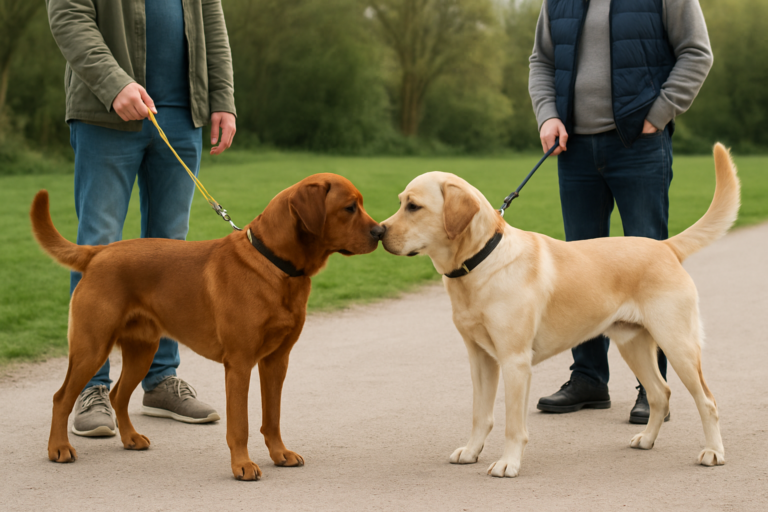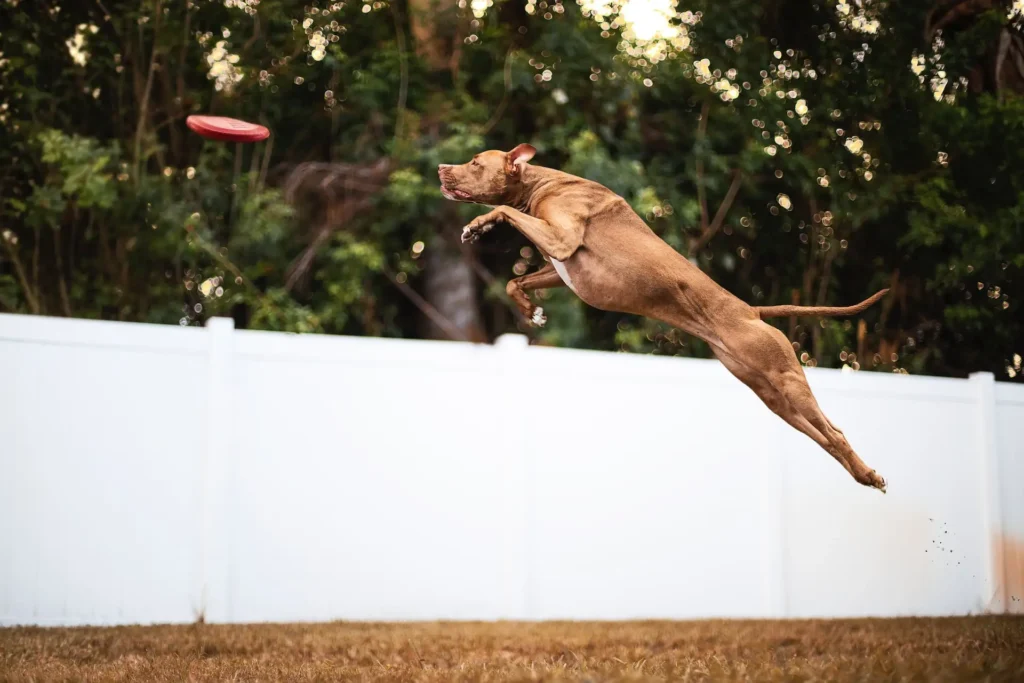
How high can a dog jump? There is no single number that applies to every dog. A small companion dog, an athletic Border Collie, a Greyhound, and a giant breed have completely different bodies, motivation, fitness levels, and jumping techniques.
Quick answer: Many healthy dogs can jump impressively relative to their own size, but there is no reliable rule saying every dog can jump a specific multiple of its height. Jumping ability depends on body structure, fitness, age, health, training, surface, run-up, technique, and motivation.
For perspective, the Guinness World Record for the highest jump by a dog is 191.7 cm, or 75.5 inches, achieved by a Greyhound named Feather. That is approximately 6 feet 3.5 inches over a hurdle.
That record should not be treated as a target for pet dogs. What a dog is physically capable of jumping and what that dog should safely be asked to jump are two very different things.
If your real concern is whether your dog can clear a backyard fence, jump onto furniture, participate in agility, or become injured from repeated jumping, those questions require slightly different answers.
How High Can a Dog Jump? 6 Things to Know
| Factor | Why It Matters |
|---|---|
| 1. There is no universal formula | Two dogs of the same height can have very different jumping ability. |
| 2. Build and athleticism matter | Leg length, body weight, muscle, coordination, and conditioning influence jumping. |
| 3. Jump type matters | A vertical hurdle, broad jump, wall scramble, and fence escape are not equivalent. |
| 4. Motivation changes performance | A dog chasing prey may attempt something it would never try during training. |
| 5. Age and health limit safe jumping | Puppies, injured dogs, and dogs with joint or spinal problems need additional caution. |
| 6. Fence height alone is not enough | Dogs can jump, climb, dig, use nearby objects, or exploit weak gates. |
1. There Is No Reliable “Dog Height × 3” Formula
You will often see claims online that a dog can jump one, two, or three times its own height.
That may work as a rough way of illustrating that dogs can jump surprisingly high, but it should not be treated as a dependable formula for predicting an individual dog’s maximum jump.
Consider two dogs that both measure 20 inches at the shoulder.
One may be:
- Lean
- Long-legged
- Highly conditioned
- Experienced with jumping
- Strongly motivated
The other may be:
- Heavier
- Less active
- Older
- Shorter-legged relative to body length
- Unfamiliar with jumping
Their maximum safe and practical jumping heights could be completely different despite identical shoulder measurements.
For backyard safety, never calculate fence height using a simple body-height multiplier and assume your dog cannot escape.
2. Breed, Build, Fitness, and Motivation All Matter
Jumping is a complex athletic movement involving the hindquarters, core, spine, shoulders, coordination, balance, and landing technique.
Important physical factors include:
- Height at the shoulder
- Leg length
- Body weight
- Body proportions
- Hind-limb strength
- Core strength
- Coordination
- Cardiovascular fitness
- Previous training
Being a larger dog does not automatically make a dog a better jumper.
A very large, heavy dog may have much more mass to propel upward and absorb on landing, while a smaller athletic dog may have a much better strength-to-weight ratio.
Which Dog Breeds Are Usually Strong Jumpers?
Dogs bred for speed, herding, hunting, working, or athletic performance often have physical characteristics that can support jumping.
Examples commonly seen performing well in jumping sports include:
- Border Collies
- Belgian Malinois
- Australian Shepherds
- Jack Russell Terriers
- Whippets
- Greyhounds
- Papillons
- Various working and sporting breeds
However, breed does not give you an exact maximum jump height.
Individual variation within a breed can be enormous.
Motivation Can Change What a Dog Attempts
A dog that refuses to jump over a two-foot training obstacle may still attempt a much more difficult escape when sufficiently motivated.
Strong triggers can include:
- A squirrel
- A rabbit
- Another dog
- A person outside the fence
- Fear
- Thunder or fireworks
- Separation distress
- Sexual motivation
Do not use your dog’s relaxed backyard behavior as proof that a fence is impossible to escape.
An unusually motivated dog may take a running approach, scramble against the fence, or use nearby furniture or landscaping as a launch point.
3. Not All Dog Jumps Are the Same
When someone says a dog “jumped six feet,” it is important to ask what kind of jump actually occurred.
| Jump Type | What It Means |
|---|---|
| High jump | Dog clears a horizontal obstacle without touching it. |
| Broad jump | Dog covers horizontal distance rather than maximum vertical height. |
| Fence jump | May involve a running approach and sometimes brief contact with the fence. |
| Wall scramble | Dog may contact and climb or scramble up part of the obstacle. |
| Agility jump | Dog clears a regulated obstacle repeatedly as part of a course. |
| Jump onto furniture | Dog jumps to a surface where the landing is elevated rather than returning to ground level. |
This matters because a dog capable of scrambling over a six-foot fence has not necessarily performed a six-foot clean vertical hurdle.
Fence escape ability and competition jump height should therefore never be treated as the same measurement.
4. What Is the Highest Recorded Dog Jump?
For a documented example of extreme canine jumping ability, Guinness World Records provides a much better reference than unverified breed claims.
The Guinness record for the highest jump by a dog is 191.7 centimeters.
That equals:
- 75.5 inches
- 6 feet 3.5 inches
- 1.917 meters
The record was achieved by Feather, a female Greyhound, in Frederick, Maryland, on September 14, 2017.
Feather was specifically trained for jumping and regularly practiced the activity.
This is an exceptional athletic record, not a recommended training target for an ordinary pet.
Guinness also maintains separate records involving different types of jumping, including jumping combined with scrambling over a wall. Those should not be compared directly with a clean high jump.
How High Do Dogs Jump in Agility?
Agility gives us useful standardized numbers, but competition jump height does not represent a dog’s maximum physical capability.
AKC Regular agility classes currently use the following jump-height divisions:
| Dog Height at Withers | Regular AKC Jump Height |
|---|---|
| 11 inches and under | 8 inches |
| 14 inches and under | 12 inches |
| 18 inches and under | 16 inches |
| 22 inches and under | 20 inches |
| Over 22 inches | 24 inches |
These divisions are designed for organized competition. They are not tests of how high a dog can possibly jump.
Agility requires dogs to perform many obstacles at speed, so efficiency, safety, repeatability, handling, and course design matter much more than maximum height.
How Do You Measure a Dog for Jump Height?
Dogs used in agility are measured at the withers.
The withers are located at the top of the shoulder blades and represent the standard reference point used for canine height.
To get an approximate measurement at home:
- Have your dog stand naturally on a level surface.
- Locate the highest point of the shoulder blades.
- Measure vertically from that point to the ground.
For official AKC agility competition, dogs are measured according to formal procedures and may require an official jump-height measurement or card.
Again, measuring your dog at the withers tells you which competition division may apply. It does not calculate the dog’s personal maximum jumping capability.
5. Puppies Should Not Be Trained for Maximum-Height Jumping
The old advice that every puppy should simply wait until exactly 15 months before jumping is too simplistic.
Puppies have growth plates at the ends of developing bones, and those structures do not close at the same age in every dog.
AKC guidance says puppies should generally not be asked to perform extreme or competitive jumping until around 12–15 months or later.
Large and giant breeds can mature considerably later. AKC veterinary guidance notes that long-bone growth plates in some large and giant breeds may not fuse until approximately 16–18 months.
The bigger and slower-maturing the dog, the less useful a one-age-fits-all rule becomes.
Can Puppies Learn Agility?
Yes, but they do not need to perform high jumps.
Young dogs can learn valuable foundation skills such as:
- Following the handler
- Going around obstacles
- Body awareness
- Balance
- Targeting
- Walking over poles placed on the ground
- Recall
- Impulse control
AKC specifically recommends introducing growing puppies to jumps with the bars very low or even on the ground.
There is no benefit to testing a puppy’s maximum jump height.
Is Jumping Bad for Dogs?
Normal jumping is not inherently bad for a healthy adult dog.
The risk changes depending on:
- Jump height
- Number of repetitions
- Landing surface
- Dog’s conditioning
- Technique
- Age
- Body weight
- Existing orthopedic problems
Sports such as agility involve rapid acceleration, turning, jumping, and landing, which place repeated forces on joints and soft tissues.
Dogs that participate seriously in jumping sports benefit from progressive training and physical conditioning rather than simply repeating high jumps.
Avoid Slippery Landing Surfaces
Traction matters.
AKC recommends avoiding jumping practice on slippery surfaces such as:
- Hardwood
- Tile
- Other slick flooring
VCA also notes that slipping on surfaces such as hardwood or tile can contribute to injuries involving muscles such as the iliopsoas.
Grass, appropriate matting, or another high-traction surface is generally much more suitable for controlled jumping practice.
Which Dogs Need Extra Caution With Jumping?
Some dogs should not be encouraged to repeatedly perform high-impact jumps without veterinary guidance.
That includes dogs with:
- Arthritis
- Hip dysplasia
- Elbow disease
- Previous cruciate ligament injuries
- Back or spinal problems
- Patellar problems
- Muscle or tendon injuries
- Recent orthopedic surgery
- Significant obesity
Senior dogs also commonly become less comfortable jumping onto furniture or into vehicles as mobility changes.
For those dogs, ramps, steps, rugs, and other mobility aids may be safer than repeatedly jumping up and down.
How Do You Know If a Dog Hurt Itself Jumping?
Monitor a dog after an awkward landing or unusually large jump.
Contact your veterinarian if you notice:
- Limping
- Refusing to put weight on a leg
- Sudden reluctance to jump
- Difficulty standing
- Pain when moving
- Swelling around a joint
- Persistent licking of one area
- Unusual stiffness
- Whining or signs of pain
- Reduced activity after the incident
A dog that normally jumps onto the couch or into the car and suddenly refuses to do so may be showing pain rather than becoming lazy or stubborn.
6. How High Should a Fence Be for a Dog?
There is no universal fence height that is guaranteed to contain every dog.
A dog’s escape ability depends on more than the height of the barrier.
AKC notes that dogs escape yards by:
- Jumping
- Climbing
- Digging
- Chewing through barriers
- Opening or exploiting gates
- Using objects beside the fence as climbing aids
For that reason, a four-foot fence should not automatically be considered safe simply because your dog has never jumped four feet during training.
Likewise, even a taller fence may fail if a determined dog can climb it.
What Can You Do If Your Dog Jumps the Fence?
AKC recommends several environmental changes for dogs that jump or climb fencing.
- Increase or extend the effective fence height.
- Add a section at the top that angles inward where appropriate.
- Remove objects near the fence that can serve as launch points.
- Consider appropriate roller-style fence systems for climbers.
- Repair weak sections and secure gate latches.
- Supervise dogs that have a history of escaping.
Potential climbing aids can include:
- Garbage bins
- Wood piles
- Benches
- Playground equipment
- Large rocks
- Garden furniture
If your dog has already escaped over a fence, treat that fence configuration as inadequate regardless of its advertised height.
Why Is My Dog Trying to Jump the Fence?
Increasing the height of a fence may solve the immediate containment issue, but identifying the dog’s motivation can help prevent repeated escape attempts.
Dogs may try to escape because of:
- Boredom
- Loneliness
- Prey drive
- Interest in another dog
- Territorial behavior
- Fear
- Separation-related distress
- Insufficient exercise or enrichment
AKC recommends continuing regular walks even when a dog has a large fenced yard because a backyard does not automatically provide sufficient physical and mental stimulation.
A determined escape artist should not simply be left outside alone for long periods while the owner relies on the fence to solve the behavior.
How to Teach a Dog to Jump More Safely
If your goal is agility or another dog sport, focus on technique and conditioning instead of maximum height.
Useful principles include:
- Start with very low obstacles.
- Use a bar that can fall if accidentally hit.
- Train on a high-traction surface.
- Increase difficulty gradually.
- Avoid excessive repetitive jumping.
- Build strength, coordination, and body awareness.
- Give the dog adequate recovery time.
For growing puppies, keep jumps at ground level or very low and concentrate on foundation skills.
If you intend to compete seriously, working with an experienced agility instructor can help teach appropriate jumping mechanics.
How High Can a Dog Jump? Quick Summary
| Question | Answer |
|---|---|
| Is there one normal maximum? | No. Individual ability varies enormously. |
| What is the documented world record? | 191.7 cm / 75.5 in / 6 ft 3.5 in. |
| Does a dog’s height predict its jump? | Only partially. Build, strength, fitness, technique, and motivation also matter. |
| Can puppies practice jumping? | Only age-appropriate low-impact foundations; avoid maximum-height jumping while growing. |
| Is jumping dangerous? | It can be when excessive, poorly trained, performed on slippery surfaces, or attempted by an unsuitable dog. |
| Is a four-foot fence always enough? | No. There is no universally escape-proof fence height. |
How High Can a Dog Jump? The Bottom Line
There is no accurate formula that tells you how high every dog can jump based only on breed or shoulder height.
Body structure, weight, muscle, conditioning, technique, training, age, health, motivation, run-up, and surface all influence performance.
At the extreme end, Guinness World Records lists a 191.7 cm / 75.5-inch jump by a Greyhound named Feather. But maximum-record performance tells us very little about what an ordinary dog should safely be asked to do.
For puppies, prioritize normal development and low-impact foundation work rather than high jumping. Growth plates close at different ages depending partly on the dog’s size and breed.
For adult sport dogs, jumping should be introduced progressively on appropriate surfaces with good conditioning and technique.
And if your question is really about backyard containment, do not calculate fence height from your dog’s measured jump alone. Dogs can take running starts, scramble, climb, dig, and use nearby objects to escape. A secure physical setup, supervision, training, and adequate enrichment all matter.
Frequently Asked Questions
How high can the average dog jump?
There is no scientifically useful single average maximum that applies to all dogs. Size, body proportions, fitness, breed, experience, motivation, and the type of jump all affect performance.
Can dogs jump three times their height?
Some extremely athletic dogs can perform jumps that are several times their shoulder height, but “three times the dog’s height” should not be treated as a universal rule for predicting individual ability.
What is the highest jump ever recorded by a dog?
Guinness World Records lists the highest jump by a dog as 191.7 cm, or 75.5 inches. The record was achieved by a female Greyhound named Feather in 2017.
Can a dog jump a 4-foot fence?
Some dogs can. Athletic ability, running space, motivation, and whether the dog can climb or scramble against the fence all influence escape risk. Do not assume a four-foot fence will safely contain every dog.
Can a dog jump a 6-foot fence?
An exceptionally athletic or determined dog may be able to get over a tall fence, particularly if it can take a running approach, climb the barrier, or use objects near the fence as launch points. No single fence height is completely escape-proof for every dog.
What dog breed can jump the highest?
There is no official breed-wide maximum. Many athletic working, herding, terrier, and sighthound breeds are capable jumpers. The documented Guinness highest-jump record is currently held by a Greyhound, but that does not prove every Greyhound jumps higher than every dog of another breed.
How high do agility dogs jump?
AKC Regular agility jump divisions currently range from 8 to 24 inches, depending on the dog’s height at the withers. Competition jump height is intentionally standardized and does not represent the dog’s maximum physical capability.
At what age can a puppy start jumping?
Puppies can learn low-impact agility foundations early, but extreme or competitive jumping should wait until skeletal development is sufficiently advanced. AKC generally advises avoiding extreme jumping until around 12–15 months or later, with large and giant breeds potentially maturing later.
Is jumping bad for a dog’s joints?
Normal controlled jumping can be appropriate for a healthy, conditioned adult dog, but repetitive high-impact jumping, poor landings, slippery surfaces, overtraining, or underlying orthopedic disease can increase injury risk.
Why has my dog suddenly stopped jumping?
A sudden reluctance to jump onto furniture, into a vehicle, or over familiar obstacles can indicate pain or a mobility problem. If the change persists or is accompanied by limping, stiffness, weakness, or discomfort, arrange a veterinary examination.
How do I stop my dog from jumping the fence?
Improve the physical barrier, remove objects that provide a launch point, secure gates, supervise the dog, and identify why the dog wants to escape. Exercise, enrichment, prey drive, fear, loneliness, or outside triggers may all influence escape behavior.
Jumping, Agility & Safety Sources
This guide provides general information about canine jumping ability and safety. A dog’s maximum physical ability should not automatically be treated as a safe exercise or training height.
- Guinness World Records — Highest Jump by a Dog
- American Kennel Club — Is It Safe for Puppies to Jump?
- American Kennel Club — Dog Agility and Jump Heights
- American Kennel Club — Official Agility Measurements and Jump Height Cards
- American Kennel Club — Practicing Agility Safely at Home
- American Kennel Club — Growth Plates and Large-Breed Puppy Exercise
- VCA Animal Hospitals — Iliopsoas Injury and Rehabilitation
- American Kennel Club — How to Prevent Dogs From Escaping the Yard
- American Kennel Club — Choosing a Dog Fence
- VCA Animal Hospitals — Pain and Mobility Changes in Aging Dogs